Serval

- Origin
- Africa
- Type
- Wild cat
- Height
- 54–62 cm (21–24 in)
- Weight
- 8–18 kg (18–40 lb)
- Colors
- Golden-yellow to buff with black spots and stripes; white underbelly
- Life span
- About 10 years in the wild, up to 20 in captivity
- Status
- Least Concern (IUCN)
The serval (Leptailurus serval) is a wild cat native to Africa and the only member of its genus. It is a slender, medium-sized animal with a small head, very large ears and the longest legs of any cat in proportion to its body. Three subspecies are recognised, in southern, central and western, and eastern Africa.
Range and habitat
Servals are widespread south of the Sahara. They live in grasslands, wetlands, moorlands and bamboo thickets, up to 3,800 m (12,500 ft) on Mount Kilimanjaro, and favor places near water where reeds and tall grass give cover. They avoid rainforest and arid country. In North Africa the serval is known only from Morocco, has been reintroduced in Tunisia, and is feared extinct in Algeria.
Appearance
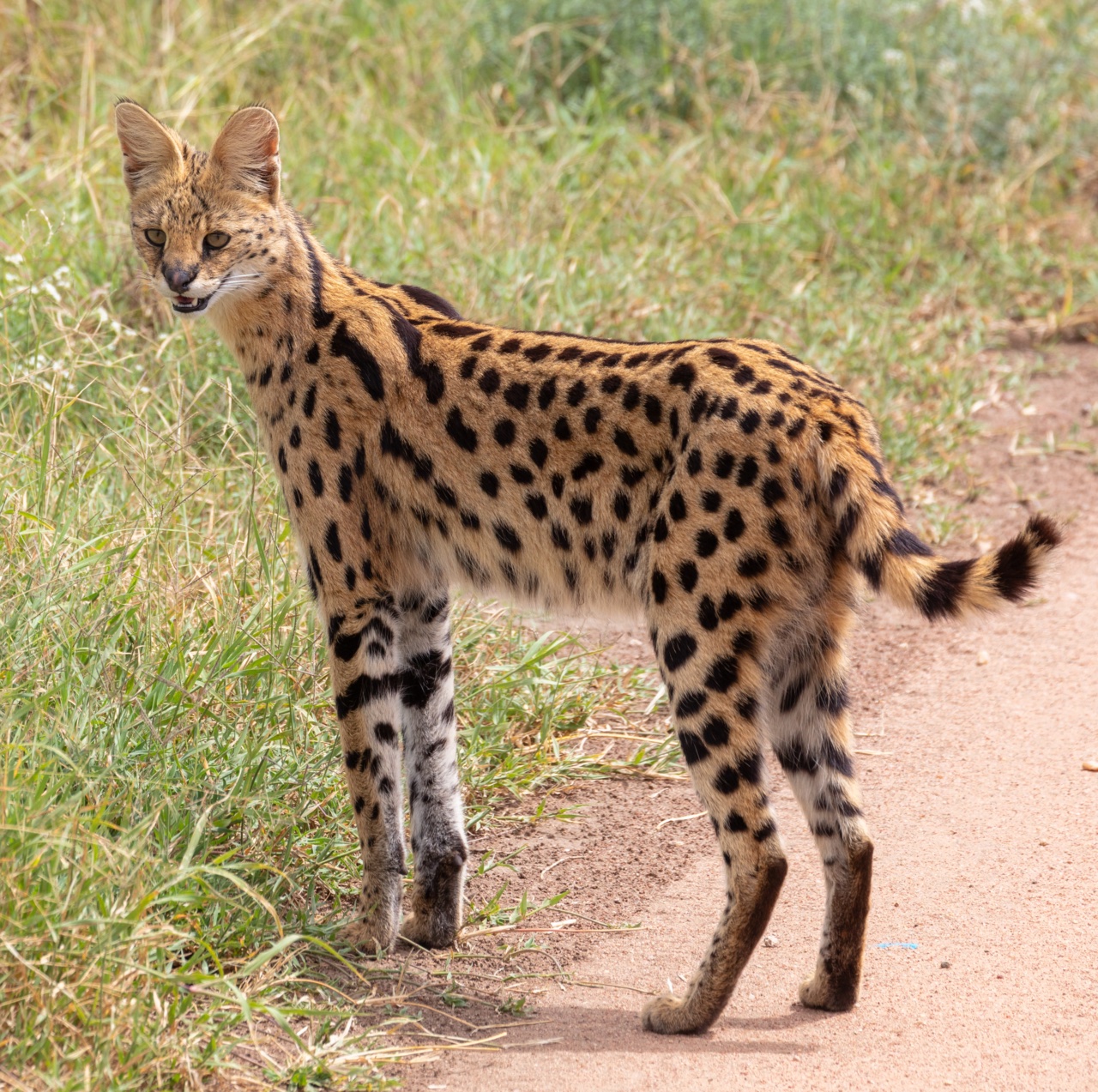
A serval stands 54 to 62 cm (21–24 in) at the shoulder and weighs 8 to 18 kg (18–40 lb); females tend to be lighter. The head and body measure 67 to 100 cm (26–39 in), and the black-tipped tail is about 30 cm (12 in) long. The long legs owe much to greatly lengthened bones in the feet.
The coat is golden-yellow to buff, heavily marked with black spots of varying size. Three or four black stripes run from the back of the head over the shoulders before breaking into rows of spots. The underbelly is white. The ears are black on the back with a white band across the middle, sit close together, and can each turn up to 180 degrees on their own. Black (melanistic) servals have been seen in the wild, mostly in Kenya.
Behavior
Servals live alone and are active by day and by night, with peaks in the early morning, around dusk and at midnight. Males and females keep home ranges of 10 to 32 km² (3.9 to 12.4 sq mi) that overlap widely, marking them with urine, droppings and saliva. Neighbors tend to avoid each other, and fights are rare.
Rodents, especially vlei rats, make up 80–97% of the diet, alongside small birds, frogs, insects and reptiles. The serval finds prey by ear, sometimes standing still for up to 15 minutes, then springs more than 2 m (6 ft 7 in) off the ground, comes down on the animal with its forefeet and kills it with a bite to the head or neck.
Mating time varies from region to region. After a pregnancy of two to three months, one to four kittens are born in dense vegetation or an abandoned burrow. Weaning begins at a month, the young start hunting at about six months, and they leave their mother at around a year.
Conservation
The serval is listed as Least Concern and lives in many protected areas; hunting is banned or regulated across its range. The main threat is the loss of wetlands and grasslands. Skins are still traded in some West African countries, and herders sometimes kill servals, although they rarely take livestock.
Servals are occasionally kept as pets, which some countries regulate, and a serval crossed with a house cat produces the Savannah cat, first bred in 1986.
Facts on this page were checked against Wikipedia and may have changed since.