Lion
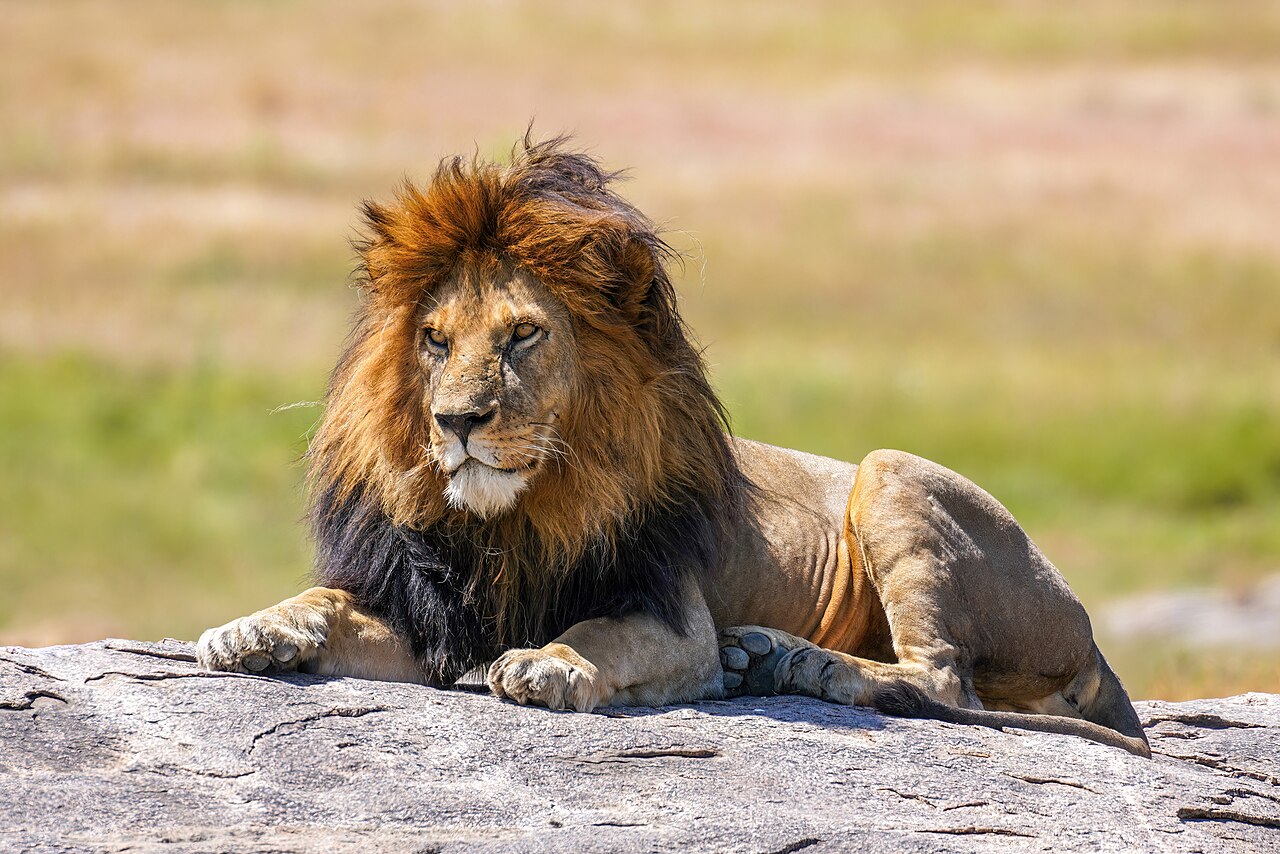

- Origin
- Africa
- Type
- Big cat
- Coat
- Short, light buff to dark brown; males have a mane
- Life span
- 12–17 years in the wild
- Status
- Vulnerable (IUCN)
The lion (Panthera leo) is a big cat of the genus Panthera and, among cats, second in size only to the tiger. It is the most social of the wild cats, living in family groups called prides. Two subspecies are recognised: a northern one, which includes the lions of West and Central Africa and of India, and a southern one in East and Southern Africa.
Range and habitat
Lions live in grasslands, savannas and shrublands. In the Neolithic they ranged across Africa and from southeastern Europe to India. Today they are found only in scattered populations in sub-Saharan Africa and in one population in western India, in and around Gir National Park in Gujarat.
The lion has been listed as Vulnerable on the IUCN Red List since 1996. Numbers in African countries have fallen by about 43 percent since the early 1990s, and lions struggle to survive outside protected areas. Habitat loss and conflict with people are the main concerns.
Appearance
The lion is a muscular, broad-chested cat with a short, rounded head, round ears and a dark tuft of hair at the tip of the tail. The fur ranges from light buff and silvery gray to yellowish red and dark brown, paler underneath. Cubs are born with dark spots that fade as they grow, though faint ones may remain on the legs and belly.
Males are larger than females and have broader heads. Their mane covers most of the head, neck, shoulders and chest. It is usually brownish, mixed with yellow, rust and black hairs, begins to grow in adolescence and is full at about four years. It probably evolved as a signal of fitness: males with darker manes appear to breed more successfully and hold their place in a pride longer. Asiatic lions tend to have thinner manes.
Behavior
A pride is made up of related females and their cubs, with one or a few adult males who are unrelated to the females. An average pride has around 15 lions. Members often split into smaller groups and keep in touch by roaring, a sound made mostly at night that carries as far as 8 km (5 mi). Males are pushed out of the pride they were born in at two or three years old and spend years wandering before they win a pride of their own. When new males take over, they often kill the young cubs already there.
Lions are apex predators, hunting mostly medium-sized and large hoofed mammals; the females usually hunt together. They are more active by day than other wild cats, but where they are persecuted they shift to night and twilight.
Pregnancy lasts about 110 days. The lioness gives birth to one to four cubs in a hidden den away from the pride and brings them to join it at six to eight weeks old. Lions may live 12 to 17 years in the wild and more than twenty in captivity.
Facts on this page were checked against Wikipedia and may have changed since.