Clouded Leopard
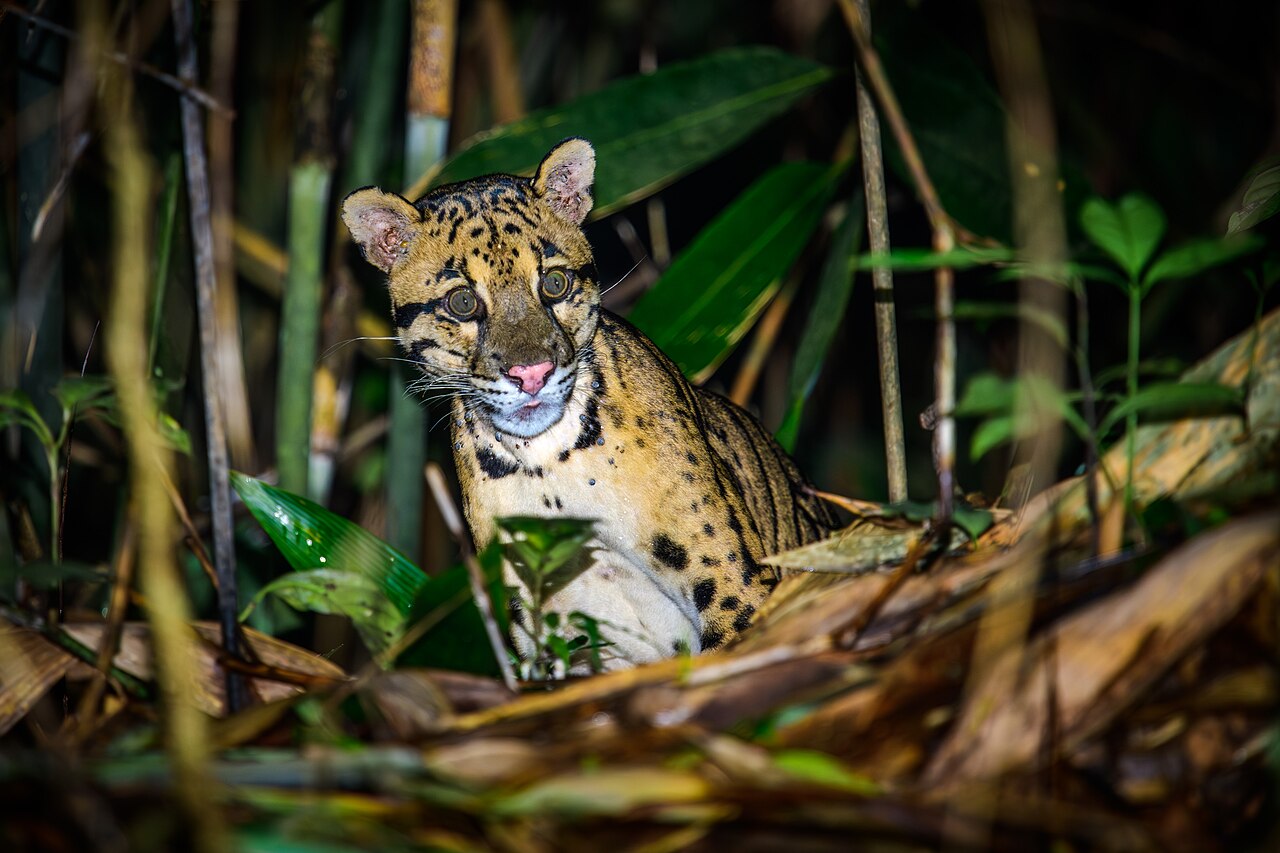

- Origin
- Southeast Asia
- Type
- Big cat
- Height
- 50–55 cm (20–22 in)
- Weight
- 11.5–23 kg (25–51 lb)
- Colors
- Dark gray or ocher with large dusky, dark-edged blotches
- Life span
- About 11 years in captivity
- Status
- Vulnerable (IUCN)
The clouded leopard (Neofelis nebulosa) is a wild cat of the dense forests of mainland Asia, named for the large, cloud-like blotches on its coat. It is the closest living relative of the big cats of the genus Panthera, from which its line separated several million years ago. A sister species, the Sunda clouded leopard of Borneo and Sumatra, was recognised as distinct in 2006.
Range and habitat
The species ranges from the Himalayan foothills of Nepal, Bhutan and northeast India through Myanmar, southeastern Bangladesh, Thailand, Laos, Cambodia and Peninsular Malaysia to China south of the Yangtze. It is locally extinct in Singapore and Taiwan, where the last confirmed record dates from 1989, and possibly also in Vietnam and on Hainan. It lives in forest of many kinds, from lowland evergreen forest to mountain slopes above 3,000 m (9,800 ft) in the Himalayas.
Appearance
The ground color is dark gray or ocher, largely covered by dusky gray blotches edged behind with dark, looping stripes. The head is spotted, the ears are black, and broken stripes run across the cheeks and down the neck. The legs and belly are spotted, and the tail carries large paired spots.
The legs are short and stout and the paws broad. Head and body measure 68.6 to 108 cm (27–42.5 in), and the tail is almost as long, at 61 to 91 cm (24–36 in); females are somewhat smaller than males. The canine teeth are the longest of any living cat in proportion to body size, 4 cm (1.6 in) or more, which has earned the animal the nickname “modern-day sabre-tooth”.
Behavior
Clouded leopards are solitary and mostly active at night and at dusk. They are among the best climbers in the cat family. Captive animals have been seen going down vertical trunks head first and hanging from branches by their hind paws and tail. They rest in trees during the day and do much of their hunting on the forest floor, stalking or lying in wait. Known prey includes macaques, hog deer, muntjac, porcupines, pangolins, slow lorises, squirrels and pheasants.
Mating in the wild usually takes place between December and March. After about 93 days the female gives birth to one to five cubs, most often three. The cubs’ eyes open at about ten days, they are weaned at around three months and independent at about ten months.
Threats and conservation
Fewer than 10,000 adults are thought to remain, with no single population above 1,000, and numbers are falling. The cat has been listed as Vulnerable since 2008. Large-scale deforestation and poaching for skins and other body parts are the main threats. It is on CITES Appendix I and hunting is banned in most range countries, though enforcement is often weak.
Clouded leopards have been kept in zoos since the early 20th century, and coordinated breeding programs began in the 1980s. Early efforts often failed because males can be aggressive toward females; pairs introduced to each other when young breed more successfully.
Facts on this page were checked against Wikipedia and may have changed since.