Snow Leopard

- Origin
- Central and South Asia
- Type
- Big cat
- Height
- About 56 cm (22 in)
- Weight
- 25–75 kg (55–165 lb)
- Coat
- Thick, with hairs 5–12 cm (2.0–4.7 in) long
- Colors
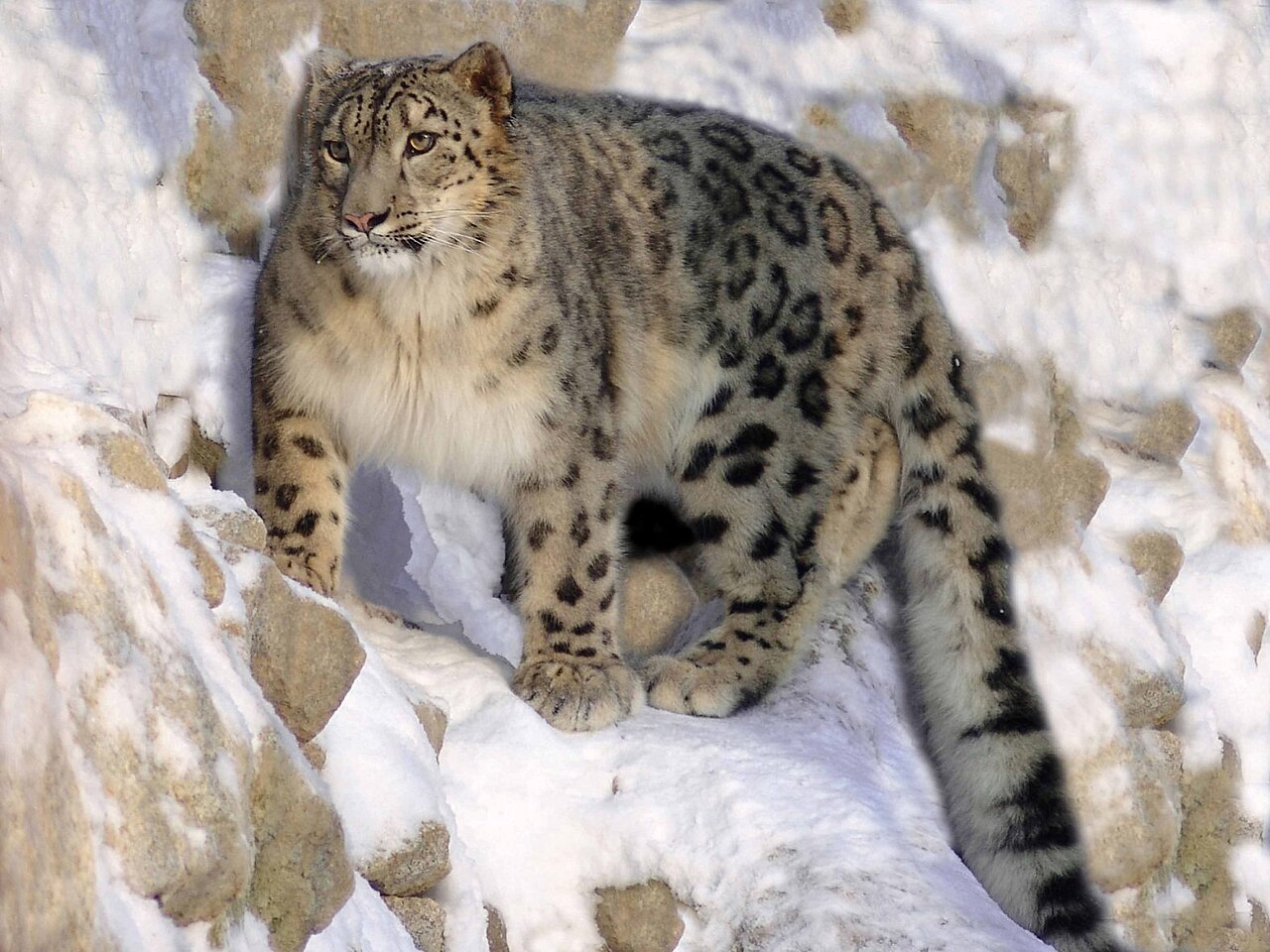
- Whitish to gray with black spots and rosettes
- Life span
- 15–18 years in the wild; up to 25 in captivity
- Status
- Vulnerable (IUCN)
The snow leopard (Panthera uncia) is a big cat of the high mountains of Asia. For a long time it was placed in a genus of its own, Uncia, but genetic studies have shown that it belongs with the other big cats in Panthera, where its closest relative is the tiger.
Range and habitat
Snow leopards live from the eastern Hindu Kush in Afghanistan through the Karakoram, the Pamirs, the Tian Shan and the Himalayas of India, Nepal and Bhutan, across the Tibetan Plateau and western China, and north to Mongolia, the Altai and southern Siberia west of Lake Baikal.
They keep to alpine and subalpine country at 3,000 to 4,500 m (9,800 to 14,800 ft), and lower in the north of the range. In summer they are usually above the tree line, on mountain meadows and among rocks up to 6,000 m (19,700 ft). In winter they come down to around 1,200 to 2,000 m (3,900 to 6,600 ft).
Appearance
The fur is whitish to gray, with black spots on the head and neck and larger rosettes on the back, flanks and tail, and a whitish belly. The snow leopard is stocky, short-legged and slightly smaller than the other big cats. Head and body measure 75 to 150 cm (30 to 59 in), and the tail adds 80 to 105 cm (31 to 41 in). Males average 45 to 55 kg (99 to 121 lb) and females 35 to 40 kg (77 to 88 lb).
Much about the animal is fitted to cold mountains. Small, rounded ears lose little heat. Broad paws spread its weight on snow, and fur on their undersides gives grip on steep, loose ground. The long, flexible tail helps it balance among rocks. The tail is thick with stored fat and heavily furred, and the cat wraps it over its face like a blanket when it sleeps.
The snow leopard cannot roar. It meows, grunts, moans and makes the soft puffing sound called prusten, and it can purr while breathing out.
Behavior
Snow leopards live alone and are most active around dawn and in the late afternoon and early evening. Home ranges are large. In the Gobi, males used 144 to 270 km² (56 to 104 sq mi) and females 83 to 165 km² (32 to 64 sq mi).
They hunt wild sheep and goats above all, including blue sheep, Siberian ibex, argali, markhor and Himalayan tahr, along with smaller animals such as marmots, pikas and voles. They also take livestock.
Mating takes place in late winter. After 90 to 100 days the female gives birth, between April and June, in a rocky den lined with her own fur. A litter is usually two or three cubs.
Threats
Fewer than 10,000 mature snow leopards are thought to remain, and the number is expected to fall by about 10 percent by 2040. The main threats are poaching and loss of habitat. The species is listed in CITES Appendix I and is protected by law in most of the countries where it lives.
Facts on this page were checked against Wikipedia and may have changed since.