Bengal Tiger

- Origin
- Indian subcontinent
- Type
- Big cat
- Height
- 90–110 cm (35–43 in)
- Weight
- 110–260 kg (240–570 lb)
- Coat
- Short, striped
- Colors
- Yellow to light orange with dark brown to black stripes; white belly
- Status
- Listed as Endangered in India, Nepal and Bhutan; Critically Endangered in Bangladesh and China
The Bengal tiger is the tiger population of the Indian subcontinent, part of the subspecies Panthera tigris tigris. It is among the largest wild cats alive and is the national animal of both India and Bangladesh.
Range and habitat
Bengal tigers live in India, southern Nepal, Bangladesh, Bhutan and southwestern China. Until the early 19th century their range reached west to the Indus valley; the last tigers in what is now Pakistan were shot in 1906. Tigers are thought to have been on the subcontinent for 12,000 to 16,500 years.
They use many kinds of country: moist evergreen and dry tropical forest, deciduous forest, mangroves, upland forest and the tall alluvial grasslands at the foot of the Himalayas. Much of that grassland has been turned into farmland, and the best of what remains lies in a few blocks along the border of India and Nepal, where prey is plentiful and tigers live at high densities.
As of 2022 there were an estimated 3,167–3,682 tigers in India, 316–355 in Nepal, 131 in Bhutan and about 125 in Bangladesh.
Appearance
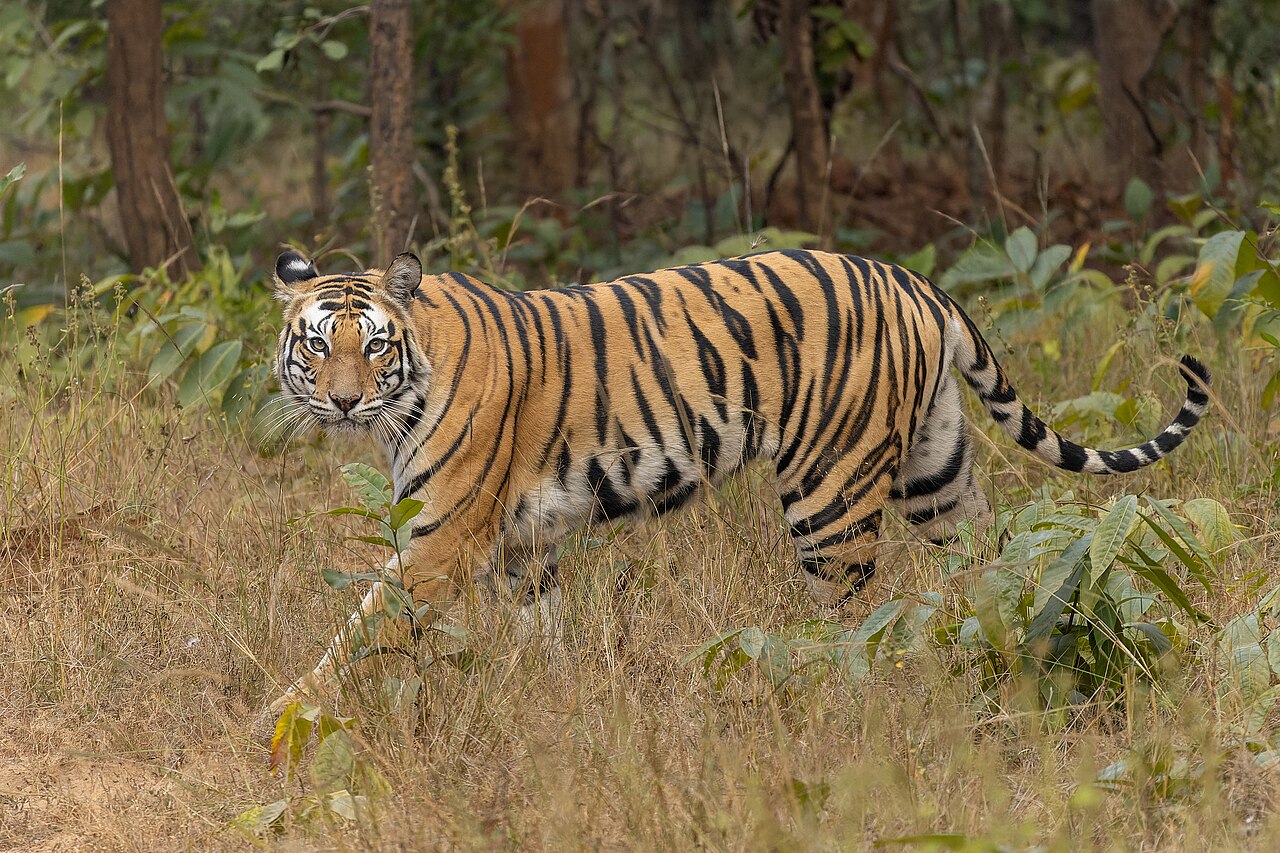
The coat is yellow to light orange with dark brown to black stripes. The belly and the insides of the legs are white, and the tail is orange with black rings. White tigers are a rare recessive form, not albinos, and have turned up in the wild from time to time; the golden tiger, pale gold with red-brown stripes, is another.
Adult males weigh 200–260 kg (440–570 lb) and females 110–180 kg (240–400 lb). Males measure 283–311 cm (111–122 in) from nose to tail tip and females 255–285 cm (100–112 in), and they stand 90–110 cm (35–43 in) at the shoulder. Males in the Terai lowlands regularly pass 227 kg (500 lb), and two caught in Chitwan National Park in the 1980s weighed more than 270 kg (600 lb).
Behavior
The basic tiger family is a mother and her cubs. Adults otherwise live and hunt alone, each keeping a home range that supplies prey, water and shelter. A male’s range is large and takes in the smaller ranges of several females; in one Indian reserve a male used about 200 km² (77 sq mi) in summer while the females within it used 16–31 km² (6–12 sq mi). Male ranges seldom overlap, while neighboring females share some ground. Young tigers begin to leave their mother’s range at around 19 months, and males travel much farther than females.
Threats and conservation
Poaching, habitat loss and the breaking up of habitat are the main dangers. The most pressing is the illegal trade in skins and body parts, driven largely by demand for tiger bone in traditional Chinese medicine. Tigers are also shot in revenge for killing cattle. No single tiger landscape in the Bengal tiger’s range is large enough to hold 250 breeding animals.
India launched Project Tiger in 1973, setting aside reserves meant to act as breeding centers from which tigers could spread. In the Terai Arc along the India–Nepal border, 11 protected areas are managed as one linked population.
Facts on this page were checked against Wikipedia and may have changed since.