Tiger

- Origin
- Asia
- Type
- Big cat
- Height
- 80–110 cm (31–43 in)
- Weight
- 75–260 kg (165–570 lb)
- Coat
- Short, orange with black stripes and white underparts
- Colors
- Orange, from yellowish to reddish; rare white and golden forms
- Life span
- 12–15 years in the wild; up to 19 in captivity
- Status
- Endangered (IUCN)
The tiger (Panthera tigris) is a large cat native to Asia and a member of the genus Panthera, along with the lion, leopard, jaguar and snow leopard, its closest relative. Nine subspecies were traditionally named, among them the Bengal, Siberian and Sumatran tigers, though some authorities now recognise only two.
Range and habitat
Tigers once lived from eastern Turkey and northern Iran across Central Asia, the Indian subcontinent and Indochina to southeastern Siberia, Sumatra, Java and Bali. By 2022 they occupied less than 7 percent of that area, in scattered populations in the Indian subcontinent, Indochina, Sumatra, northeastern China and the Russian Far East.
The tiger is mainly a forest animal and an adaptable one. It lives in the cold mixed forests of the Amur region, the tropical forests of India and Southeast Asia, the mangroves of the Sundarbans and the swamp and mountain forests of Sumatra.
The species has been listed as Endangered since 1986. The world population was estimated at 3,726 to 5,578 in 2022. Forest loss, poaching for skins and body parts, and revenge killings over livestock are the main threats. The tiger is legally protected in every country where it lives, and reserves, anti-poaching patrols and wildlife corridors have helped in places: Nepal’s population doubled in a decade.
Appearance
A tiger measures 1.4 to 2.8 m (4 ft 7 in to 9 ft 2 in) in head and body and stands 0.8 to 1.1 m (2 ft 7 in to 3 ft 7 in) at the shoulder. Siberian and Bengal tigers are the largest, with male Bengals weighing 200 to 260 kg (440 to 570 lb); island tigers are the smallest, with Sumatran females at 75 to 110 kg (165 to 243 lb).
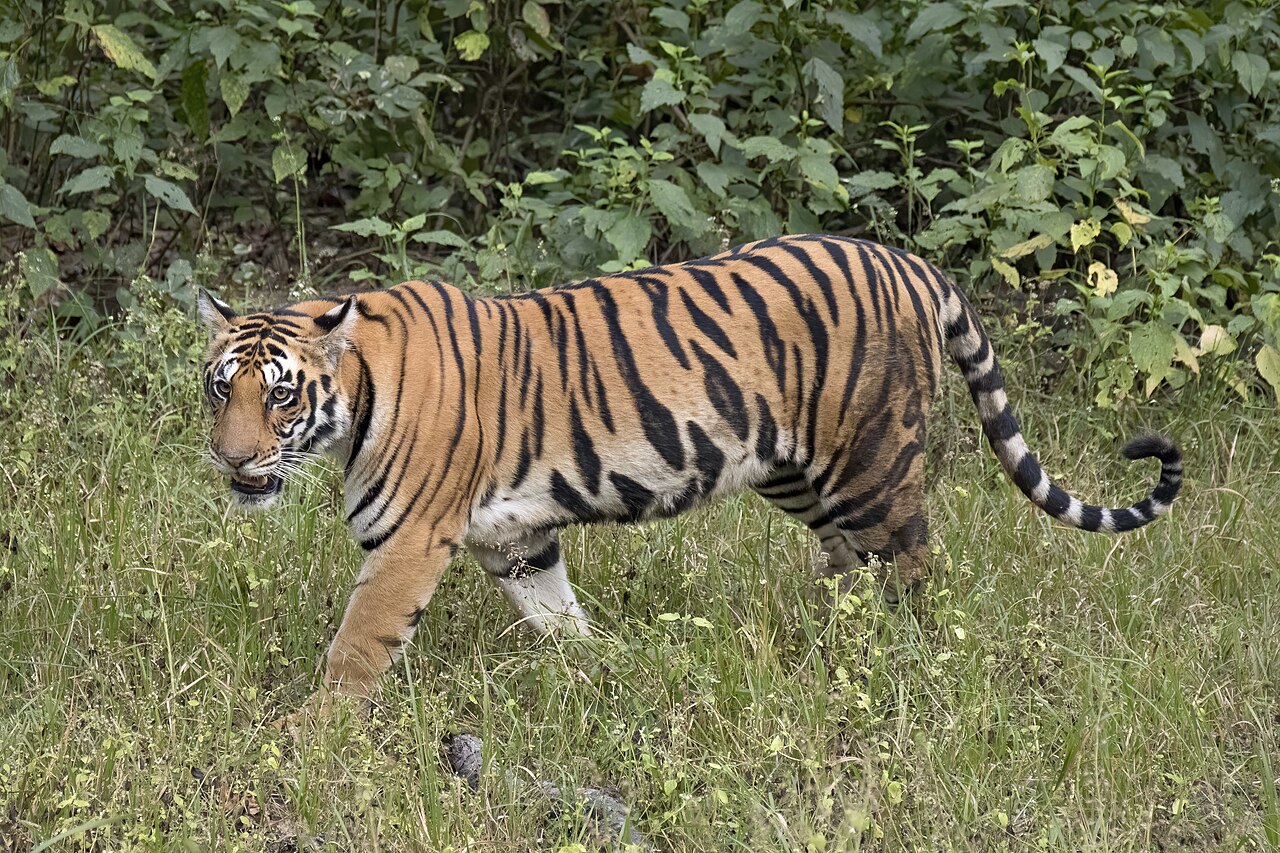
The coat is orange, from yellowish to reddish, with white on the belly, the insides of the legs and parts of the face. The black or dark brown stripes are mostly vertical and are different on every animal. They hide the tiger among trees, reeds and tall grass. White and golden tigers are rare color forms, now almost unknown in the wild.
Behavior
Adult tigers live mostly alone. Each defends a home range against others of its sex, and a male’s range overlaps those of several females. They roar to announce themselves, a sound that carries 3 km (1.9 mi). Tigers swim strongly but seldom climb.
The tiger is an apex predator that feeds mainly on large and medium-sized hoofed animals such as sambar deer, gaur and wild boar. It hunts by ambush, creeping close under cover and usually killing with a bite to the throat. A tiger typically kills about once a week.
Mating can happen in any month, most often from November to April. After a pregnancy of a little over three months the tigress gives birth in a hidden den, usually to two or three cubs. They are weaned at about six months and independent at 18 to 24.
More tigers now live in captivity than in the wild.
Facts on this page were checked against Wikipedia and may have changed since.