Leopard
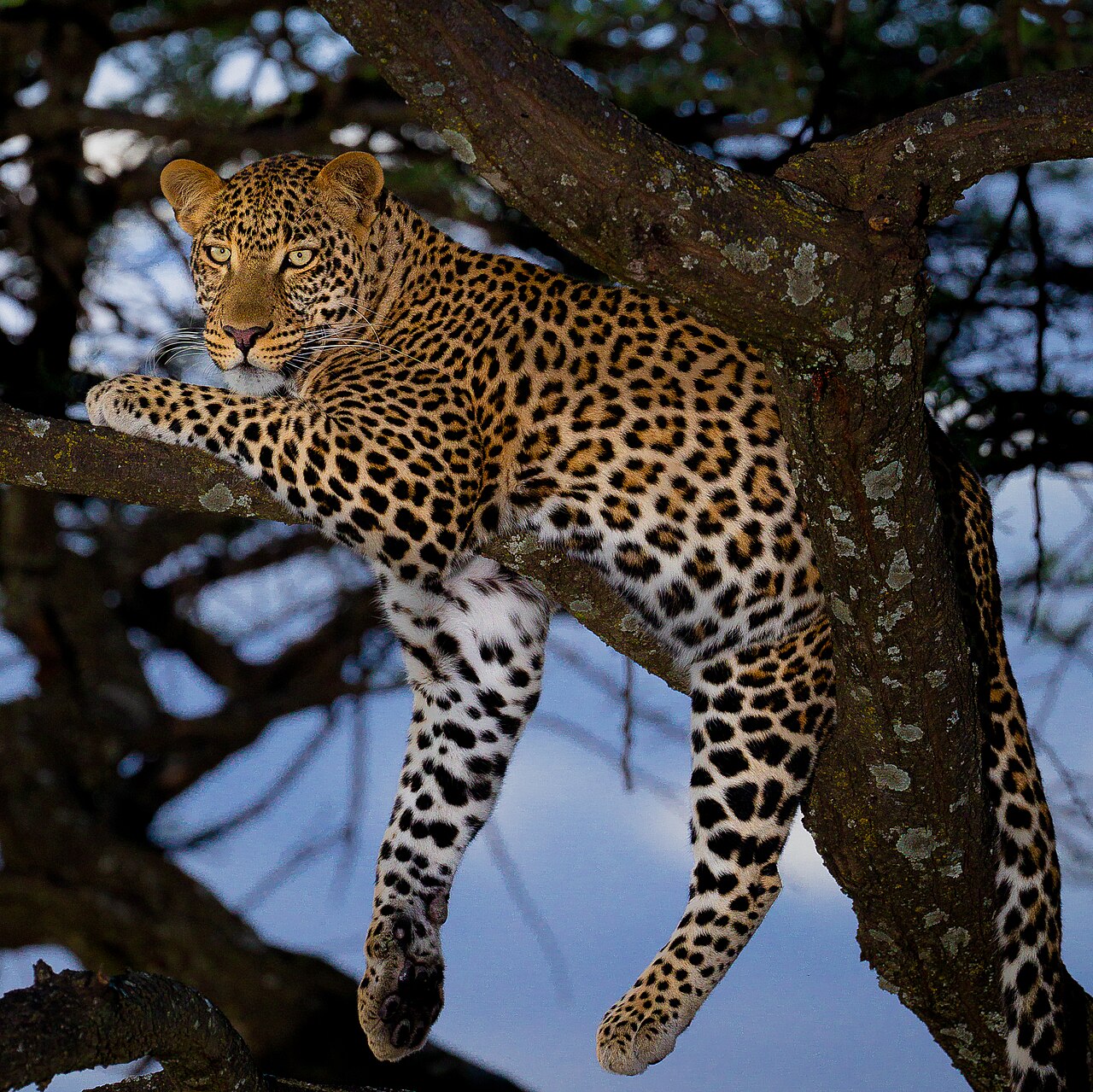

- Origin
- Africa and Asia
- Type
- Big cat
- Height
- 57–70 cm (22–28 in)
- Weight
- 20.5–72 kg (45–159 lb)
- Coat
- Soft and thick, longer in cold climates
- Colors
- Pale yellowish to dark golden with dark rosettes; black (melanistic) form
- Status
- Vulnerable (IUCN)
The leopard (Panthera pardus) is one of the five living species in the genus Panthera. It is a slender, muscular cat with a golden coat marked with dark rosettes, and it lives across much of Africa and Asia. Eight subspecies are recognised.
Range and habitat
No wild cat is spread more widely, although its populations are fragmented and shrinking. The leopard evolved in Africa and later moved into Eurasia; it once lived in Europe too.
It is at home in rainforest, savanna, grassland, woodland, mountains and dry country, and it can live close to towns where it finds prey and cover and is left alone. It is so stealthy that people may not know it is nearby. In sub-Saharan Africa it survives in marginal land where other large cats have gone, and it is fairly common on the Indian subcontinent. In West Africa, though, its range is thought to have shrunk by 95%, and it now occupies only about a quarter of its historical range overall.
Appearance
The fur is soft and thick, pale yellowish to dark gold, with dark spots grouped into rosettes that are different on every animal. The belly is white and the long tail is ringed toward its white tip. Leopards of dry regions are paler; those of forests and mountains are darker. The rosettes lack the small inner spots of a jaguar’s.
Black leopards, often called black panthers, owe their color to a recessive gene.
Males are larger than females. They stand 60–70 cm (24–28 in) at the shoulder and usually weigh 30.9–72 kg (68–159 lb); females stand 57–64 cm (22–25 in) and weigh 20.5–43 kg (45–95 lb). The head and body measure 92–183 cm (36–72 in), with a tail of 66–102 cm (26–40 in).
Behavior
Leopards are solitary and territorial, coming together only to mate. They are active mainly from dusk to dawn and rest by day in thickets, among rocks or on tree branches. They climb very well and come down trees headfirst. A leopard can run at more than 58 km/h (36 mph) and leap over 6 m (20 ft). Its best-known call is a rasping roar that sounds like sawing.
It is an opportunistic hunter that stalks and ambushes, relying on sharp hearing and sight. It prefers medium-sized prey of 10–40 kg (22–88 lb), mostly hoofed animals such as impala, bushbuck and chital, along with monkeys, and it sometimes hauls a kill into a tree. More than 100 prey species have been recorded.
Females give birth to two to four cubs after 90 to 105 days, in a cave, among boulders or in a thicket. Up to half the cubs die in their first year. The young stay with their mother for 18 to 24 months.
Threats and conservation
The main threats are the breaking up of habitat and the clearing of forest for farming, which reduce prey and bring leopards into conflict with herders. Trophy hunting and poaching for skins and bones add to the losses. The species is listed on CITES Appendix I.
Facts on this page were checked against Wikipedia and may have changed since.