Jungle Cat
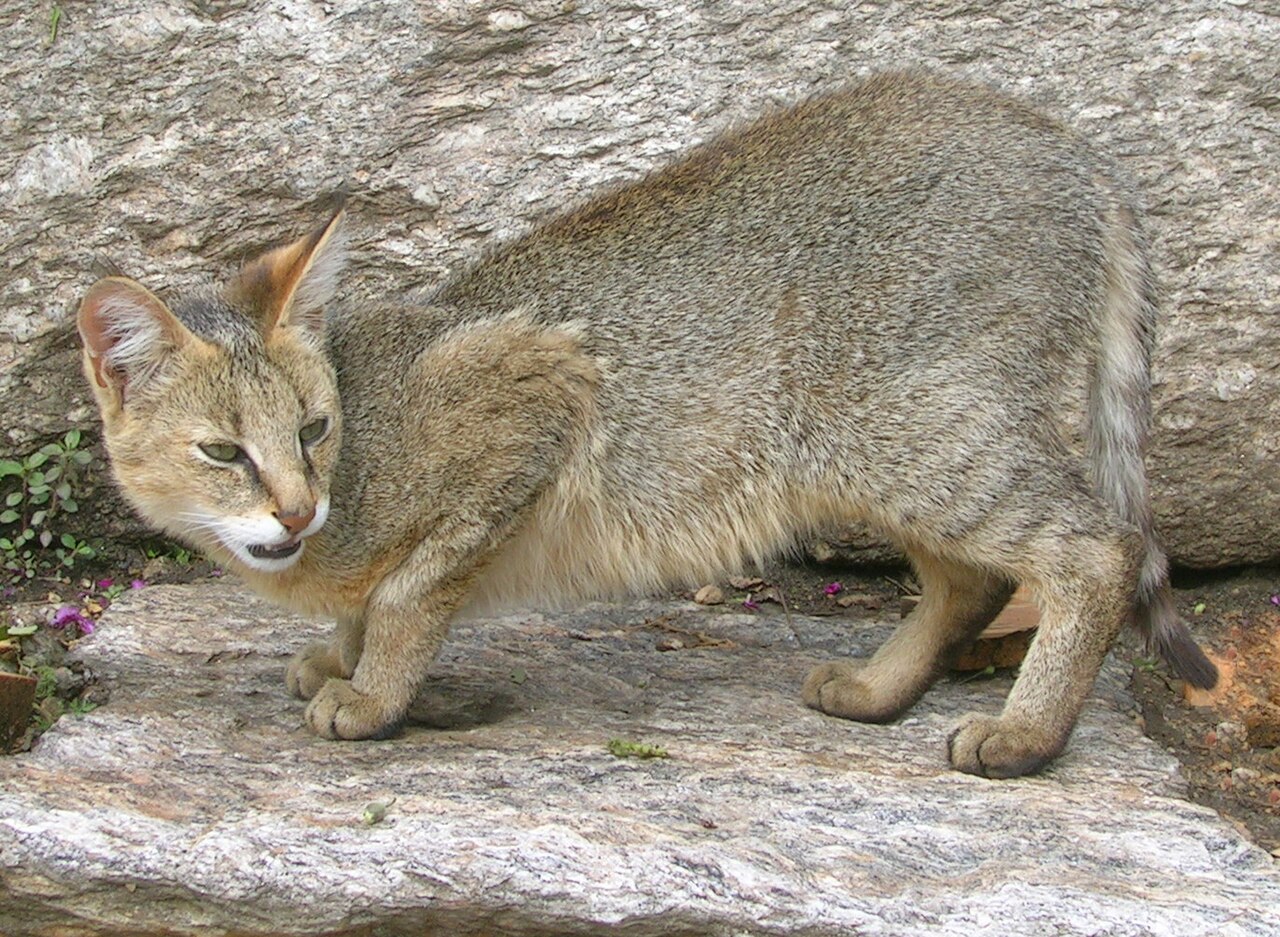

- Origin
- Asia
- Type
- Wild cat
- Height
- About 36 cm (14 in)
- Weight
- 2–16 kg (4.4–35.3 lb)
- Coat
- Plain sandy, reddish brown or gray, without spots
- Life span
- 15–20 years in captivity
- Status
- Least Concern (IUCN)
The jungle cat (Felis chaus), also known as the reed cat or swamp cat, is a medium-sized wild cat found from the eastern Mediterranean and the Caucasus across Central, South and Southeast Asia. Despite its name it avoids rainforest and lives mostly in wetlands with dense vegetation.
Range and habitat
The jungle cat lives in the Middle East, the Caucasus, the Indian subcontinent, Sri Lanka, Central and Southeast Asia and southern China. It needs water and thick cover: swamps, riverbanks, coasts, reed beds, grassland and scrub. It is common on farmland, in bean and sugarcane fields for instance, and is often seen near villages. In India it is the most common small wild cat. It copes poorly with cold and is rare where snow is frequent, though it has been recorded above 3,000 m (9,800 ft) in Nepal.
The species is listed as Least Concern, but the draining of wetlands, dams, pollution, trapping and poisoning all threaten it. Numbers around the Caspian Sea and in the Caucasus have dropped sharply since the 1960s, and in Thailand, where it was once the most common wild cat near villages, it is now considered critically endangered.
Appearance
This is the largest living member of the genus Felis, bigger and more slender than a house cat. The body is 59 to 76 cm (23 to 30 in) long, the shoulder height nearly 36 cm (14 in) and the weight 2 to 16 kg (4.4 to 35.3 lb).
The coat is an even sandy, reddish brown or gray with no spots, speckled by dark-tipped hairs. Kittens are striped and spotted. The face is long and narrow with a white muzzle and yellow eyes. The ears are large, pointed, reddish brown behind and set close together, each ending in a small tuft of black hair. The tail is fairly short, with a few dark rings and a black tip. Long legs, a short tail and tufted ears give the cat the look of a small lynx.
Behavior
The jungle cat hunts mostly by day, slowing down in the midday heat, and rests in burrows and thickets. It is solitary except when mating or raising young, and marks its territory with urine and scent.
It eats mainly small mammals such as rodents, gerbils and hares, along with birds, fish, frogs, insects and small snakes. It also eats fruit, especially in winter. It stalks, then sprints or pounces, and it can leap into the air to catch birds. It climbs well, has been timed at 32 km/h (20 mph), and swims strongly, diving in after fish.
Females come into season between January and March, and pregnancy lasts nearly two months. The mother makes a grass-lined den in an old burrow, a hollow tree or a reed bed and has one to five kittens, usually two or three. They open their eyes at 10 to 13 days, are weaned at about three months, begin catching prey at six months and leave at eight or nine.
Facts on this page were checked against Wikipedia and may have changed since.