Leopard Cat

- Origin
- South, Southeast and East Asia
- Type
- Wild cat
- Height
- About 41 cm (16 in)
- Weight
- 0.55–7.1 kg (1.2–16 lb)
- Coat
- Spotted
- Colors
- Tawny to yellowish brown in the south, pale silver-gray in the north, with black spots
- Life span
- Up to 13 years in captivity
- Status
- Least Concern (IUCN)
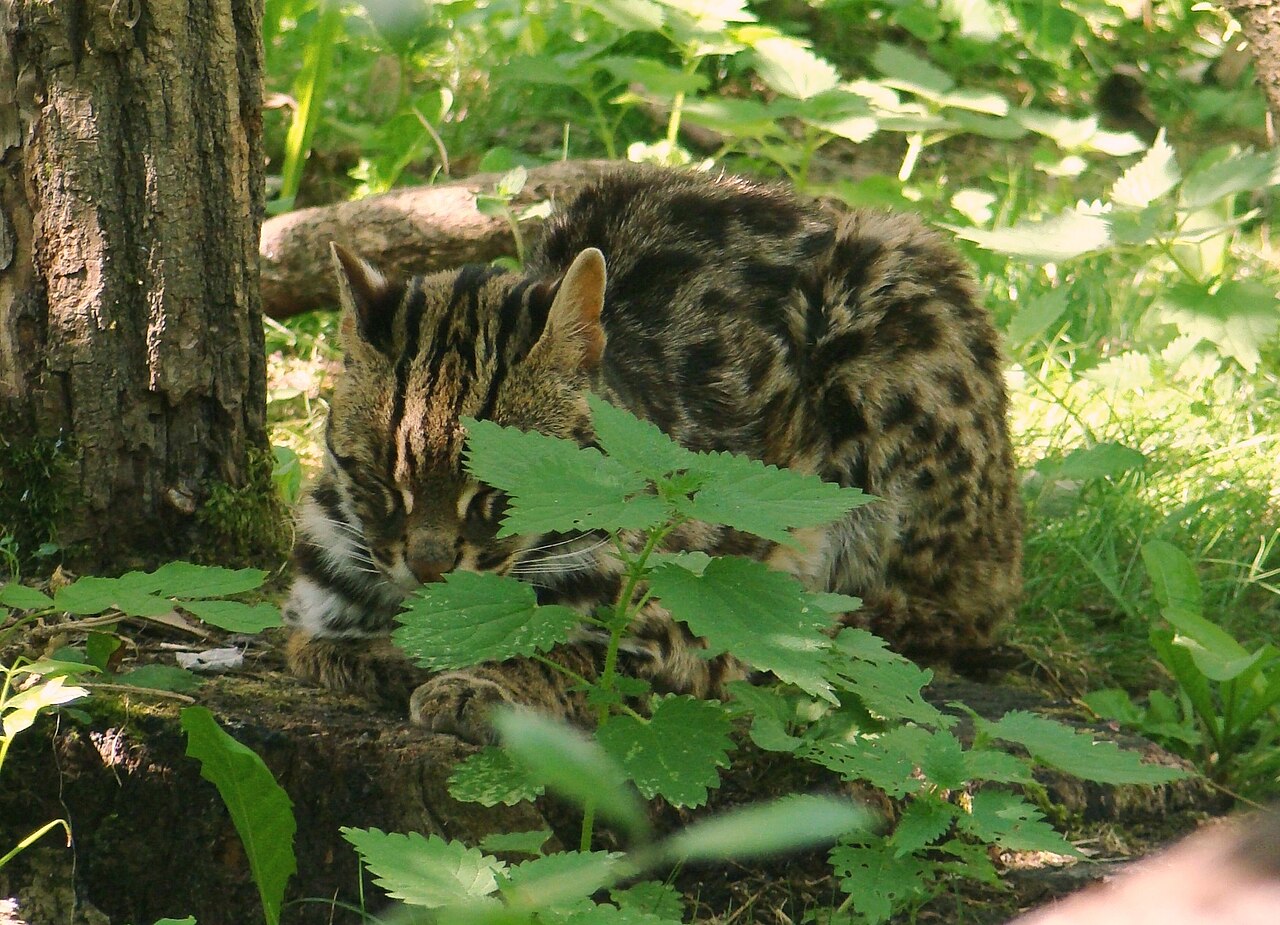
The leopard cat (Prionailurus bengalensis) is a small spotted wild cat of mainland Asia. It is the most widely spread of Asia’s small wild cats. Since 2017 the cats of Java, Borneo, Sumatra and nearby islands have been treated as a separate species, the Sunda leopard cat. Two subspecies of the mainland cat are recognised: a southern one from Pakistan to China, and a northern one, the Amur leopard cat, in the Russian Far East, Manchuria, Korea, Taiwan and the Japanese islands of Iriomote and Tsushima.
Range and habitat
The leopard cat lives from eastern Afghanistan and northern Pakistan across much of the Indian subcontinent and Southeast Asia to China and the Russian Far East. It is found in tropical evergreen rainforest at sea level and in subtropical deciduous and conifer forest in the Himalayan foothills, and has been recorded as high as 4,474 m (14,678 ft) in Nepal. It also lives on farmed land with enough cover, such as oil palm and sugar cane plantations. In the far north it stays near rivers and wooded ravines and avoids places with more than about 10 cm (3.9 in) of snow.
Appearance
A leopard cat is about as big as a domestic cat but slimmer and longer in the leg, with clear webbing between the toes. The small head has two dark stripes running from the eyes back to the ears, shorter white streaks from the eyes to the nose, and a short, narrow white muzzle. The body and legs are covered in black spots, with two to four rows of long spots down the back. The tail is about half as long as the head and body. The chest and belly are white.
The species varies so much across its range that it was once taken for several. Southern cats are yellowish brown and northern ones pale silver-gray, and the markings may be spots, rosettes or dotted streaks. Size varies as well. In the tropics leopard cats weigh 0.55 to 3.8 kg (1.2 to 8.4 lb) and measure 38.8 to 66 cm (15.3 to 26.0 in) in head and body. In northern China and Siberia they reach 7.1 kg (16 lb) and 75 cm (30 in).
Behavior
Leopard cats live alone outside the breeding season. Some are active by day, but most hunt at night. They climb well, spend a good deal of time in trees and rest there or in dense thorny undergrowth.
Small rodents such as rats and mice make up most of the diet, along with lizards, amphibians, birds, insects and sometimes poultry.
In the tropics kittens are born all year round, and further north in spring. A litter is two or three kittens, born after 60 to 70 days.
Threats
The leopard cat is hunted through most of its range for fur, for food and for sale as a pet, and is often killed as a poultry thief. The population is put at well over 50,000 and declining, and habitat loss threatens the cat in parts of its range.
Facts on this page were checked against Wikipedia and may have changed since.