Cougar

- Origin
- The Americas
- Type
- Wild cat
- Height
- 60–90 cm (24–35 in)
- Weight
- 34–72 kg (75–159 lb)
- Coat
- Short and plain
- Colors
- Tawny, from silvery gray to reddish, paler underneath
- Status
- Least Concern (IUCN)
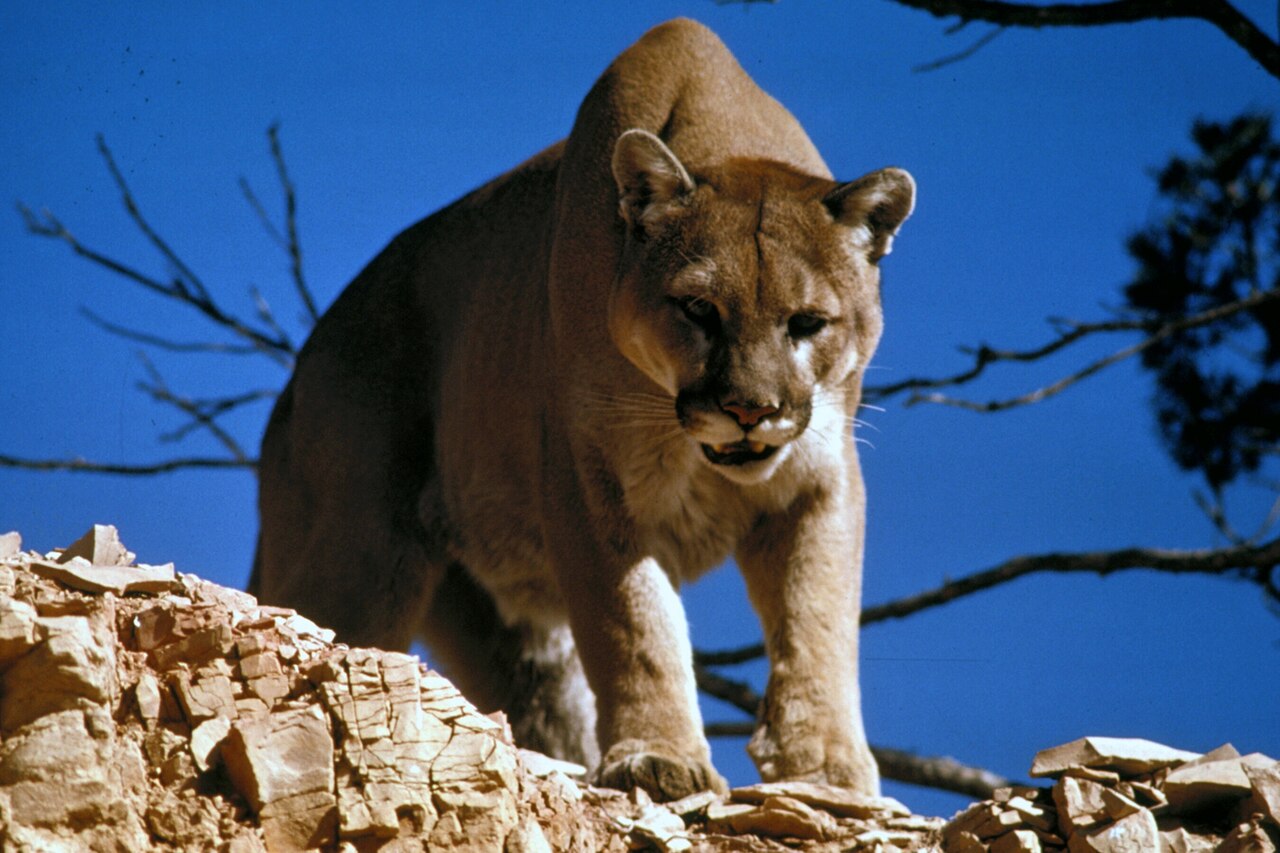
The cougar (Puma concolor) is a large wild cat of North, Central and South America. It goes by more names than any other animal, over forty in English alone, including puma, mountain lion, catamount and panther. Despite its size it is not one of the roaring big cats. It belongs with the smaller cats, and its nearest relatives are the jaguarundi and the cheetah. It cannot roar, and it is the largest cat that purrs.
Range and habitat
No other wild land mammal in the Western Hemisphere is spread so widely. The cougar lives from the Yukon, British Columbia and Alberta through the western United States and Mexico to the Amazon and the southern Andes in Patagonia. It uses nearly every kind of country: forests of all types, lowland and mountain deserts, and open ground up to 5,800 m (19,000 ft). It likes dense brush and rocky places for stalking.
Hunting after European settlement and the spread of development cut its numbers across much of its old range. In eastern North America it has been mostly gone since the early twentieth century, apart from the isolated Florida panther. It is now moving back into parts of the Midwest and Canada.
Appearance
The cougar is slender and agile, with a round head, upright ears and powerful forequarters, neck and jaws for holding large prey. It is the fourth-largest cat species. Males are about 2.4 m (7 ft 10 in) from nose to tail tip and females about 2.05 m (6 ft 9 in), with the tail making up 63 to 95 cm (25 to 37 in). Males usually weigh 53 to 72 kg (117 to 159 lb) and females 34 to 48 kg (75 to 106 lb). Cougars are smaller near the equator and bigger toward the poles.
The coat is plain tawny, anywhere from silvery gray to reddish, with paler fur on the jaws, chin, throat and belly. Kittens are born spotted, with blue eyes and ringed tails. The hind legs are the largest for body size of any cat, which gives the cougar great leaping power. It can jump up to 5.5 m (18 ft) from the ground into a tree.
Behavior
Cougars live mostly alone, hold territories and are thinly spread. When they are active varies from place to place and seems to depend on other predators, prey, livestock and people. They hunt by ambush. Deer and other hoofed animals such as elk, moose and bighorn sheep are the main prey, but they also take rodents, hares, birds and sometimes domestic animals.
Females raise the young alone. After about three months of pregnancy a litter of one to six cubs, usually two, is born in a cave or other sheltered spot. The cubs begin to be weaned at around three months and stay with their mother for one to two years.
Cougars are shy and mostly keep away from people. Fatal attacks are rare, although they increased in North America as more people moved into cougar country.
Facts on this page were checked against Wikipedia and may have changed since.