African Golden Cat

- Origin
- West and Central Africa
- Type
- Wild cat
- Height
- 38–55 cm (15–22 in)
- Weight
- 5.5–16 kg (12–35 lb)
- Coat
- Short; plain or spotted
- Colors
- Chestnut or reddish brown, grayish brown to dark slate; sometimes black
- Life span
- Up to 12 years in captivity
- Status
- Vulnerable (IUCN)
The African golden cat (Caracal aurata) is a wild cat found only in the rainforests of West and Central Africa. It is a close relative of the caracal and the serval, and was formerly placed in a genus of its own, Profelis. Two subspecies are recognised, one east of the Congo River and one west of the Cross River.
Range and habitat
The species lives from Senegal across to the Central African Republic and Kenya, and south as far as northern Angola. It keeps to tropical forest, from sea level up to about 3,000 m (9,800 ft), and favors dense, moist forest with thick undergrowth near rivers. It has also been found in cloud forest, bamboo forest and high moorland.
Appearance
This is a heavily built cat, roughly twice the size of a domestic cat, with long, stocky legs, big paws, a fairly short tail and a small, rounded head. Head and body measure 61 to 101 cm (24 to 40 in), with a tail of 16 to 46 cm (6.3 to 18.1 in). Males are larger than females.
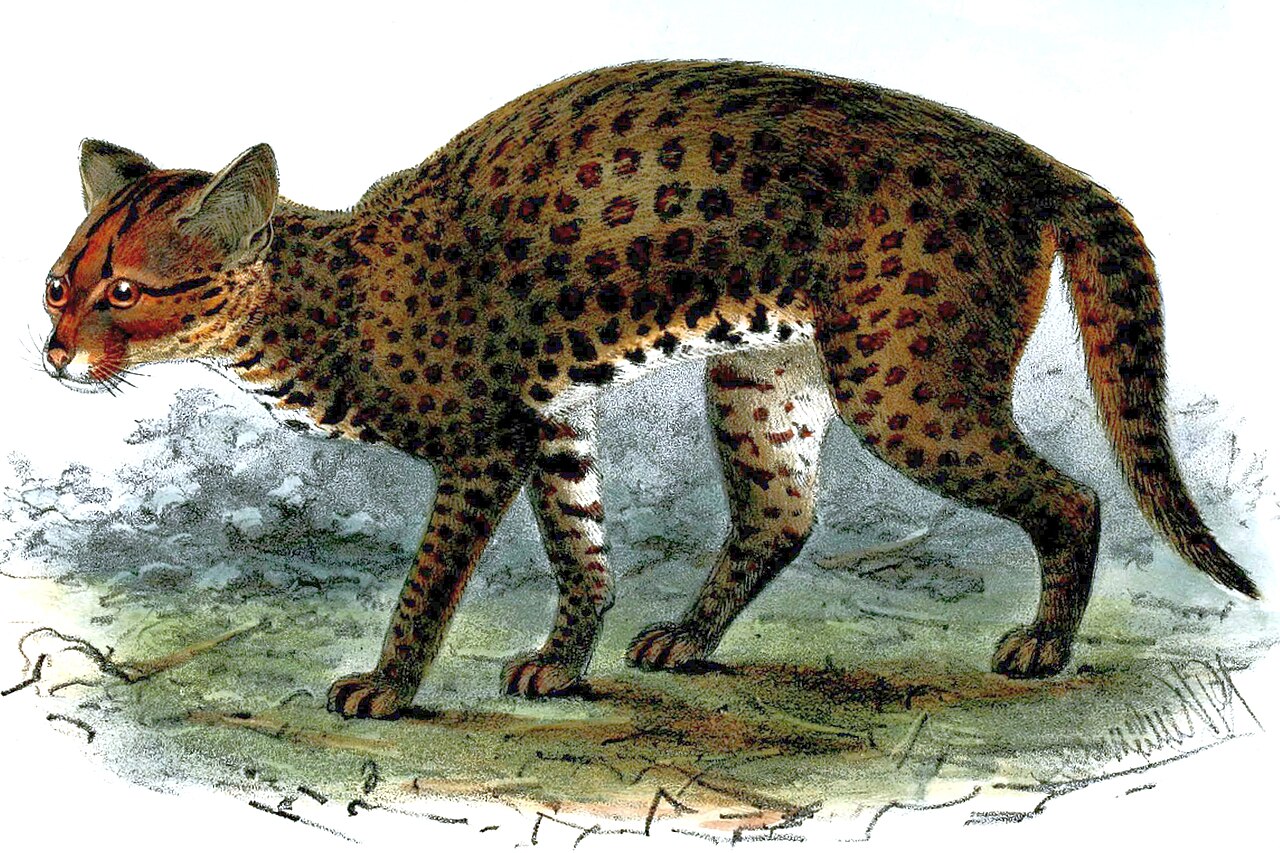
The coat varies a great deal. It may be chestnut, reddish brown, grayish brown or dark slate, and all-black animals occur. The red and gray forms were once thought to be separate species. Some cats are spotted all over, others only on the belly and inner legs, and cats in the west of the range tend to be more heavily spotted than those in the east. The cheeks, chin, throat and underside are pale to nearly white, and the tail ends in a black tip. A whorl of fur in front of the shoulders, where the hair changes direction, is typical of the species. It looks something like a caracal, but its ears are shorter, rounded and without tufts, its tail is longer and its face is shorter and rounder. Eye color runs from pale blue to brown.
Behavior
Very little is known about how this cat lives, because it is so seldom seen. It is solitary, and mostly active at dusk, dawn and night, although it has been seen hunting by day where prey allows. It can climb but hunts mainly on the ground, taking tree hyraxes and rodents above all, and also birds, small monkeys, duikers, small antelope and young giant forest hogs. It sometimes takes poultry and livestock.
What is known of its breeding comes from captive animals. A female has one or two kittens after about 75 days. Their eyes open within a week and they are weaned at six to eight weeks.
Threats
The species is threatened by the clearing of rainforest, including conversion to oil palm plantations, mining and road building, and by hunting for bushmeat, especially in the Congo Basin. It is listed in CITES Appendix II, and hunting it is banned in many of the countries where it lives.
Facts on this page were checked against Wikipedia and may have changed since.