Pampas Cat

- Origin
- South America
- Type
- Wild cat
- Coat
- Highly variable: gray, reddish or rusty brown, with stripes, rosettes or faint spots
- Life span
- About 9 years; some over 16
- Status
- Near Threatened (IUCN)
The Pampas cat (Leopardus colocola), also known as the colocolo, is a small wild cat of South America. It takes its name from the Pampas grasslands but lives in many other kinds of country too. It is listed as Near Threatened, because the conversion and destruction of its habitat may bring its numbers down.
Scientists have long disagreed about whether it is one species or several. A 2005 reference work split it into three: the colocolo, the Pantanal cat and a more narrowly defined Pampas cat. Genetic studies did not support that split, and in 2017 the Cat Specialist Group treated it as a single species with seven subspecies. A 2020 study then proposed five separate species, a scheme used by the Pampas Cat Working Group in its conservation projects.
Range and habitat
The Pampas cat ranges across most of Argentina and Uruguay, into the Gran Chaco and Cerrado of Bolivia, Paraguay and Brazil, and north along the Andes through Ecuador, possibly just reaching southwestern Colombia. It lives in grassland, shrubland and dry forest. In the Andes it is found between 1,800 and 5,000 m (5,900 and 16,400 ft); in central and northwestern Argentina it lives below 1,240 m (4,070 ft); and in the far south it occupies the Patagonian steppe below 1,100 m (3,600 ft). In 2016 it was recorded for the first time in the Sechura Desert and the dry forest of northwestern Peru.
Appearance
The Pampas cat is a little bigger than a house cat, with a bushier tail. Its size varies by region: the body is 46 to 75 cm (18 to 30 in) long, and the tail 23 to 29 cm (9.1 to 11.4 in).
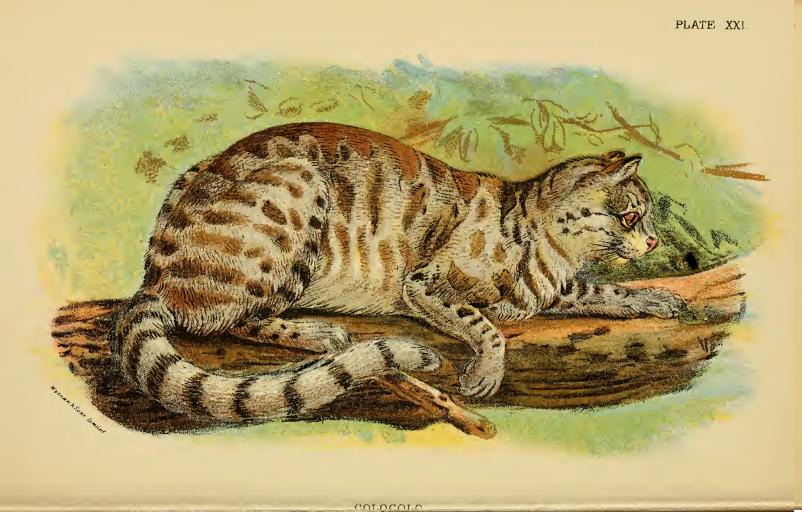
Its coat varies more than that of most cats. Six forms are described, and the one thing they share is a pair of dark lines on each cheek. In central Chile the cat is reddish or dark gray with rusty stripes on the flanks, reddish rings on the tail and dark stripes on the legs. In the northern Andes it carries large reddish-brown rosettes with darker rims and a ringed tail. Farther south the markings fade, down to a plain grayish cat with a tail without rings and bold brown stripes only on the legs. In Brazil and neighboring countries the cat is almost wholly rusty brown with faint spots, black feet and a black tail tip, and the form found in Uruguay and southern Brazil is paler and more yellowish. Black individuals also occur.
Behavior
Little is known about how the Pampas cat hunts or breeds. It is believed to feed mainly on small mammals and birds: guinea pigs are thought to make up much of its diet, together with viscachas, other rodents and the ground-living birds called tinamous. Observers disagree about whether it is active mainly by night or by day.
Litters are small, usually one or two kittens and occasionally three, each weighing about 130 g (4.6 oz) at birth. The average lifespan is nine years, though some animals have lived past 16.
Facts on this page were checked against Wikipedia and may have changed since.