Cheetah
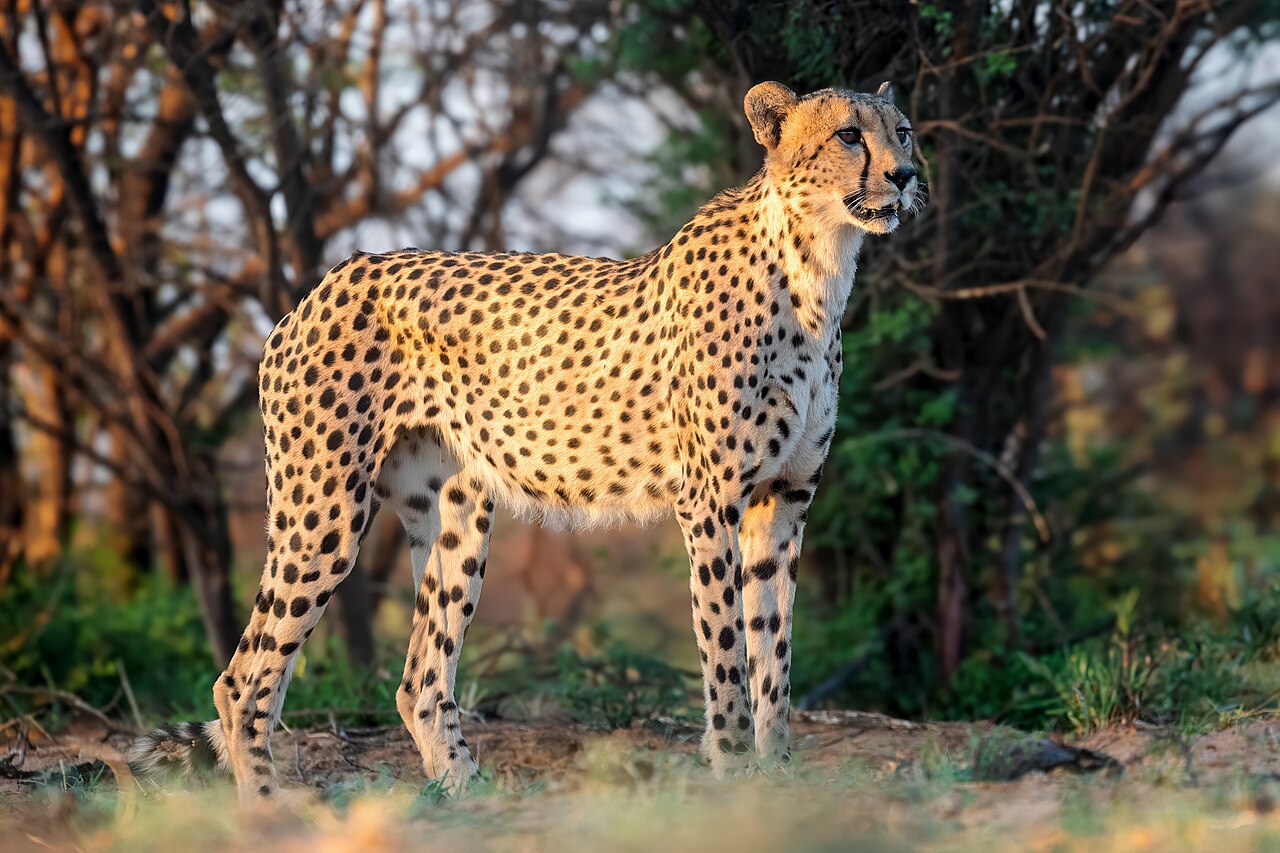

- Origin
- Africa
- Type
- Wild cat
- Height
- 67–94 cm (26–37 in)
- Weight
- 21–65 kg (46–143 lb)
- Coat
- Short, tawny to pale buff with solid black spots
- Life span
- 10–15 years in the wild
- Status
- Vulnerable (IUCN)
The cheetah (Acinonyx jubatus) is a large, slender wild cat and the only living member of its genus. It is the fastest animal on land, built for the chase, with powerful hind legs and a long, flexible lower spine.
Range and habitat
Four subspecies are recognised, native to Africa and central Iran. Today the cheetah survives mostly in small, scattered populations in northwestern, eastern and southern Africa and in central Iran; an African subspecies was introduced to India in 2022. It lives in varied country, from the savannas of the Serengeti to dry mountain ranges in the Sahara and hilly desert.
The cheetah is listed as Vulnerable on the IUCN Red List, with the world population estimated at 6,517 mature animals in 2021. It is threatened by habitat loss, conflict with people, poaching and a high susceptibility to disease. Cheetahs have unusually little genetic variation, thought to be the result of two population bottlenecks about 100,000 and 12,000 years ago, and this has made captive breeding difficult.
Appearance
The cheetah has a small rounded head, a short snout, a deep chest, long legs and a long tail. Black “tear” streaks run from the inner corners of the eyes down to the mouth, a feature found in no other cat. The coat is tawny to creamy white or pale buff and covered with around 2,000 evenly spaced solid black spots; the pattern is different on every animal. A short, rough mane runs along the neck and shoulders, and is more obvious in males.
Adults stand 67 to 94 cm (26 to 37 in) at the shoulder, measure 1.1 to 1.5 m (3 ft 7 in to 4 ft 11 in) in head and body, and weigh 21 to 65 kg (46 to 143 lb). Females are smaller on average than males.
The king cheetah, with large blotches and three wide dark stripes down the back, is a rare coat variety caused by a recessive mutation, once described as a separate species.
Behavior
Cheetahs live in three kinds of groups: females with their cubs, “coalitions” of males, and lone males. Females wander over large home ranges in search of prey, while males hold much smaller territories. Unlike most cats, cheetahs hunt by day, with peaks at dawn and dusk.
They take small to medium-sized prey, mostly under 40 kg (88 lb), and favor antelopes such as impala, springbok and Thomson’s gazelle. A cheetah stalks to within 30 to 200 m (98 to 656 ft), then sprints at 93 to 104 km/h (58 to 65 mph), trips the animal with its dewclaw and kills with a bite to the throat. Cheetahs purr, loudly, and make a bird-like chirp when excited.
Breeding happens all year. After nearly three months, a female has three or four cubs, which are weaned at about four months and independent at about 20 months. Lions and hyenas kill many cubs and often steal the adults’ kills. Wild females live 14 to 15 years and males about ten.
Facts on this page were checked against Wikipedia and may have changed since.