Lynx

- Type
- Wild cat
- Coat
- Thicker and paler in cold climates, shorter and darker in warm ones
- Colors
- Medium brown to gold or beige-white, sometimes dark-spotted; white chest, belly and inner legs
A lynx is any of the four living species of the genus Lynx, a group of medium-sized wild cats: the Eurasian lynx, the Iberian lynx, the Canada lynx and the bobcat. The name comes from Greek, by way of Latin and Middle English. The Eurasian lynx is the largest of the four, and the bobcat and Canada lynx are the smallest, though size varies a good deal within each species.
All four are thought to descend from Lynx issiodorensis, which appeared in Africa about 4 million years ago and soon spread into Eurasia. The bobcat is believed to stem from animals that crossed the Bering Land Bridge around 2.5 million years ago, and the Canada lynx from a later crossing by Eurasian lynx about 200,000 years ago.
Range and habitat
Lynx live in high-elevation forests with dense cover of shrubs, reeds and tall grass.
The Eurasian lynx ranges from central and northern Europe across Asia to northern Pakistan and India, including the Tibetan Plateau. It is most common in northern Europe: Norway, Sweden, Finland, Estonia and northern Russia. Reintroduction projects begun in the 1970s returned the lynx to Slovenia, Croatia and parts of Switzerland, and a small population has lived in Germany’s Harz mountains since 2000. Lynx died out in Britain in the 17th century.
The Iberian lynx lives in southern Spain and formerly lived in eastern Portugal, where there is now a breeding center in the Algarve.
In North America, the bobcat is common across southern Canada, the continental United States and northern Mexico, while the Canada lynx keeps mainly to the boreal forests of Canada and Alaska.
Appearance
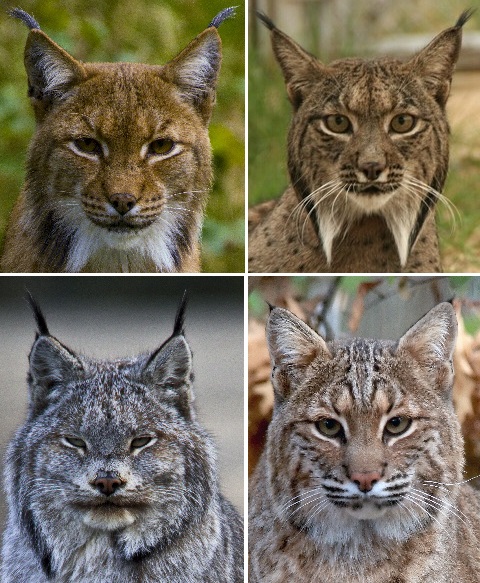
Lynx have a short tail, tufts of black hair on the tips of the ears, long whiskers on the face and large, padded paws for walking on snow. Under the neck is a ruff marked with black bars that can look like a bow tie, though it is often hard to see.
The coat ranges from medium brown through gold to beige-white and sometimes carries dark brown spots, mostly on the legs. The chest, belly and insides of the legs are white in all four species. Color, fur length and paw size change with climate: lynx of the southwestern United States are dark and short-haired with smaller, less padded paws, while those of the cold north have thicker, paler fur and bigger, better-padded feet.
Behavior
Lynx usually live alone, although a few may now and then travel and hunt together. They den in rock crevices or under ledges. They hunt on the ground but can climb trees, and swim well enough to catch fish.
Their prey runs from deer, reindeer and chamois down to the smaller animals they take more often: snowshoe hares, squirrels, mice, voles, foxes, fish, grouse, ptarmigan and other birds, and sometimes sheep and goats.
Mating takes place in late winter. After about 70 days the female gives birth to one to four kittens, once a year. The young stay with their mother through one more winter, about nine months in all, before going off on their own.
Facts on this page were checked against Wikipedia and may have changed since.