Kodkod

- Origin
- Chile
- Type
- Wild cat
- Height
- About 25 cm (10 in)
- Weight
- 2–2.5 kg (4.4–5.5 lb)
- Coat
- Brownish-yellow to gray-brown with dark spots; black animals are common
- Life span
- About 11 years
- Status
- Least Concern (IUCN)
The kodkod (Leopardus guigna), also called the güiña or Chilean cat, is the smallest cat species native to the Americas. It was first described from Chile in 1782 by Juan Ignacio Molina. Its closest relative is Geoffroy’s cat, and two subspecies are recognised: one in southern Chile and Argentina, the other in central and northern Chile.
Range and habitat
The kodkod lives mainly in central and southern Chile, with a small part of its range in the adjoining areas of Argentina. It is closely tied to the mixed temperate rainforests of the southern Andes and the coastal ranges, especially the Valdivian and Araucaria forests, where bamboo grows in the understory. It prefers evergreen rainforest to deciduous forest, scrub or conifer forest, and occurs up to the treeline at about 1,900 m (6,200 ft).
It copes with altered country to a degree, living in secondary forest and shrub and on the edges of settled and farmed land. Logging is the main threat, as native forest gives way to pine plantations and agriculture, particularly in central Chile. The cats are also killed for raiding poultry: of five radio-collared kodkods on Chiloé Island in 1997 and 1998, two were killed after getting into chicken coops.
The species was listed as Vulnerable when its population was thought to be under 10,000 mature animals. It is now listed as Least Concern on the IUCN Red List, as the total is judged to be higher than that.
Appearance
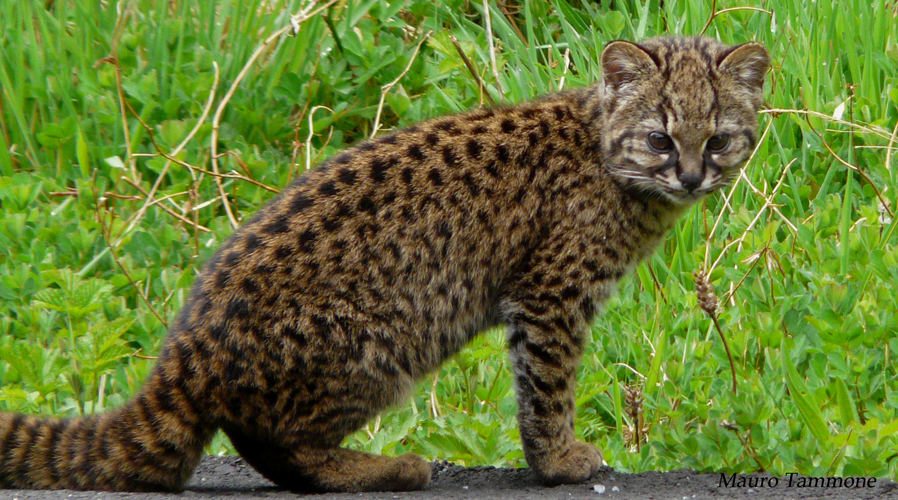
The kodkod has a small head, large feet and a thick tail. Its fur ranges from brownish-yellow to gray-brown, marked with dark spots, with a pale underside and a ringed tail. The ears are black with a white spot on the back, and the spots on the neck and shoulders nearly join into broken streaks. Black kodkods, on which the spots can still be made out, are quite common.
Adults measure 37 to 51 cm (15 to 20 in) in head and body, with a tail of 20 to 25 cm (7.9 to 9.8 in). They stand about 25 cm (10 in) at the shoulder and weigh 2 to 2.5 kg (4.4 to 5.5 lb).
Behavior
Kodkods are active by day and by night alike, but they cross open ground only in darkness. By day they rest in thick vegetation in ravines, along well-covered streams and in piles of dead gorse. They climb very well and can go up trees more than a meter thick.
They hunt on the ground for birds, lizards and rodents, taking species such as the southern lapwing, austral thrush and chucao tapaculo, as well as domestic geese and chickens. Males hold exclusive territories of 1.1 to 2.5 km² (0.42 to 0.97 sq mi); females use smaller ranges of 0.5 to 0.7 km² (0.19 to 0.27 sq mi).
Pregnancy lasts about 72 to 78 days and a litter has one to three kittens. A kodkod may live to about 11 years.
Facts on this page were checked against Wikipedia and may have changed since.