Margay
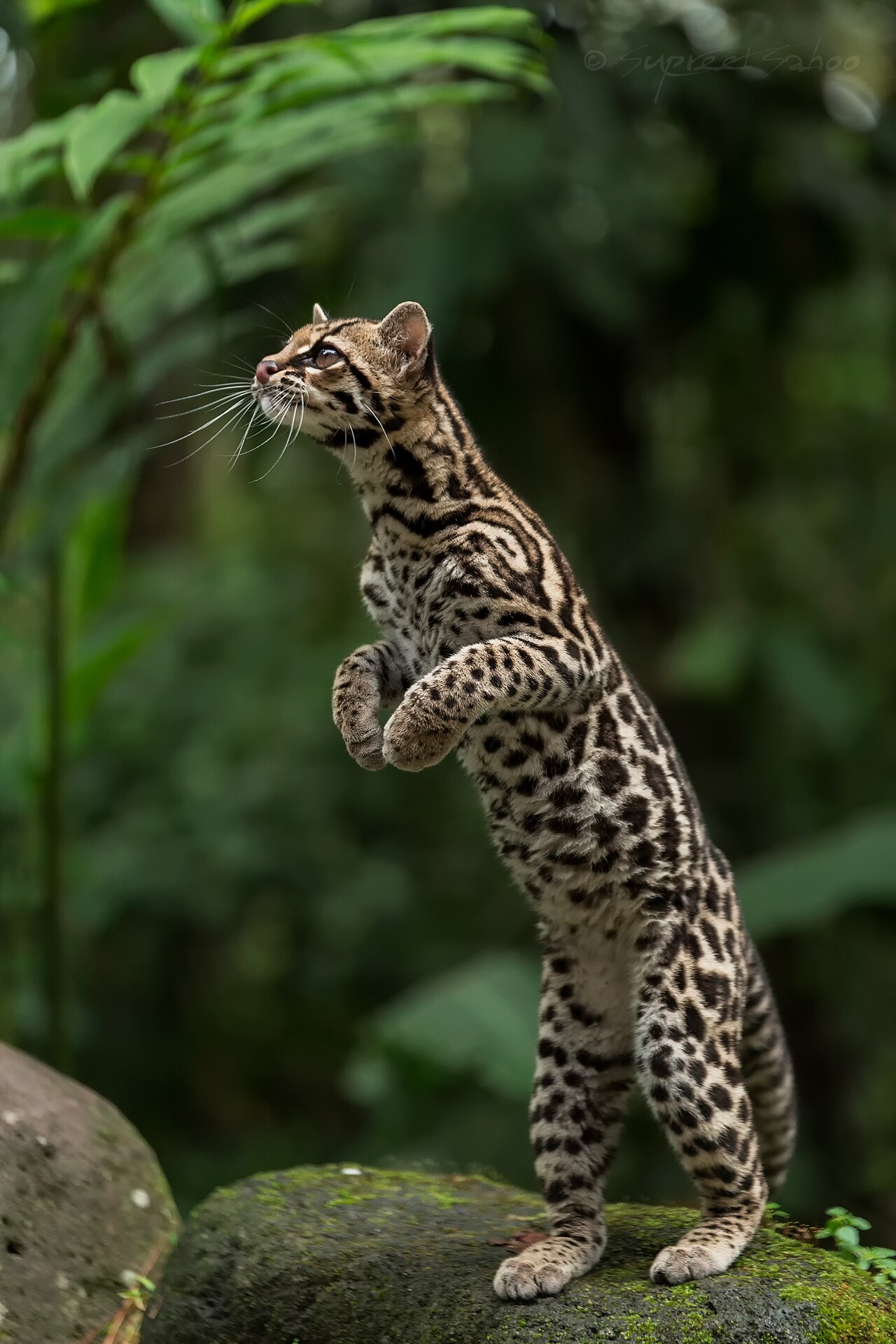

- Origin
- Central and South America
- Type
- Wild cat
- Weight
- 2.6–4 kg (5.7–8.8 lb)
- Coat
- Brown with rows of dark rosettes and streaks; banded tail
- Life span
- More than 20 years in captivity
- Status
- Near Threatened (IUCN)
The margay (Leopardus wiedii) is a small wild cat native to Mexico, Central America and South America. It is solitary, active at night and lives mostly in dense forest, where it spends much of its time in the trees. Its scientific name honors Prince Maximilian of Wied-Neuwied, who collected specimens in Brazil; the species was first described in 1821.
Range and habitat
The margay is found from the tropical lowlands of Mexico through Central America to Brazil and Paraguay, with the southern edge of its range in Uruguay and northern Argentina. It lives almost entirely in dense forest, from tropical evergreen and dry forest to high cloud forest, and has now and then been seen in coffee and cocoa plantations.
The only record from the United States is a specimen collected near Eagle Pass, Texas, before 1852, and the species is considered locally extinct there.
Until the 1990s margays were hunted for the wildlife trade. The species has been listed as Near Threatened since 2008, and its numbers are thought to be falling as farming breaks up and clears its forest.
Appearance
The margay looks much like the ocelot, its larger relative, but has a slightly shorter head, bigger eyes and a longer tail and legs. It weighs 2.6 to 4 kg (5.7 to 8.8 lb). The body is 48 to 79 cm (19 to 31 in) long and the tail adds another 33 to 51 cm (13 to 20 in).
The fur is brown, marked with rows of dark brown or black rosettes and lengthwise streaks, and the underside is paler, from buff to white. The tail carries many dark bands and a black tip. The backs of the ears are black with a round white mark in the middle.
Behavior
The margay is an exceptional climber, sometimes called the tree ocelot. Its ankles can turn as much as 180 degrees, so it grips branches as well with its hind paws as with its front ones, and it uses its long tail for balance. It can leap up to 3.7 m (12 ft) horizontally and chases birds and monkeys through the canopy.
It eats small primates such as marmosets and tamarins, birds, lizards, eggs, small snakes, tree frogs, squirrels and arthropods, along with some grass and fruit. It can live and hunt entirely in the trees but sometimes comes down for ground prey such as agoutis, armadillos and pacas. One margay was observed imitating the call of a young pied tamarin while hunting.
Margays live alone in home ranges of 11 to 16 square kilometers (4.2 to 6.2 sq mi), which they mark with urine and scratches.
Pregnancy lasts about 80 days and almost always produces a single kitten, usually born between March and June and weighing 85 to 170 g (3 to 6 oz). The kitten opens its eyes at about two weeks and starts on solid food at seven to eight weeks. Margays mature at 12 to 18 months.
Facts on this page were checked against Wikipedia and may have changed since.