Marbled Cat
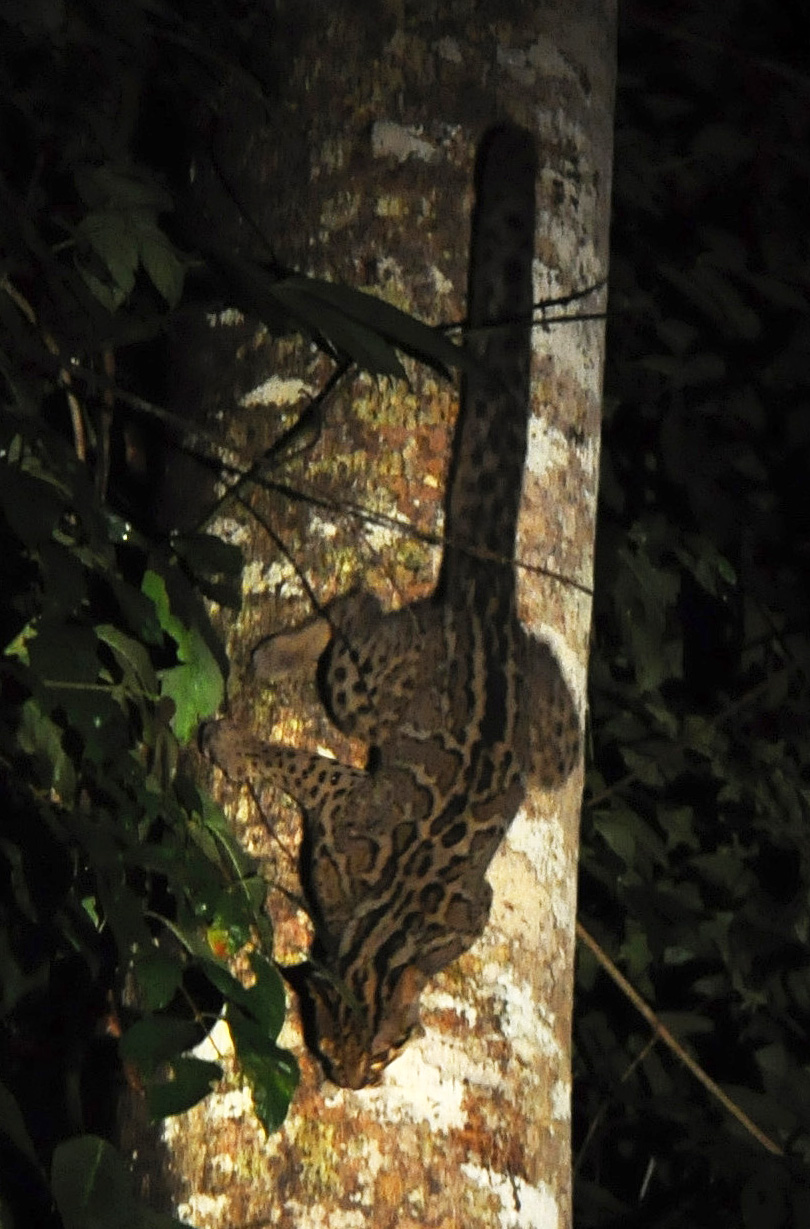

- Origin
- Southeast Asia
- Type
- Wild cat
- Weight
- 2–5 kg (4.4–11 lb)
- Coat
- Long, thick and soft, with dark-edged blotches
- Colors
- Brownish gray to ochre brown, grayish to buff below, with black markings
- Life span
- Up to 12 years in captivity
- Status
- Near Threatened (IUCN)
The marbled cat (Pardofelis marmorata) is a small wild cat of the forests of South and Southeast Asia. It was once grouped with the big cats, but genetic study has shown that its closest relatives are the Asian golden cat and the bay cat.
Range and habitat
The marbled cat lives along the foothills of the eastern Himalayas and east through tropical Asia into southwestern China, and on the islands of Sumatra and Borneo. In India it is found only in the forests of the northeast. It is tied mainly to moist and mixed deciduous and evergreen tropical forest, generally up to about 2,500 m (8,200 ft), although it has been recorded higher in Nepal and Bhutan.
Its numbers are poorly known, because camera traps across most of its range have recorded it only rarely.
Appearance
The marbled cat is about the size of a house cat, with a short, round head, rounded ears and a very long, thickly furred tail that matches the head and body in length. Head and body measure 45 to 62 cm (18 to 24 in) and the tail 35 to 55 cm (14 to 22 in). The long tail works as a counterweight and points to a life spent largely in trees.
The fur is thick and soft, brownish gray to ochre brown above and grayish to buff below. Black stripes mark the head, neck and back. The flanks carry irregular dark-edged blotches that run together into the marbled pattern that gives the cat its name. The legs and belly have solid black spots, and the tail is spotted near the body and ringed toward the end. The feet are large and webbed between the toes. The canine teeth are unusually big for a cat of this size and resemble those of the big cats, which appears to be a case of similar features evolving separately.
Behavior
Marbled cats recorded in northeastern India and on Borneo were active by day, with a peak around noon, while the first one ever followed by radio collar was active mainly at night and at dusk and dawn.
Much of its prey probably comes from the forest canopy: birds, squirrels and other rodents, and reptiles. One was seen in Thailand preying on a leaf monkey.
Only a few have been bred in captivity. Pregnancy is put at 66 to 82 days, and the recorded litters were of two kittens each.
Threats
The marbled cat depends on large stretches of unbroken forest, and the main threat is the loss of that forest to logging, farming and settlement. Snares set for any animal are common through much of its range and probably kill many. It is wanted for its skin, meat and bones, although it is seldom seen in the illegal wildlife trade. The species is listed in CITES Appendix I, and hunting it is banned in most of the countries where it lives.
Facts on this page were checked against Wikipedia and may have changed since.