Flat-headed Cat

- Origin
- Southeast Asia
- Type
- Wild cat
- Weight
- 1.5–2.5 kg (3.3–5.5 lb)
- Coat
- Short, reddish-brown, with a mottled white belly
- Life span
- Up to 14 years in captivity
- Status
- Endangered (IUCN)
The flat-headed cat (Prionailurus planiceps) is a small wild cat of Southeast Asia, closely tied to water and specialized for catching fish. It was first described in 1827 from a skin collected in Sumatra, and it belongs to the same genus as the fishing cat and the leopard cat.
Range and habitat
The species is found only in lowland tropical rainforest in the far south of Thailand, Peninsular Malaysia, Sumatra and Borneo. It lives in wetlands: freshwater and peat swamp forests and lowland swamps near rivers and coasts. More than 70 percent of records come from within 3 km (1.9 mi) of water. A 2013 record from a Malaysian forest reserve without major rivers, close to oil palm plantations, suggests it may tolerate changed surroundings better than was thought.
In Thailand it had not been seen since 1995 and was believed lost, until camera traps recorded it several times in 2024 and 2025 in Princess Sirindhorn Wildlife Sanctuary.
The flat-headed cat has been listed as Endangered on the IUCN Red List since 2008. Its main threat is the destruction of wetlands and lowland forest for settlements, farming, aquaculture and oil palm plantations. Overfishing, traps set to protect poultry, road traffic and competition with domestic cats add to the pressure. It is protected by law in Thailand, Malaysia and Indonesia.
Appearance
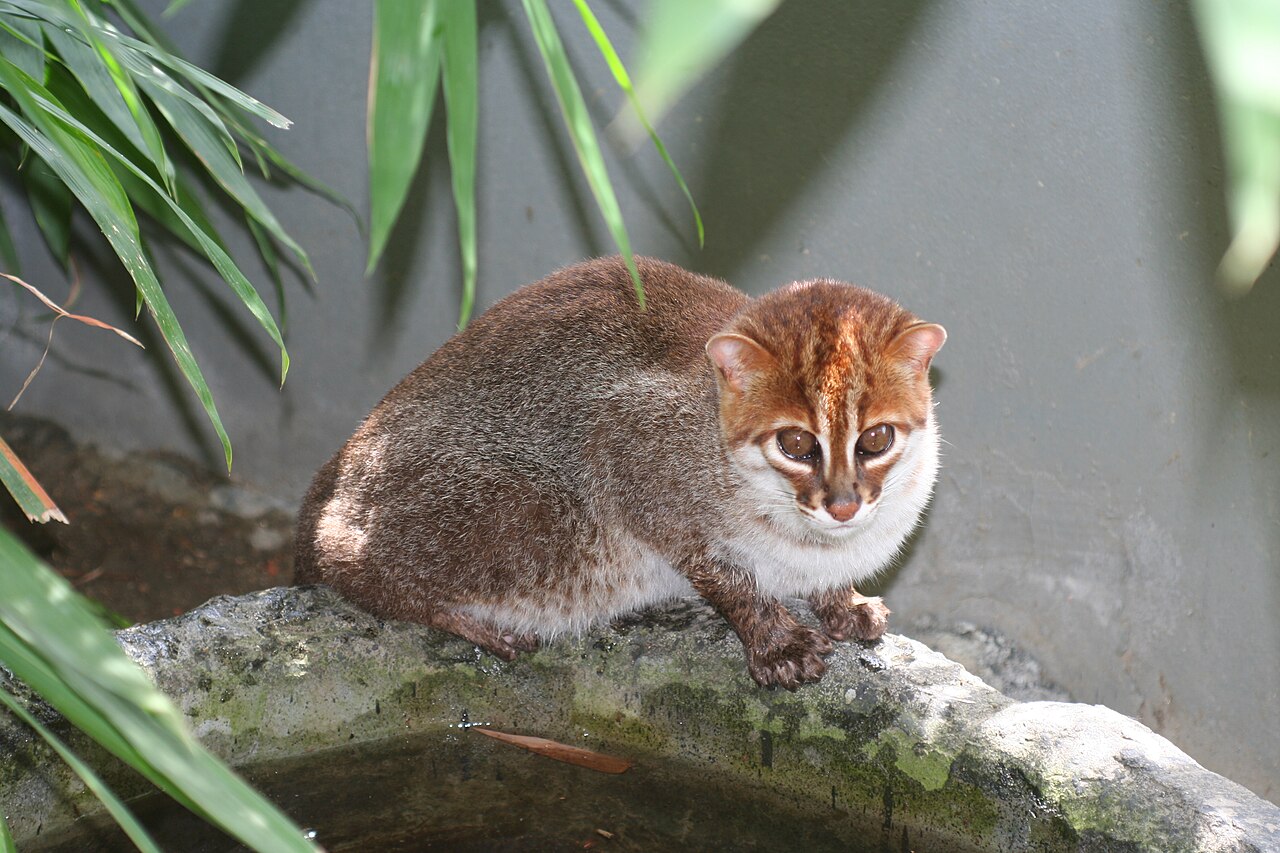
This is a slender cat with a long, flattened head, rounded ears and fairly short legs. The head is reddish-brown on top, the body a dark roan brown and the belly mottled white. The muzzle and chin are white, and two pale streaks run up beside the nose between the eyes. The eyes sit close together, which improves its judgment of depth.
Several features suit a fishing life. The teeth are unusually long and the jaws strong, good for holding slippery prey. The toes are webbed, giving grip in mud and water, and the claws cannot be fully drawn in, so about two-thirds of each one shows.
The head and body measure 41 to 50 cm (16 to 20 in), the short tail 13 to 15 cm (5.1 to 5.9 in), and the weight is 1.5 to 2.5 kg (3.3 to 5.5 lb).
Behavior
The flat-headed cat is hard to study, since it lives in thick vegetation in wet places and is rarely photographed. Animals recorded in Kalimantan were active mostly at night. It is presumed to be solitary and to mark its range with scent.
Its diet seems to be mostly fish, along with frogs and probably crustaceans; it also takes rats and chickens. Captive cats show far more interest in prey in water than on land. They will plunge the whole head under to seize a live fish, then carry it a couple of meters from the water before eating, and have been seen washing objects in the manner of a raccoon.
Pregnancy lasts about 56 days. The three litters recorded in captivity held one or two kittens. Two captive animals lived for 14 years.
Facts on this page were checked against Wikipedia and may have changed since.