Pallas's Cat
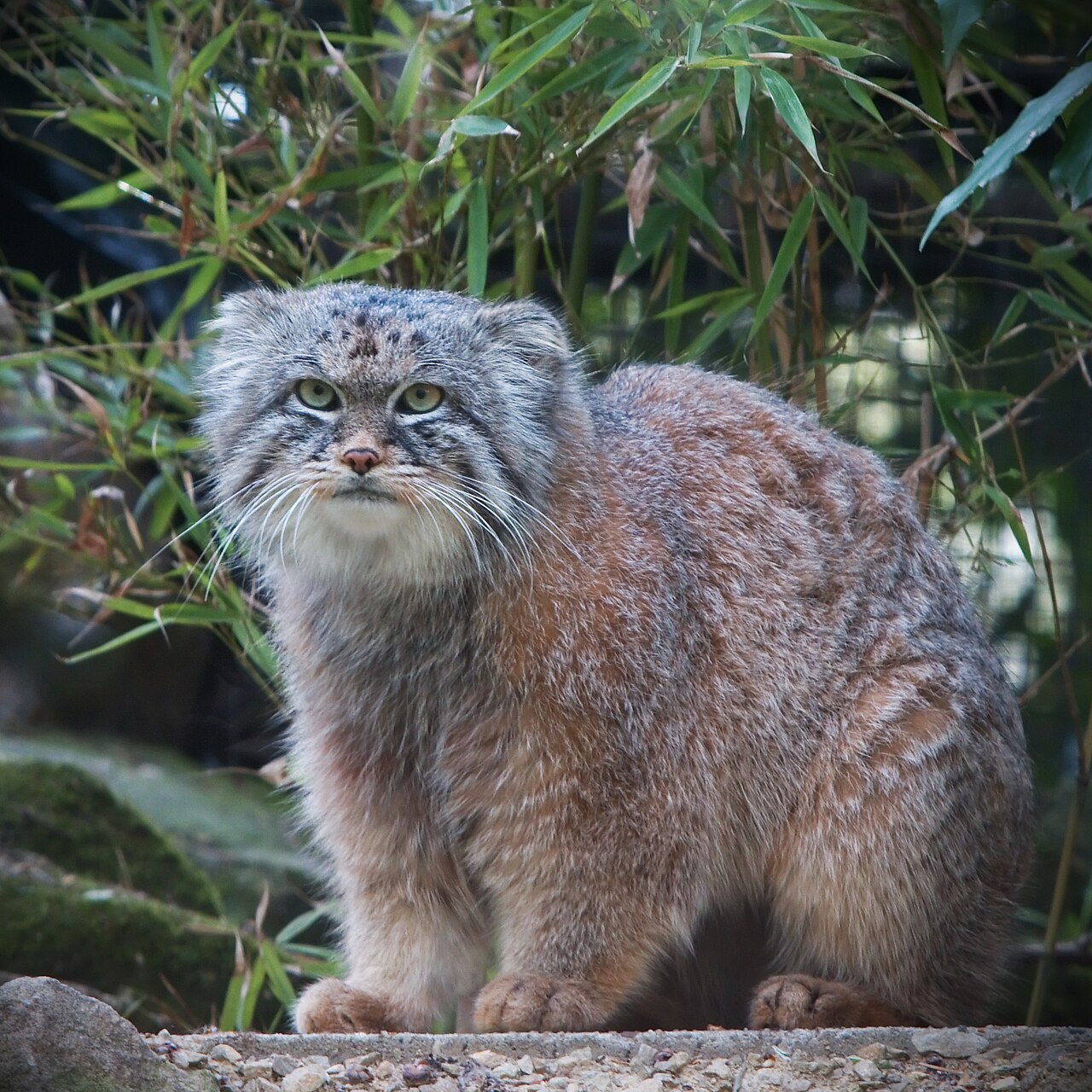

- Origin
- Central Asia
- Type
- Wild cat
- Weight
- 2.5–4.5 kg (5.5–9.9 lb)
- Coat
- Very long, dense and soft
- Colors
- Light gray with yellowish or reddish tones and black markings
- Status
- Least Concern (IUCN)
Pallas’s cat (Otocolobus manul), also called the manul, is a small wild cat of the cold, dry uplands of Central Asia. It is named after Peter Simon Pallas, who first described it in 1776 after meeting one near Lake Baikal. Two subspecies are recognised, one from Iran to Mongolia and one in the Himalayas from Kashmir to Bhutan.
Range and habitat
The species is spread across a huge area, though at widely scattered sites: from the Caucasus and the Iranian Plateau through the Hindu Kush, parts of the Himalayas and the Tibetan Plateau to the Altai, southern Siberia and Mongolia. It lives in rocky mountain grassland and shrubland, on scree slopes, outcrops and ravines, and in dry steppe and semi-desert. It keeps to places where lasting snow cover is less than 15 to 20 cm (6 to 8 in) deep.
Appearance
Pallas’s cat is about the size of a house cat, but its stocky build and long, dense fur make it look much stouter. Head and body measure 46 to 65 cm (18 to 26 in), with a bushy tail of 21 to 31 cm (8.3 to 12.2 in). The legs are short.
The fur is light gray with pale yellowish or reddish tones and some white and black hair tips. In winter it is grayer and thicker, and the markings show less. It is among the densest coats of any cat, with up to 9,000 hairs per square centimeter. The forehead is dotted with small black spots, two black zigzag lines cross each cheek, and the chin and lips are white. Narrow dark stripes run across the lower back, and the gray tail has seven thin black rings and a black tip.
The rounded ears sit low on the sides of the head, so the cat can peer over a rock while showing very little of itself. The eyes are yellowish and ringed with white, and the pupils close to small round disks in bright light instead of slits.
Behavior
Pallas’s cat lives alone. It shelters in caves, rock crevices and marmot burrows, moving between dens through the year.
It is a specialist hunter of small mammals, above all pikas and rodents such as voles, gerbils and ground squirrels. It stalks them or waits in ambush at burrow entrances, and sometimes hooks them out of shallow burrows with a paw.
Females can breed at about one year old. After 66 to 75 days a litter of two to six kittens is born, in the wild between late April and late May.
Threats
Because of its wide range and presumed large population, the species has been listed as Least Concern since 2020. Some populations are threatened by poaching, by the loss of prey to rodent-control programs, and by mining and construction that break up its habitat.
Facts on this page were checked against Wikipedia and may have changed since.