Black-footed Cat
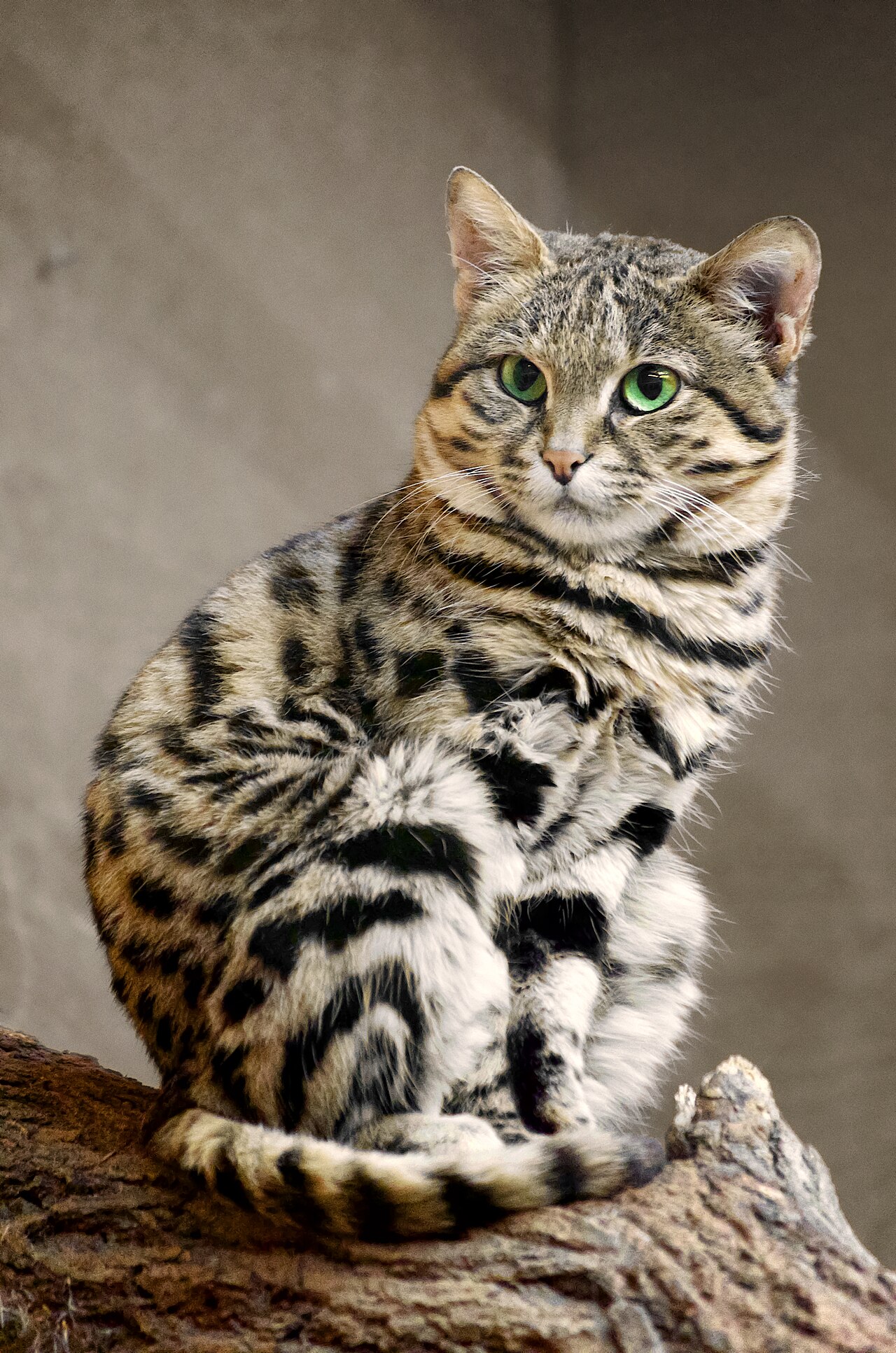

- Origin
- Southern Africa
- Type
- Wild cat
- Height
- Under 25 cm (9.8 in)
- Weight
- 1.1–2.45 kg (2.4–5.4 lb)
- Coat
- Tawny with bold black spots and stripes; dense underfur
- Life span
- Up to 15 years in captivity
- Status
- Vulnerable (IUCN)
The black-footed cat (Felis nigripes), also called the small-spotted cat, is the smallest wild cat in Africa. It lives only in the dry grasslands and scrub of Southern Africa. In spite of the name, only the soles of its feet are black or dark brown.
Range and habitat
Its range is much smaller than that of the other small cats of the region. It runs from South Africa north into southern Botswana, with a few records from Namibia, the far south of Angola and southern Zimbabwe. The cat lives in open, arid savanna and semi-arid shrubland in the Karoo and the southwestern Kalahari, country with short grass, low bushes and 100 to 500 mm (3.9 to 19.7 in) of rain a year.
It has been listed as Vulnerable since 2002. Threats include poison baits and traps set for other predators, overgrazing, the decline of the springhares whose burrows it uses, disease, road deaths and herding dogs.
Appearance
Females measure about 34 to 37 cm (13 to 14.5 in) in head and body and weigh 1.1 to 1.65 kg (2.4 to 3.6 lb). Males reach 42.5 to 50 cm (16.7 to 19.7 in) and 1.6 to 2.45 kg (3.5 to 5.4 lb). The cat stands less than 25 cm (9.8 in) at the shoulder, and its tapering tail is about half as long as its body.
The fur is tawny, from pale sandy to dark ochre, and covered in black spots that lengthen into stripes on the neck, back and shoulders. Broad black bands circle the upper legs, dark rings cross the throat, and two black streaks run from the corners of the eyes over the cheeks. The tail is banded and tipped with black.
Behavior
The black-footed cat is nocturnal and solitary. By day it rests in hollow termite mounds or in the empty burrows of springhares, aardvarks and porcupines, which it enlarges by digging. It bolts for cover at the slightest disturbance but fights fiercely when cornered; in parts of the Karoo it is called the “anthill tiger”. Unlike most cats, it is a poor climber.
It comes out after sunset and hunts all night in any weather, covering 5 to 16 km (3 to 10 mi). Radio-collared cats made a catch about every 50 minutes and killed up to 14 small animals in a night. Rodents and small birds are the staple, but it also takes Cape hares heavier than itself and can snatch birds from the air with a leap of 1.4 m (4 ft 7 in).
Females are receptive for only a few hours. After 63 to 68 days they give birth, usually to one or two kittens, during the southern summer between October and March. The kittens are weaned at two months and independent at three to four. Captive animals have lived for just over 15 years. Both wild and captive cats often suffer from AA amyloidosis, a disease that usually ends in kidney failure.
Facts on this page were checked against Wikipedia and may have changed since.