Ocelot
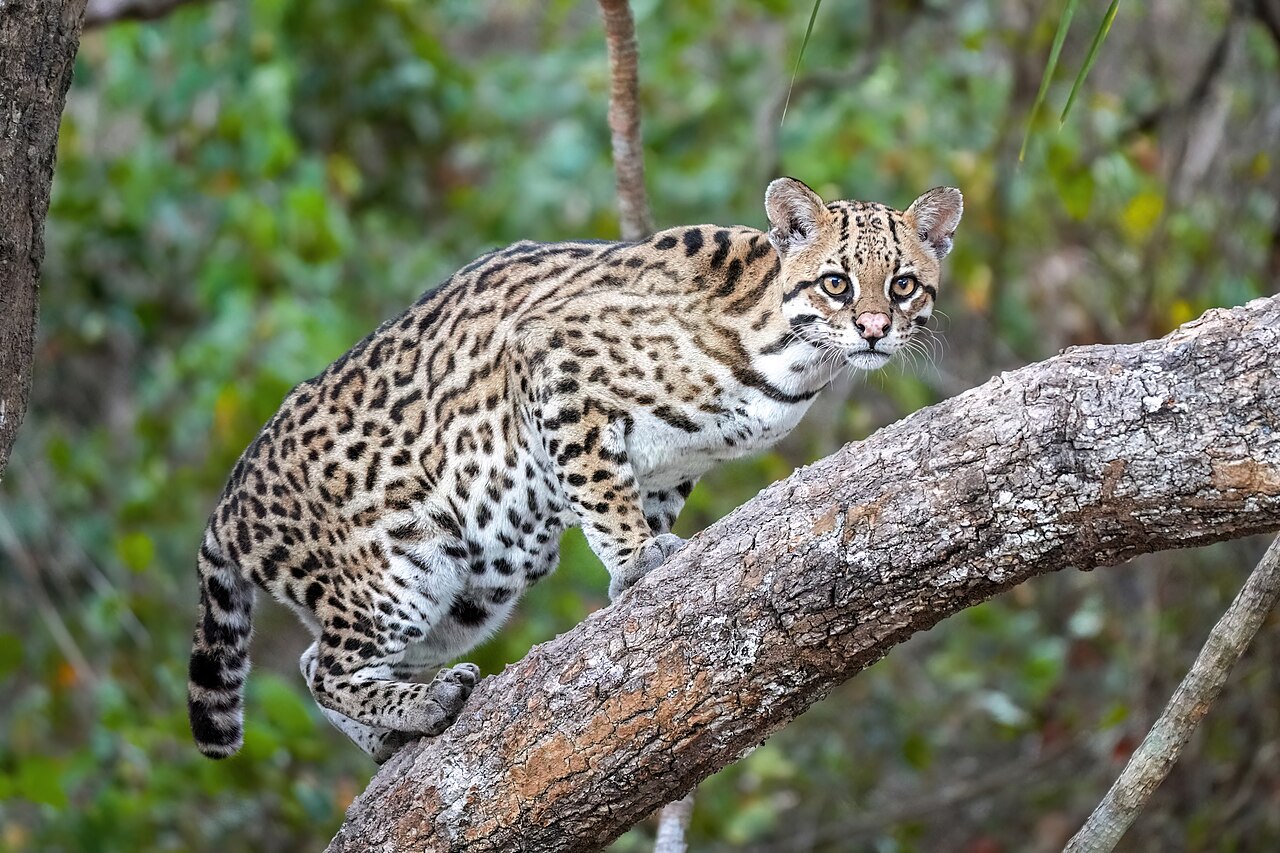

- Origin
- Central and South America
- Type
- Wild cat
- Height
- 40–50 cm (16–20 in)
- Weight
- 7–18 kg (15–40 lb)
- Coat
- Short, cream to tawny or gray, with black spots, bands and stripes
- Life span
- Up to 20 years in captivity
- Status
- Least Concern (IUCN)
The ocelot (Leopardus pardalis) is a medium-sized spotted wild cat native to the southwestern United States, Mexico, Central and South America and the islands of Trinidad and Margarita. It is the largest member of its genus. Linnaeus described it in 1758.
Range and habitat
Ocelots range from Texas and Arizona south to northern Argentina, up to 3,000 m (9,800 ft). They live in tropical forest, thorn forest, mangrove swamp and savanna, and prefer dense cover near water, well away from roads and settlements.
The species is listed as Least Concern because its range is so wide, and in 2013 the population was put at more than 40,000 adults. Many local populations are shrinking, though. Habitat is being cleared and broken up, and road deaths have become a major threat. In Texas only 50 to 80 animals were thought to remain in 2014. The fur trade took a heavy toll in the 1960s and 1970s, peaking at 140,000 skins traded in 1970, before bans cut it back; the ocelot was placed on CITES Appendix I in 1989.
Appearance
An ocelot stands 40 to 50 cm (16 to 20 in) at the shoulder. The head and body measure 55 to 100 cm (22 to 39 in) and the tail 30 to 45 cm (12 to 18 in). Females weigh 7 to 12 kg (15 to 26 lb) and males 8 to 18 kg (18 to 40 lb), about the size of a bobcat.
The short fur has solid black markings on a ground of cream, tawny, yellowish or gray. Spots on the head and legs are small, while the back, cheeks and flanks carry bands and stripes, and dark stripes run from the back of the neck to the tail. The neck and belly are white. The ears are round, each with a bright white spot on the back. No two ocelots have the same pattern.
Behavior
Ocelots are solitary and territorial, and active mostly at twilight and through the night. By day they rest in trees or in dens under large trees. They climb, leap and swim well. A male’s territory covers 3.5 to 46 square kilometers (1.4 to 17.8 sq mi) and takes in those of two or three females.
They hunt by following scent trails or by waiting in one spot for up to an hour, keeping to cover and avoiding open ground on moonlit nights. Most prey weighs under 1 kg (2.2 lb): rodents, rabbits, opossums and armadillos, as well as fish, crabs, insects, reptiles and birds. An ocelot needs 600 to 800 g (21 to 28 oz) of food a day.
Ocelots can breed at any time of year. After two to three months the female gives birth to one to three kittens in a den in thick vegetation. The kittens open their eyes at 15 to 18 days, begin leaving the den at three months and stay with their mother for up to two years. Both sexes mature at about two years.
Facts on this page were checked against Wikipedia and may have changed since.