Jaguarundi

- Origin
- Central and South America
- Type
- Wild cat
- Height
- About 36 cm (14 in)
- Weight
- 3.5–7 kg (7.7–15.4 lb)
- Coat
- Short and unpatterned
- Colors
- Gray (blackish to brownish gray) or red (foxy red to chestnut)
- Life span
- Up to 15 years in captivity
- Status
- Near Threatened (IUCN)
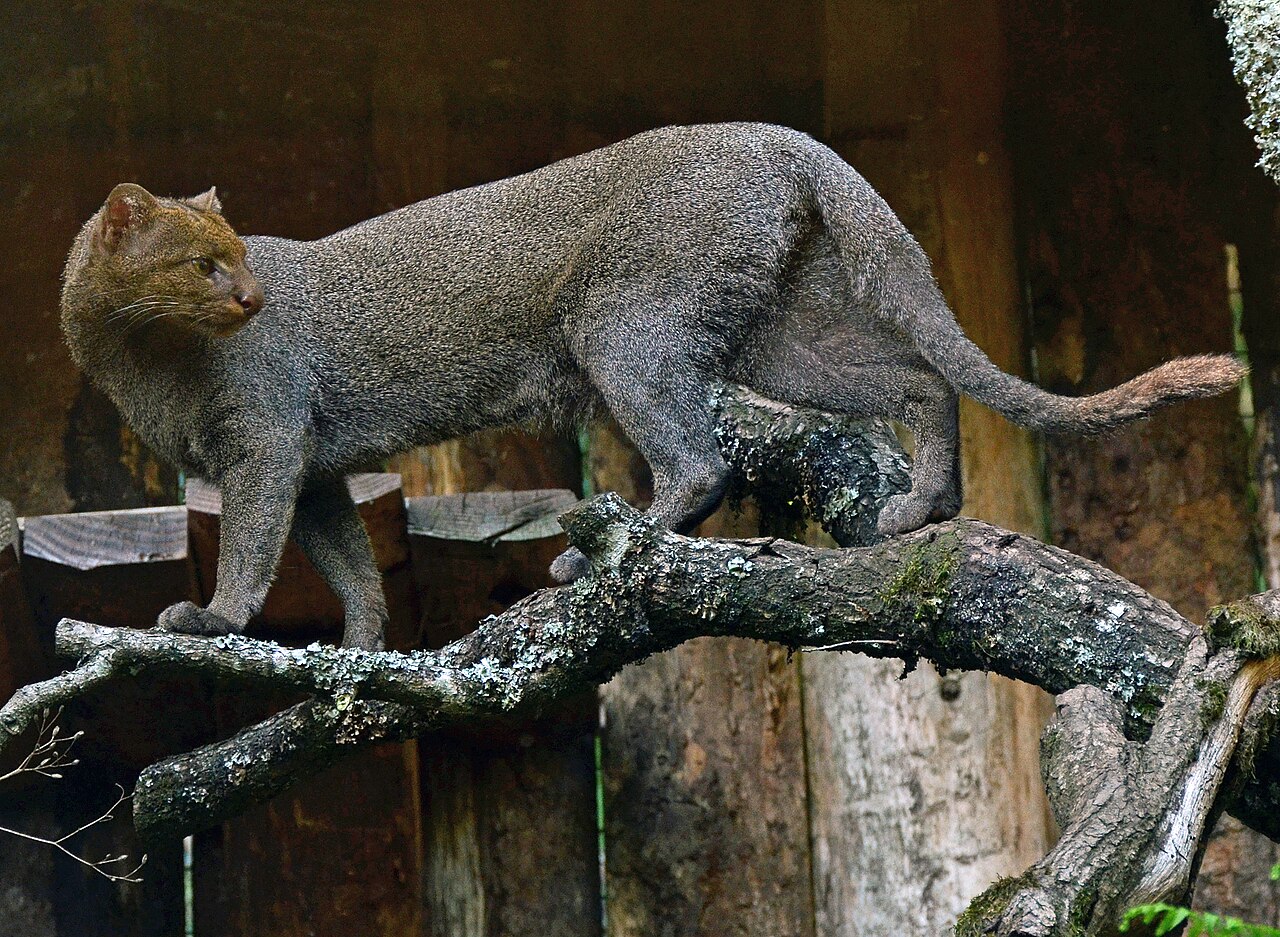
The jaguarundi (Herpailurus yagouaroundi) is a wild cat of the Americas. With its long body, short legs, small flat head and long tail it looks more like a weasel than a typical cat. Its closest relative is the cougar, and the two together are the nearest kin of the cheetah. The name comes from an Old Guarani word meaning “dark jaguar”.
Range and habitat
The jaguarundi ranges from northern Mexico through Central America and across South America east of the Andes as far as central Argentina. Among cats of the Americas, only the cougar is spread over more latitude. It is fairly common in Brazil, Peru and Venezuela. It used to live in the Lower Rio Grande Valley of south Texas; the last specimen collected in the United States was found dead on a road near Brownsville in 1986, and the species is now thought to be gone from the country.
It uses a wide range of country: tropical rainforest, deciduous forest, cloud forest, mangroves, savanna, thorn scrub and desert. Unlike the ocelot and margay it will live in open land, as long as there is dense cover, and it tends to stay near running water. It is mostly found from the lowlands up to 2,000 m (6,600 ft).
Appearance
A jaguarundi is about twice the size of a house cat. Head and body measure 53–77 cm (21–30 in) and the strong tail another 31–52 cm (12–20 in). Most weigh 3.5–7 kg (7.7–15.4 lb), with males a little larger than females; animals of about 9 kg (20 lb) have been reported.
The coat is one plain color, with at most faint marks on the face and belly. There are two forms: gray, from blackish to brownish gray and grizzled because each hair is ringed light and dark, and red, from foxy red to chestnut. Both can be born in the same litter, and the red form is seen more often in dry, open country. Kittens are spotted for a short time. The ears are small, round and set wide apart.
Behavior
The jaguarundi is shy and wary, and lives alone or in pairs. It is more active by day than most cats, hunting chiefly in daylight and evening hours. It climbs and swims well but hunts mostly on the ground, and can jump 2 m (6 ft 7 in) into the air after birds. Its prey is usually under 1 kg (2.2 lb): rodents and other small mammals above all, then ground-feeding birds, reptiles, frogs and insects, and now and then poultry, rabbits or opossums. Home ranges are large and the cats are thinly spread.
It has a broad range of calls. Thirteen have been recorded, among them purring, whistling, chattering, yapping and a bird-like chirp.
Mating takes place all year, with peaks that differ by region. After 70 to 75 days the female gives birth to one to four kittens in a den.
Threats
Numbers are falling in many parts of the range because habitat is being lost and broken up, and because the cats are killed for taking poultry.
Facts on this page were checked against Wikipedia and may have changed since.