Eurasian Lynx

- Origin
- Europe and Asia
- Type
- Wild cat
- Height
- 55–75 cm (22–30 in)
- Weight
- 7–32 kg (15–71 lb)
- Coat
- Short in summer, much thicker in winter
- Colors
- Reddish or brown with black spots; silver-gray to grayish brown in winter
- Life span
- Up to 21 years in captivity
- Status
- Least Concern (IUCN)
The Eurasian lynx (Lynx lynx) is a medium-sized wild cat and the biggest of the four living lynx species. It ranges from northern, central and eastern Europe through Central Asia and Siberia to the Tibetan Plateau and the Himalayas.
Range and habitat
This lynx lives in temperate and boreal forest up to 5,500 m (18,000 ft), and also in rocky steppe and mountain forest, wherever rough ground gives it cover for hiding and stalking. In the mountains it moves down to lower ground in winter, following its prey. Its feet are built for snow, but it cannot live where loose snow lies deeper than about 100 cm (39 in). It once lived across most of continental Europe. Persecution cleared it from the western and southern lowlands by the early 19th century, and by the 1950s it was gone from most of western and central Europe, where only scattered populations remain. In Scandinavia it came close to extinction in the 1930s and has slowly recovered since; Finland’s population has grown every year since 1991.
Appearance
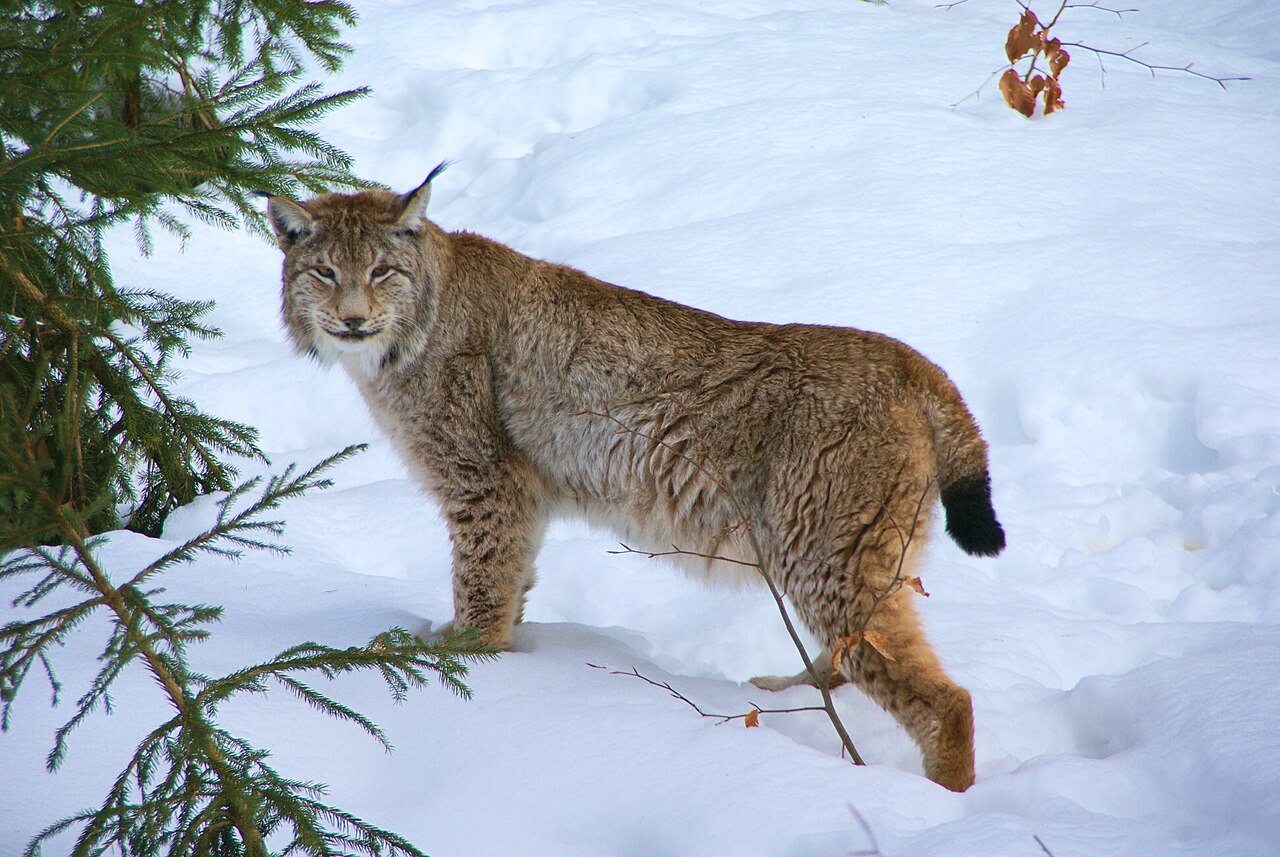
The summer coat is fairly short, reddish or brown, with black spots that vary a great deal in number and pattern; lynx in the south of the range are brighter and more heavily spotted. The winter coat is far thicker and silver-gray to grayish brown. The belly, neck and chin are whitish.
The legs are long and strong, and the big, webbed, furry paws work like snowshoes. The tail is short with a solid black tip, the ears end in black tufts, and a long gray-and-white ruff frames the face.
Males are 76–106 cm (30–42 in) long in the body and females 73–99 cm (29–39 in), standing 55–75 cm (22–30 in) at the shoulder. In Russia lynx weigh 12–32 kg (26–71 lb); those in Scandinavia and farther west are smaller, at 7–26 kg (15–57 lb).
Behavior
Adults live alone and are active mostly at night and at dusk and dawn, sleeping through the day in thick cover. A hunting range can cover anything from 20 to 450 km² (8 to 174 sq mi), and a lynx may walk up to 20 km (12 mi) in a night. Outside the mating season it is so quiet and secretive that it can live in an area unnoticed for years.
It hunts by ambush and by stalking, often scanning from a rock or fallen tree. It is the only lynx that prefers hoofed prey such as roe deer, chamois and reindeer, and it also takes hares, rodents, foxes and birds.
Mating takes place between January and April. After 67 to 74 days the female gives birth in a hidden den, usually to two kittens, which stay with her until they are about ten months old.
Threats and conservation
Despite its wide range, the lynx is threatened by habitat loss and fragmentation, poaching and the loss of its prey. It is protected under CITES Appendix II and the Berne Convention, and hunting it is illegal in many of the countries where it lives.
Facts on this page were checked against Wikipedia and may have changed since.