Bay Cat
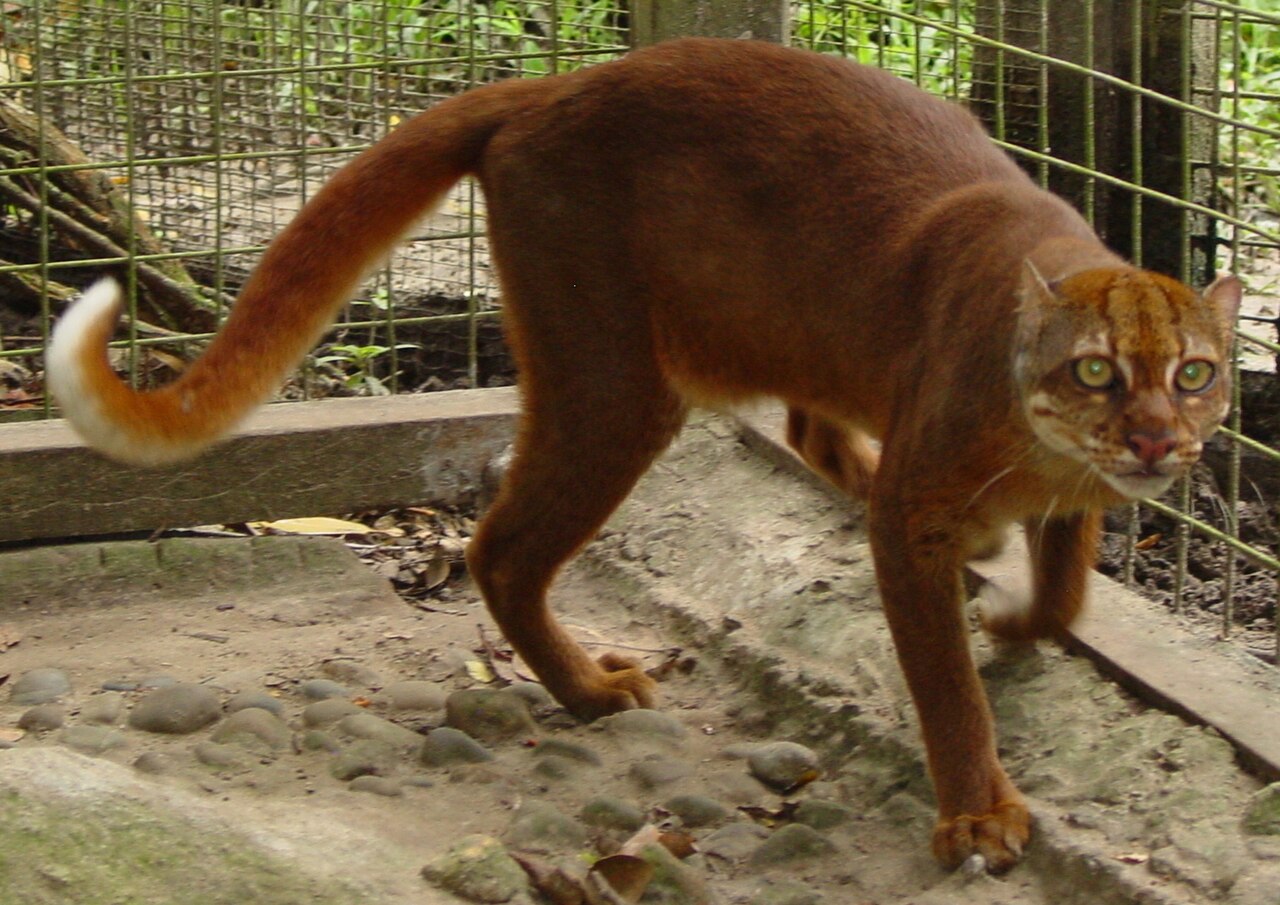

- Origin
- Borneo
- Type
- Wild cat
- Weight
- 3–4 kg (6.6–8.8 lb)
- Coat
- Short, bright chestnut, paler underneath
- Colors
- Chestnut red with a gray-brown head and a white streak under the tail
- Status
- Endangered (IUCN)
The bay cat (Catopuma badia), also called the Bornean bay cat, is a small wild cat that lives only on the island of Borneo. It is seen far less often than the other wild cats that share its forests, and seems to be thinly spread even where the habitat is untouched. Fewer than 2,500 adults are thought to exist, and the species has been listed as Endangered on the IUCN Red List since 2002.
Range and habitat
The first known specimen was a skin and skull collected by Alfred Russel Wallace in Sarawak in 1856 and described in 1874. For a long time it was taken for a young Asian golden cat. Only seven skins turned up in the 19th century, and no living animal reached scientists until 1992, when a dying female was brought to the Sarawak Museum. Samples from her confirmed that the bay cat is a close relative of the Asian golden cat.
Since then camera traps have recorded bay cats in Sarawak, Sabah and Kalimantan, but not in Brunei. It is a cat of dense tropical forest: swamp forest, lowland and hill forest, and forest along rivers. Most records come from below about 1,000 m (3,300 ft), and many from near water. Surveys in Sabah found it in the undisturbed core of forest reserves and never in plantations. One survey of more than 7,200 camera-trap days found the cat at only eight of 74 sites.
Appearance
The coat is bright chestnut, paler on the belly, with the legs and tail a little lighter and redder. The head is short and rounded and dark gray-brown, with two dark stripes running from the corner of each eye and a dark M-shaped mark on the back of the head. The chin is white, and the rounded ears are dark on the back with no white spot. The long, tapering tail has a white streak along the rear half of its underside, widening toward the tip, which carries a small black spot.
Only twelve specimens were measured between 1874 and 2004. Their head and body ran from 49.5 to 67 cm (19.5–26.4 in), with a tail of 30 to 40.3 cm (11.8–15.9 in). Adult weight is estimated at 3 to 4 kg, though too few living animals have been handled to be sure.
Behavior
Very little is known. Camera-trap records from Sabah and Sarawak show bay cats moving about by day, with peaks in the morning and early afternoon. Nothing has been recorded of what they eat or how they breed.
Threats and conservation
The bay cat depends on forest, and Borneo has one of the highest rates of deforestation in the world: forest covered nearly three-quarters of the island in the mid-1980s and 52 percent by 2005. Logging and conversion to oil palm are the main threats, and cats have also been trapped for the skin and pet trade. The species is on CITES Appendix II, and hunting and trade are banned in Kalimantan, Sabah and Sarawak.
Facts on this page were checked against Wikipedia and may have changed since.