Rusty-spotted Cat
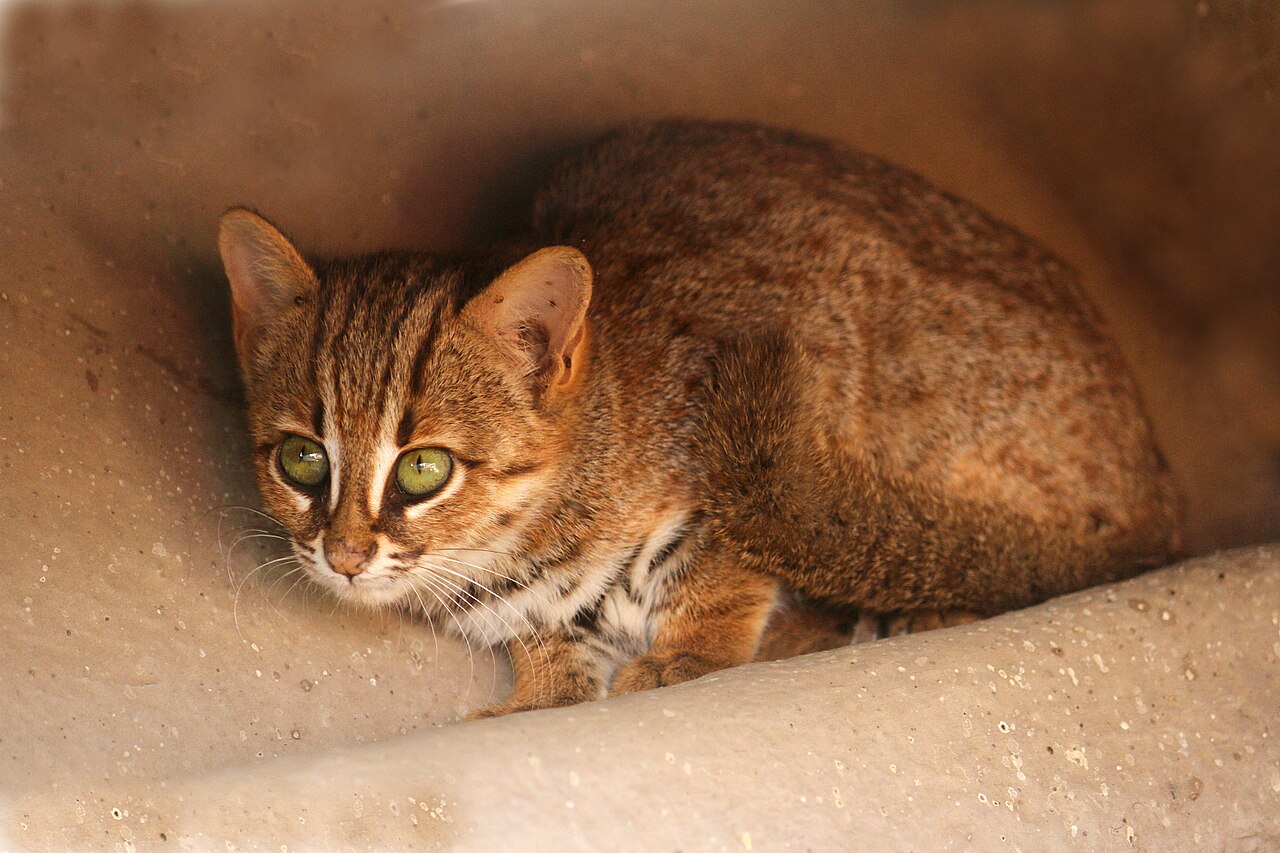

- Origin
- South Asia
- Type
- Wild cat
- Weight
- 0.9–1.6 kg (2.0–3.5 lb)
- Coat
- Short, with a bushy tail
- Colors
- Reddish gray with rusty spots; whitish underparts
- Life span
- Up to 12 years in captivity
- Status
- Near Threatened (IUCN)
The rusty-spotted cat (Prionailurus rubiginosus) is one of the smallest members of the cat family. It is the smallest wild cat in Asia and rivals the black-footed cat as the smallest in the world. It lives in India, Nepal and Sri Lanka, and has been listed as Near Threatened since 2016 because its main habitat, deciduous forest, is being lost.
Range and habitat
The species lives mainly in moist and dry deciduous forest, scrub and grassland, and prefers dense vegetation and rocky ground. It seems to be absent from evergreen forest.
In India it was long believed to live only in the south, but records now cover much of the country, including Gir National Park in Gujarat, reserves in Maharashtra, the Eastern Ghats, the Terai and Haryana. In western Maharashtra it breeds in farmland where rodents are plentiful. It was first photographed in Nepal in 2012, in Bardia National Park. Sri Lanka has two separate populations, one in the dry zone and one in the wet zone, and in 2016 the cat was recorded there above 2,000 m (6,600 ft) in Horton Plains National Park.
Appearance
The body is 35 to 48 cm (14 to 19 in) long, with a bushy tail of 15 to 30 cm (5.9 to 11.8 in), about half the body’s length.
The short fur is reddish gray over most of the body, with rusty spots on the back and sides. Four blackish lines run over the eyes, two of them continuing onto the neck, and six dark streaks mark each side of the head. The chin, throat, belly and insides of the legs are whitish with tiny brown spots, and a rusty band crosses the chest. The paws and tail are plain reddish gray.
Behavior
Very little is known about how the cat lives in the wild. Captive animals are mostly active at night, with short spells of activity by day, and most wild sightings have also been after dark. It eats mainly rodents and birds, along with lizards, frogs and insects, and hunts mostly on the ground with quick, darting movements. It appears to climb trees to get away from larger predators, and individuals have been seen hiding in trees and caves.
The female is in heat for five days. She makes a den in a hidden spot and, after 65 to 70 days, has one or two kittens. Newborns weigh only 60 to 77 g (2.1 to 2.7 oz) and are marked with rows of black spots; the rusty blotches come with age. They are sexually mature at about 68 weeks.
Threats and conservation
Habitat loss and the spread of farming are the main problems in both India and Sri Lanka. The cat does turn up in cultivated and settled areas, but nobody knows how well it can last there. Skins are sometimes found in trade, and in some places it is hunted for food or as a pest of livestock. Hunting and trade are banned in India and Sri Lanka.
Facts on this page were checked against Wikipedia and may have changed since.