Oncilla

- Origin
- Central and South America
- Type
- Wild cat
- Weight
- 1.5–3 kg (3.3–6.6 lb)
- Coat
- Thick and soft
- Colors
- Light brown to dark ocher with dark, open rosettes
- Life span
- About 11 years in the wild; up to 17 in captivity
- Status
- Vulnerable (IUCN)
The oncilla (Leopardus tigrinus), also called the northern tiger cat, little spotted cat or tigrillo, is a small spotted wild cat that ranges from Central America to central Brazil. It is listed as Vulnerable on the IUCN Red List.
What counts as an oncilla has narrowed in recent years. Populations in southern Brazil, Paraguay and Argentina were split off in 2013 as the southern tiger cat, after genetic work showed they do not interbreed with oncillas of northeastern Brazil. Proposals since then separate an eastern tiger cat and, in the Andean cloud forests, a clouded tiger cat, and a 2026 genetic study counted five species in the group.
Range and habitat
The oncilla occurs in Costa Rica and Panama, isolated from the rest of the range, and across the Amazon basin to central Brazil. It has been recorded in Costa Rican cloud forest, in the northern Andes at 1,500 to 3,000 m (4,900–9,800 ft) and higher still in Colombia, and in the dry Cerrado and Caatinga of northern Brazil.
Appearance
The oncilla looks like a small margay or ocelot, with a slimmer build and a narrower muzzle. Head and body measure 38 to 59 cm (15–23 in) and the tail 20 to 42 cm (7.9–16.5 in). That is a little longer than an average house cat, but the oncilla is usually lighter.
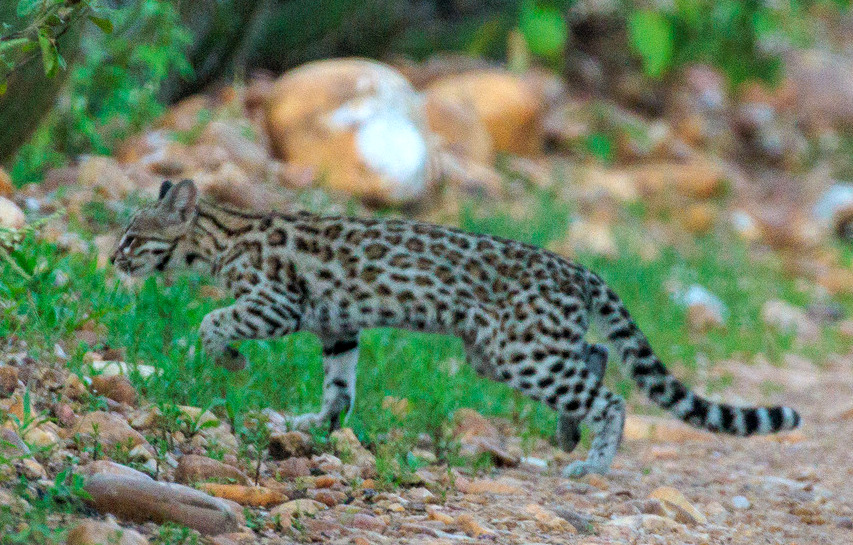
The fur is thick and soft, light brown to dark ocher, with many dark rosettes on the back and sides. The rosettes are black or brown, irregular and open in the middle. The belly is pale with dark spots, the tail is ringed, and the backs of the ears are black with a bold white spot. The pattern hides the cat in the dappled light of the forest understory.
Behavior
The oncilla lives mainly on the ground but climbs well. It hunts rodents, lizards, birds and their eggs, invertebrates and the occasional tree frog, stalking from a distance and then pouncing. Most oncillas are nocturnal, but in the Brazilian Caatinga, where day-active lizards are the main food, they hunt by day.
Females bear one to three kittens after 74 to 76 days. The eyes open after 8 to 17 days, late for so small a cat. Kittens start solid food at 38 to 56 days and are weaned by three months. Oncillas mature at around two to two and a half years.
Threats and conservation
Deforestation and poaching are the main threats. The pelts are highly valued, and reports from the 1970s and 1980s ranked the oncilla among the four most heavily hunted small cats in South America. Settlement and coffee growing, which is often established in cloud forest, take further habitat. The oncilla hybridizes with Geoffroy’s cat in the south of its range and with the Pampas cat in central Brazil; whether this harms the species is unknown.
The oncilla is on CITES Appendix I, which bans international commercial trade. Hunting is still permitted in Ecuador, Guyana, Nicaragua and Peru.
Facts on this page were checked against Wikipedia and may have changed since.