Wildcat
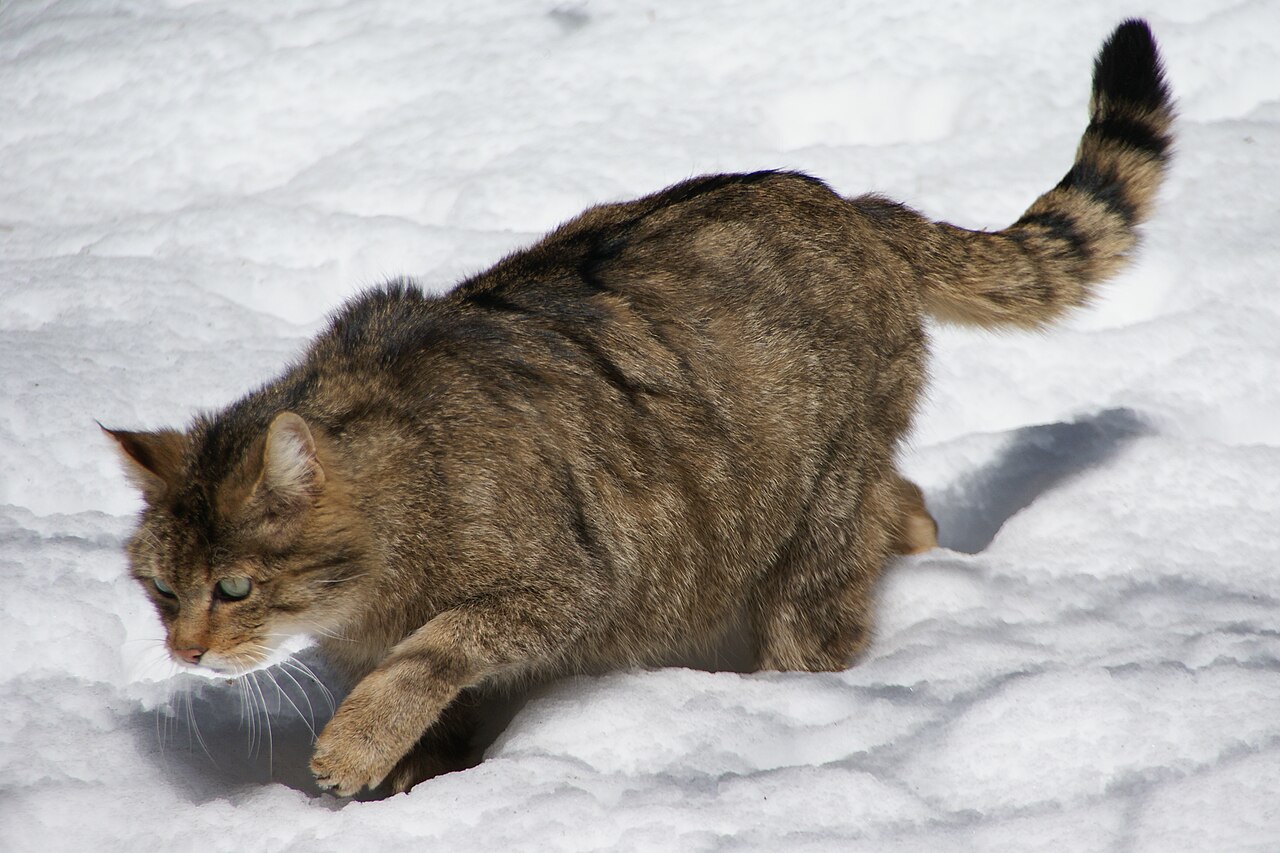

- Type
- Wild cat
- Weight
- 3–8 kg (6.6–18 lb)
- Coat
- Long with a bushy tail in the European wildcat; short in the African wildcat
- Colors
- Striped; sandy gray and faintly striped in the African wildcat, spotted in the Asiatic wildcat
- Life span
- Usually 13–14 years; up to 21
- Status
- Least Concern (IUCN)
The wildcat is not one species but two close relatives: the European wildcat (Felis silvestris) and the African wildcat (Felis lybica). Both are small wild cats, a little larger than a house cat. The African wildcat is the direct ancestor of the domestic cat.
Range and habitat
The European wildcat lives in broadleaf and mixed forests in Europe, Turkey and the Caucasus, and reaches 2,250 m in the Pyrenees. Heavy hunting between the late 17th and mid 20th centuries broke its range into fragments. Sicily is the only Mediterranean island with native wildcats.
The African wildcat uses almost every kind of country except rainforest. It is found through the savannas of Africa from Mauritania to the Horn, in small numbers in the deserts, around the edge of the Arabian Peninsula to the Caspian Sea, and across Central Asia into western India, Xinjiang and southern Mongolia.
Appearance
The European wildcat has long fur and a bushy tail with a rounded tip, longer legs than a house cat and a sturdier build. The African wildcat is smaller and more faintly striped, with short sandy-gray fur and a tapering tail. Its Asian form, the Asiatic wildcat, is spotted.
Wildcats have pointed ears, white whiskers and large eyes with yellowish-green irises. Males measure 43 to 91 cm (17 to 36 in) in head and body length, with a tail of 23 to 40 cm, and usually weigh 5 to 8 kg. Females are a little smaller, at 3 to 5 kg. The largest animals live in the cold north of the range.
Behavior
Both species are mostly nocturnal and live alone, apart from the breeding season and mothers with young. They spend the day in a hollow tree, a rock crevice, a thicket or another animal’s abandoned burrow. Territories are marked with urine, droppings, scent from the paws and scratches on trees.
Wildcats hunt by sight and hearing, lying in wait and then catching prey in a few bounds. The European wildcat eats mainly rabbits and rodents, along with birds. The African wildcat lives chiefly on mice and rats, with some birds, small reptiles and invertebrates.
Pregnancy lasts 60 to 68 days, and litters number one to seven kittens, usually born in April or May. Kittens start hunting with their mother at about 60 days, and the family breaks up after roughly five months.
Threats and conservation
The wildcat has been rated Least Concern since 2002, with a stable population of more than 20,000 adults. The chief threat is interbreeding with domestic cats. Road deaths are a problem in Europe, and in Scotland the population has fallen since the early 20th century through habitat loss and persecution. Wildcats are protected in most countries where they live and listed on CITES Appendix II.
The wildcat and people
African wildcats seem to have drawn close to people when the first farmers’ grain stores attracted rodents. A wildcat skeleton in a 9,500-year-old grave in Cyprus is the earliest sign of that bond, and domestication probably began in the Fertile Crescent. In Scotland the wildcat has appeared in clan heraldry since the 13th century.
Facts on this page were checked against Wikipedia and may have changed since.