Andean Mountain Cat

- Origin
- Andes
- Type
- Wild cat
- Height
- About 36 cm (14 in)
- Weight
- Up to 5.5 kg (12 lb)
- Coat
- Long, thick fur with a long, bushy ringed tail
- Colors
- Ashy gray with yellowish-brown blotches and dark rings
- Status
- Endangered (IUCN)
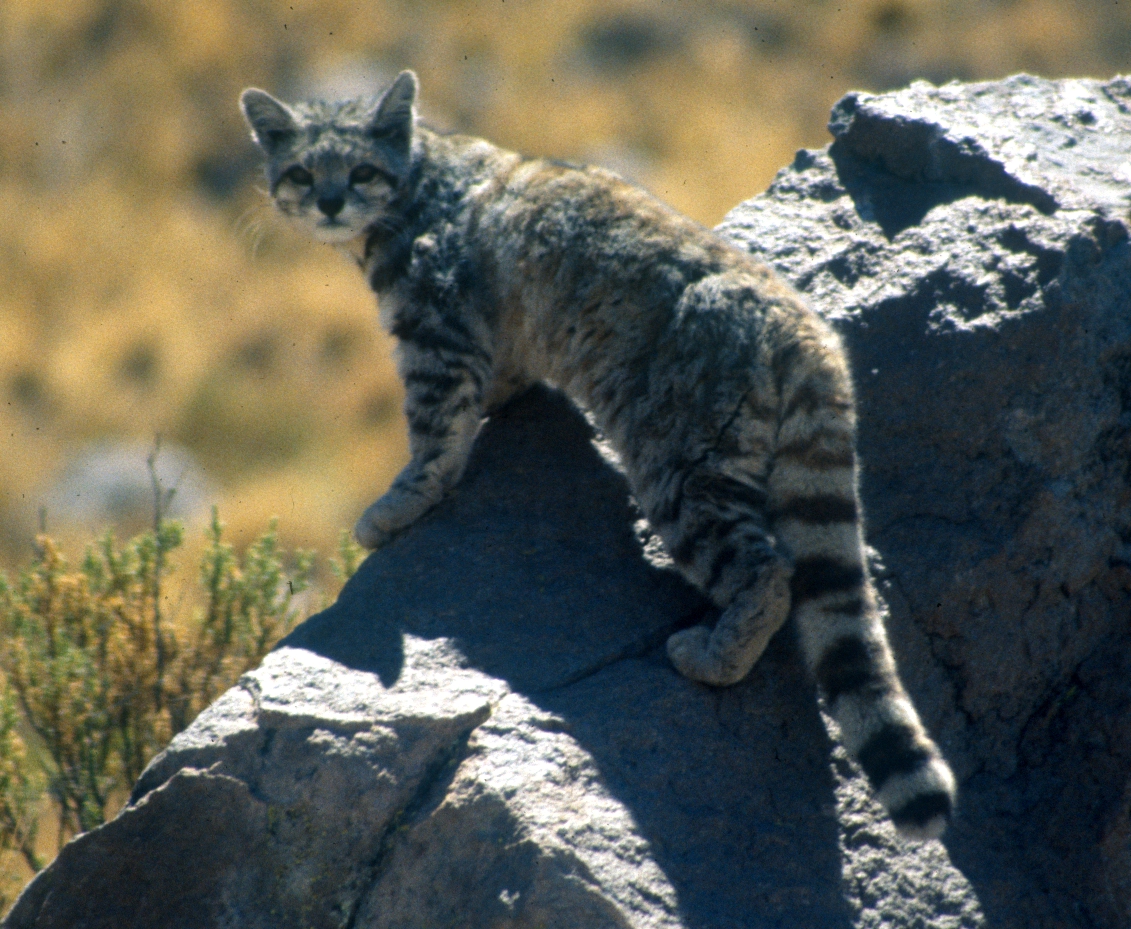
The Andean mountain cat (Leopardus jacobita) is a small wild cat that lives only high in the Andes of South America. It is listed as Endangered on the IUCN Red List, with fewer than 1,500 animals believed to survive in the wild. The species was first described by Emilio Cornalia, who named it after Jacobita Mantegazza, and it has no subspecies.
Range and habitat
The cat is found only at high elevations: from about 1,800 m (5,900 ft) in the southern Andes of Argentina to more than 4,000 m (13,000 ft) in Chile, Bolivia and central Peru. The country it lives in is dry, rocky, steep and thinly vegetated. Deep valleys break its habitat into separate pieces, and its main prey, the mountain viscacha, lives in scattered colonies, so the cats are thinly spread. One survey in Jujuy Province in northwestern Argentina found seven to twelve cats per 100 km² (39 sq mi) at around 4,200 m (13,800 ft). Genetic diversity across the range is very low.
Appearance
The fur is ashy gray, with a gray head and rounded ears. The nose and lips are black and surrounded by white, and two dark brown lines run from the corners of the eyes across the cheeks. The forelegs carry black spots, the flanks yellowish-brown blotches, and the hind legs up to two narrow dark rings. The tail is long and bushy with six to nine dark brown or black rings. Hair on the back and tail reaches 40–45 mm (1.6–1.8 in), and the pads of the feet are covered with hair.
Adults measure 57.7–85 cm (22.7–33.5 in) in head and body, with a tail of 41.3–48.5 cm (16.3–19.1 in), and stand about 36 cm (14 in) at the shoulder. The species looks much like the pampas cat, which shares its range, and the two are easily confused in the field. That makes population counts hard to get right.
Behavior
Mountain viscachas make up most of what the Andean mountain cat eats, about 94 percent of its diet by weight in one study. It also takes small reptiles, birds and other small mammals such as tuco-tucos. It shares its range with the pampas cat and the cougar. In one study both the Andean mountain cat and the pampas cat were seen most often on moonless nights.
Little is known about breeding. From local people’s sightings of pairs and litters, mating is thought to take place in July and August and may run as late as November or December. A litter is usually one or two kittens, born in spring or summer.
Threats and conservation
Habitat loss and degradation, hunting and disease all threaten the species. It is listed on CITES Appendix I and protected in every country where it lives. The Andean Cat Alliance was set up in 2003 by representatives from Argentina, Bolivia, Peru and Chile to support research and conservation. The Aymara and Quechua peoples traditionally regard the cat as a sacred animal.
Facts on this page were checked against Wikipedia and may have changed since.