Sand Cat

- Origin
- North Africa and Southwest and Central Asia
- Type
- Wild cat
- Height
- 24–36 cm (9.4–14.2 in)
- Weight
- 1.5–3.4 kg (3.3–7.5 lb)
- Coat
- Dense; long and thick in winter in Central Asia; furred soles
- Colors
- Pale sandy to light gray, with dark bars on the legs and a black-tipped tail
- Life span
- Up to 13 years in captivity
- Status
- Least Concern (IUCN)
The sand cat (Felis margarita) is a small wild cat of true desert. It lives in sandy and stony country far from water, where its pale coat hides it well. Science first learned of it from an animal found in the Algerian Sahara and described in 1858.
Range and habitat
Sand cats are spread widely but patchily through the deserts of North Africa, the Arabian Peninsula, the Middle East and Central Asia, where one was first recorded in the Karakum Desert in 1925. They prefer flat or gently rolling ground with a thin cover of grass or small bushes and avoid bare, shifting dunes, which hold little prey.
Appearance
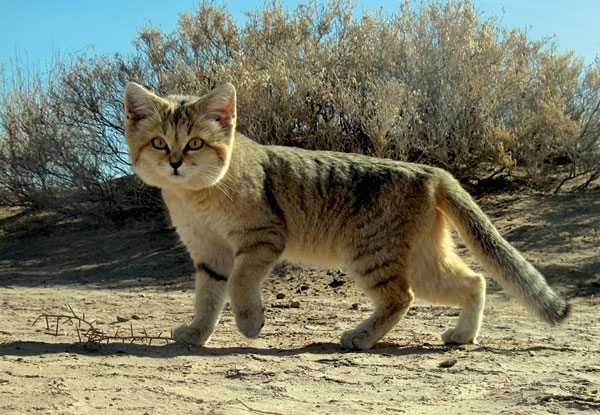
The fur is a pale sandy color, lighter on the face, throat and belly. A faint reddish line runs from the corner of each eye across the cheek, the legs carry dark bars, and the tail ends in a black tip after two or three dark rings. Some cats are plain, others faintly spotted or striped.
The head is wide and flat, with ears 5–7 cm (2.0–2.8 in) long set low on the sides. The ear canal is about twice the size of a domestic cat’s, and its hearing is keener, which helps it find prey moving underground. The eyes are large and greenish yellow.
Thick fur covers the soles of the paws and cushions the pads against burning or freezing sand. It also blurs the cat’s tracks, making them hard to follow.
The sand cat has short legs and a fairly long tail of 23–31 cm (9.1–12.2 in). Its head and body measure 39–52 cm (15–20 in), it stands 24–36 cm (9.4–14.2 in) at the shoulder and weighs 1.5–3.4 kg (3.3–7.5 lb).
Behavior
Sand cats live alone except when mating or raising kittens. They spend the day in burrows about 1.5 m (5 ft) deep, often ones left by foxes, porcupines or rodents, and come out at night to hunt. Radio-collared cats in Israel covered an average of 5.4 km (3.4 mi) a night. They move low to the ground at a fast run broken by leaps, and can sprint at 30–40 km/h (19–25 mph).
They eat mainly small rodents, along with young hares, birds, lizards and venomous vipers, and bury what they cannot finish. Prey gives them the moisture they need, though they drink when water is at hand.
After a pregnancy of 59 to 66 days the female has two or three kittens, which are independent by the end of their first year.
Threats and conservation
The species was moved from Near Threatened to Least Concern in 2016 because of its wide range and large population, though how fast it is declining is unknown. Its habitat is being degraded by settlement, grazing and the loss of desert vegetation. Sand cats are also caught in traps set for foxes and jackals, killed by dogs, tangled in reserve fences and taken for the pet trade. It is listed on CITES Appendix II, and hunting is banned in several countries.
Facts on this page were checked against Wikipedia and may have changed since.