Asian Golden Cat

- Origin
- Southeast Asia
- Type
- Wild cat
- Height
- About 56 cm (22 in)
- Weight
- 9–16 kg (20–35 lb)
- Coat
- Plain in most forms; one form has large rosettes
- Colors
- Golden, reddish, cinnamon, brown, gray or black
- Life span
- Up to 20 years in captivity
- Status
- Vulnerable (IUCN)
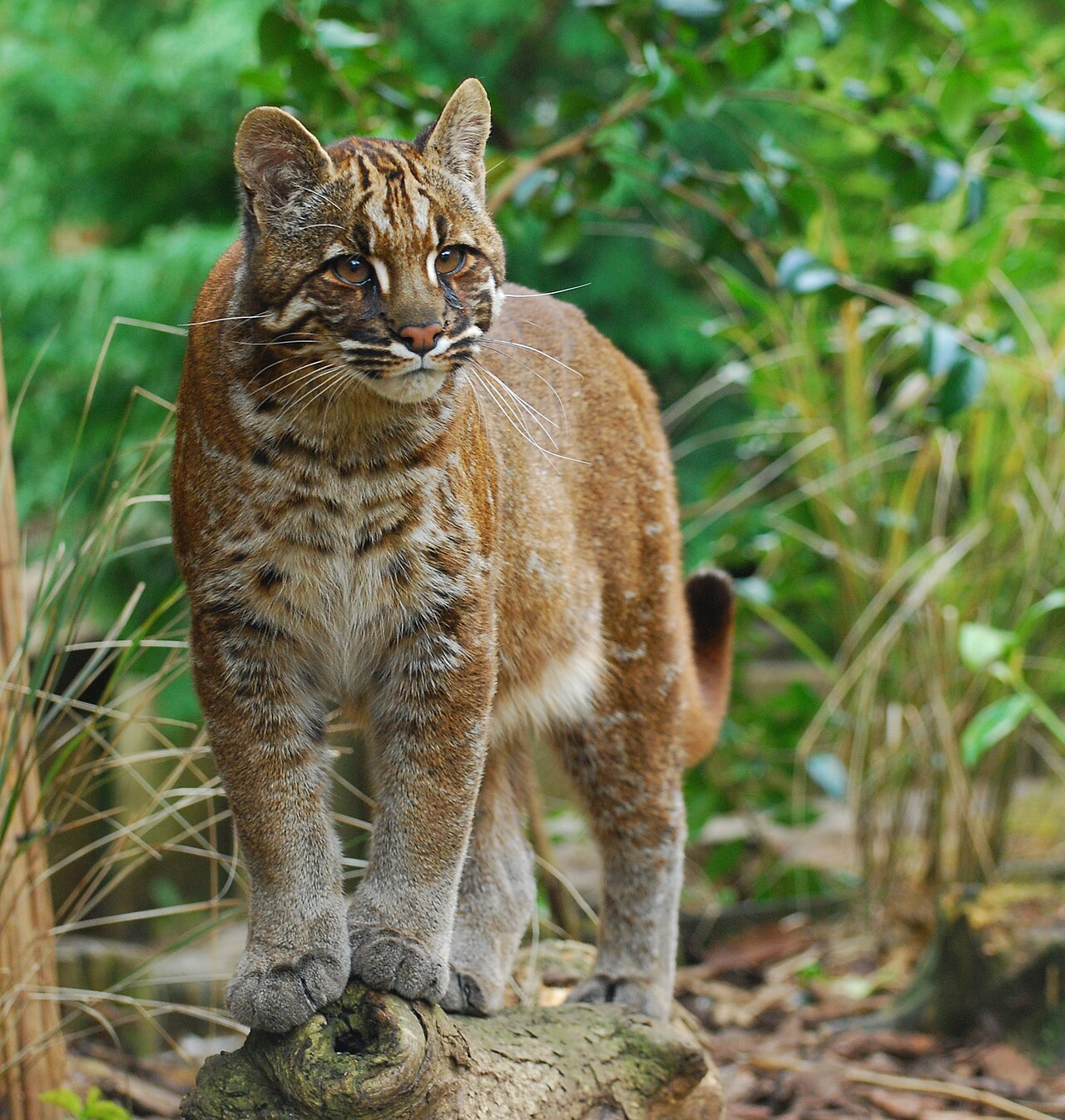
The Asian golden cat (Catopuma temminckii) is a medium-sized wild cat of South and Southeast Asia. Its nearest relatives are the bay cat of Borneo and the marbled cat. Two subspecies are recognised, one in Sumatra and the Malay Peninsula and one from Nepal east across mainland Southeast Asia.
Range and habitat
The species ranges from eastern Nepal, northeastern India and Bhutan through Bangladesh, Myanmar, Thailand, Cambodia, Laos and Vietnam to southern China, Malaysia and Sumatra. It prefers forest broken by rocky areas, and lives in dry deciduous forest, subtropical evergreen forest and tropical rainforest. It has also been recorded in grassland, shrubland, plantations and mountain country. It has been found as low as 11 m (36 ft) above sea level on the coast of Myanmar and as high as 4,600 m (15,100 ft) in Bhutan. It is rarely met in small forest fragments or near forest edges.
Appearance
Two or three times the weight of a house cat, the Asian golden cat measures 66 to 105 cm (26 to 41 in) in head and body, with a tail of 40 to 57 cm (16 to 22 in). Males are larger than females.
Its color is unusually variable. Golden, reddish-brown, cinnamon, brown, gray and black animals all occur, along with a form marked with large rosettes like an ocelot. Cats on the mainland show the full variety, while those south of the Isthmus of Kra are mostly reddish. Whatever the body color, the face carries white stripes edged in dark brown or black across the cheeks, beside the eyes and over the crown. The ears are rounded, black on the back with a gray spot. The chest, belly and insides of the legs are pale, and the tail is white underneath.
Behavior
The Asian golden cat is solitary and holds a territory. It was once thought to be mainly nocturnal, but tracking and camera studies show a flexible pattern, with activity by day, at dusk and dawn, and at night. One collared male used about 47.7 km² (18.4 sq mi) and a female about 32.6 km² (12.6 sq mi).
It lives mostly on the ground but can climb when it needs to. Its prey is thought to include birds, hares, rodents, reptiles and small hoofed animals such as muntjacs, chevrotains and young sambar deer, and it sometimes takes livestock.
In captivity, females give birth to one to three kittens after 78 to 80 days. The kittens are born with the adult coat pattern and open their eyes after six to twelve days.
Threats
The species has been listed as Vulnerable again since 2025, with an estimated 7,000 mature animals. The main threats are the loss and breaking up of forest, which is being cleared faster in Southeast Asia than anywhere else, and poaching for the wildlife trade, in which its skin and bones are sold as substitutes for tiger parts.
Facts on this page were checked against Wikipedia and may have changed since.