Asiatic Wildcat

- Origin
- Central Asia
- Type
- Wild cat
- Weight
- 3–4 kg (6.6–8.8 lb)
- Coat
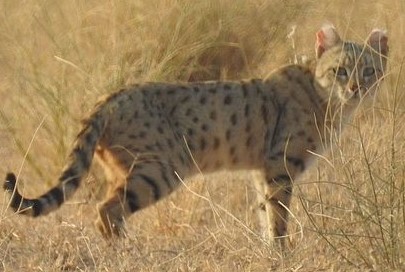
- Short, pale sandy with small, solid dark spots
- Status
- CITES Appendix II; populations thought to be declining
The Asiatic wildcat (Felis lybica ornata), also called the Indian desert cat, is a subspecies of the African wildcat. It lives from the eastern shore of the Caspian Sea north to Kazakhstan and east into western India, western China and southern Mongolia. No overall count of its numbers exists, but they are believed to be falling.
Range and habitat
In the Caucasus the Asiatic wildcat meets the European wildcat: the European animal keeps to mountain forest, and the Asiatic one to the low desert and semi-desert near the Caspian. It usually stays close to water but can live all year in waterless desert, and it climbs to 2,000 to 3,000 m (6,600 to 9,800 ft) in mountains with enough dense cover. In the north, deep winter snow sets the limit of its range.
In India it lives in the scrub of the Thar Desert, where it was still reported as common in parts of Rajasthan in 1999 but was seen only four times between then and 2006. In China’s Xinjiang region it was once the most abundant cat and is now confined to three areas in the south, after heavy hunting for its pelt and the loss of habitat to farming and oil and gas exploration.
Appearance
The coat is light and sandy, with small, round, solid spots on the upper body that do not form clusters. Color and pattern vary widely: paler cats live in dry country, and darker, more heavily marked ones in wetter, wooded areas. In Pakistan and India the spots tend to fall in vertical lines down the sides, and in Central Asia the ground color is more grayish-yellow or reddish and the spots sometimes merge into stripes.
A darker band usually runs along the spine, the thighs are clearly striped and the underside is whitish. The forehead carries four black bands, and a thin dark stripe runs from the corner of each eye to the ear. The tail is long and tapering, with several black rings and a black tip, and each ear ends in a small tuft of hair. The legs are longer than a house cat’s. The animal weighs about 3 to 4 kg (6.6 to 8.8 lb), and males are heavier than females.
Behavior
Asiatic wildcats are often seen by day. They shelter in rock crevices and in burrows dug by other animals.
Rodents are their main food, especially gerbils, jirds and jerboas, followed by hares and birds, then reptiles, fish, insects and eggs. In western Rajasthan they live largely on desert gerbils but also take hares, doves, partridges, sandgrouse and peafowl.
Wild females often mate with domestic tomcats, and hybrid kittens are common near villages. The cat was hunted heavily for its fur in Afghanistan, where more than 1,200 pelts were on sale in Kabul’s bazaars in 1977. It is listed on CITES Appendix II and is protected in Turkmenistan, Kyrgyzstan, Tajikistan, Mongolia, China and Russia; Afghanistan banned hunting and trade in 2009.
Facts on this page were checked against Wikipedia and may have changed since.