Caracal

- Origin
- Africa
- Type
- Wild cat
- Height
- 40–50 cm (16–20 in)
- Weight
- 7–19 kg (15–42 lb)
- Coat
- Short, soft and dense
- Colors
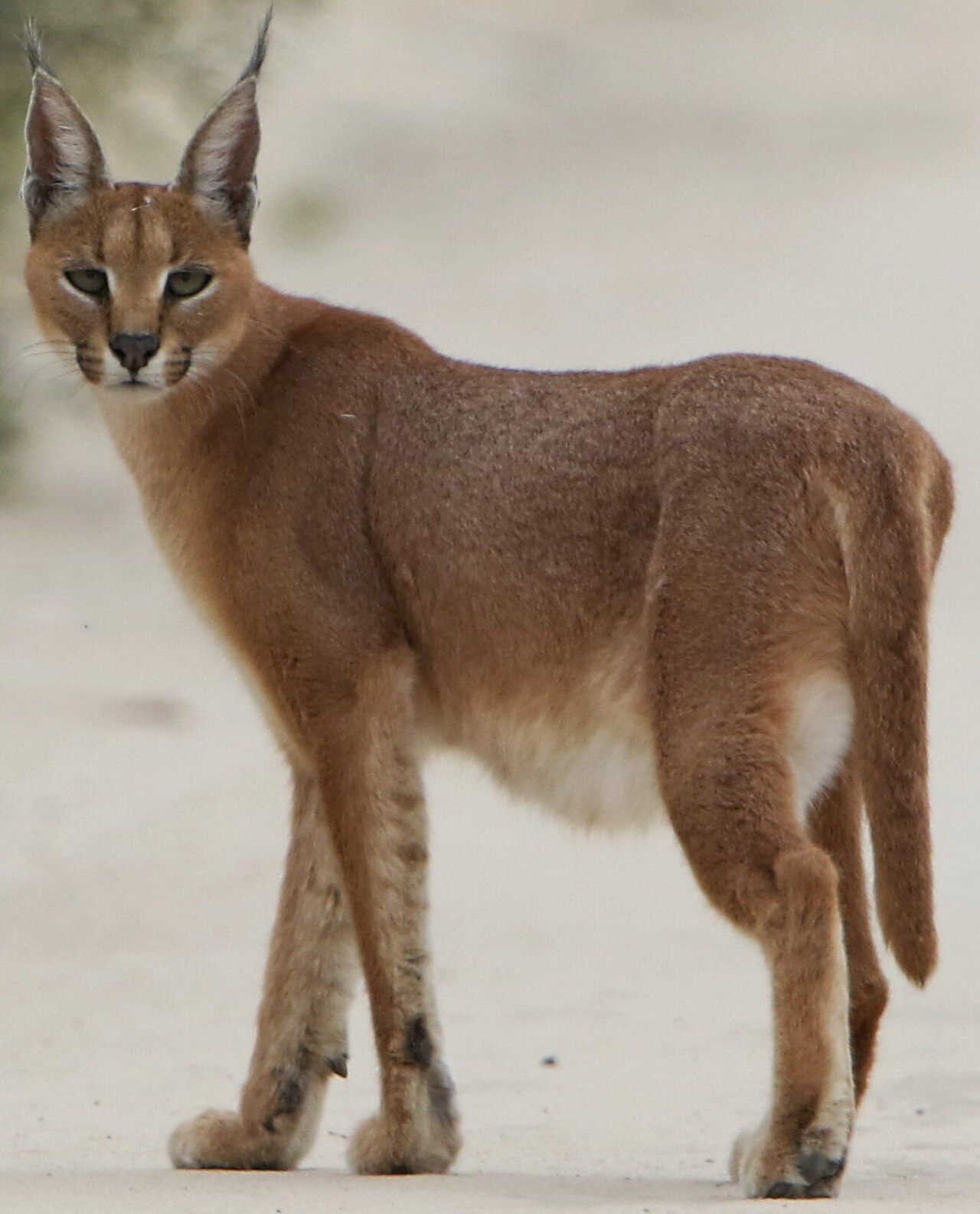
- Plain reddish tan or sandy, paler underneath, with black ear tufts
- Life span
- About 16 years in captivity
- Status
- Least Concern (IUCN)
The caracal (Caracal caracal) is a medium-sized wild cat found across Africa, the Middle East, Central Asia and the dry parts of Pakistan and northwestern India. Its name comes from a Turkish phrase meaning “black ear”. It is sometimes called the desert lynx or Persian lynx because of its tufted ears, but it is not a true lynx; its nearest relatives are the African golden cat and the serval.
Range and habitat
In Africa the caracal is widespread south of the Sahara and rare in the north. In Asia it ranges from the Arabian Peninsula through the Middle East to Turkmenistan, Uzbekistan and western India, where fewer than 100 may remain. It lives in savanna, scrub, semidesert, forest and marshy lowland, and favors dry country with some cover.
Appearance
The caracal is slender but strongly built, with long legs, a short face and a tail that reaches only to the hocks. The hind legs are longer than the front ones, so the back slopes down from the rump. Males measure 78 to 108 cm (31–43 in) in head and body and weigh up to 19 kg; females are smaller, up to about 16 kg.
The coat is a plain reddish tan or sandy color with no spots or blotches, which is the easiest way to tell it from a lynx. The belly and the insides of the legs are paler, often with small reddish marks. The face is marked with black lines from forehead to nose, white patches around the eyes and mouth, and the ears end in black tufts about 4.5 cm (1.8 in) long.
Behavior
Caracals are mostly active at night and are secretive and hard to observe. They live alone or in pairs and hold territories, which they mark with urine and claw scratches. The ear tufts seem to play a part in communication: caracals have been seen flicking their heads from side to side at each other.
Small mammals make up at least 80 percent of the diet, along with birds, reptiles and insects, and the cat can bring down antelope two or three times its own size. It stalks to within about 5 m (16 ft) and then sprints. Its strong hind legs can launch it more than 3 m (9.8 ft) into the air to catch birds on the wing. Where sheep and goats are kept it sometimes takes small livestock.
Breeding happens all year. After a gestation of two to three months, one to six kittens are born in thick vegetation or an abandoned burrow. They leave their mother at nine to ten months.
Threats and conservation
The species as a whole is listed as Least Concern, but its fortunes vary: it is stable in central and southern Africa, close to extinction in North Africa and critically endangered in parts of Central Asia and Pakistan. Habitat loss, killing by herders, road accidents and capture for the pet trade are the main threats. Hunting is banned in many range countries.
Facts on this page were checked against Wikipedia and may have changed since.