Fishing Cat
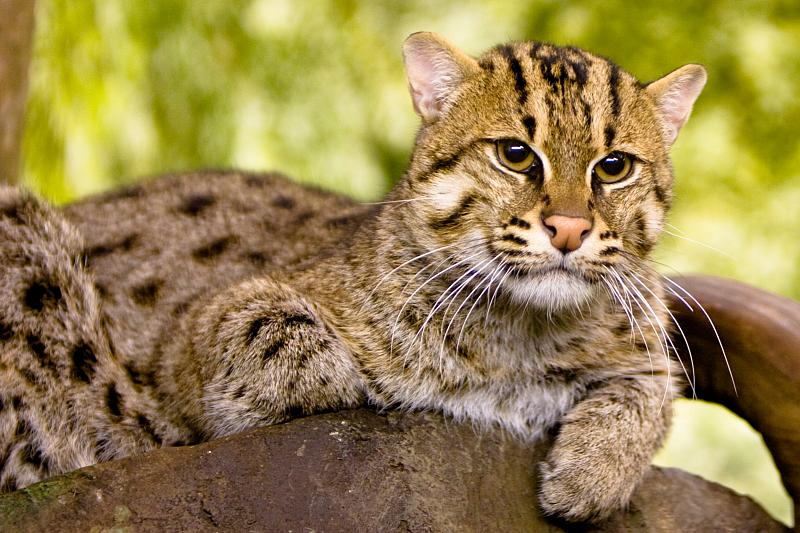

- Origin
- South and Southeast Asia
- Type
- Wild cat
- Weight
- 5–17 kg (11–37 lb)
- Coat
- Short, dense and layered, with longer glossy guard hairs
- Colors
- Yellowish gray with black lines and spots
- Life span
- Up to 10 years in captivity
- Status
- Vulnerable (IUCN)
The fishing cat (Prionailurus viverrinus) is a medium-sized wild cat of South and Southeast Asia. It lives beside water, swims strongly and catches most of its food there. It is about twice the size of a house cat and the largest member of its genus.
Range and habitat
The fishing cat is spread widely but patchily. It keeps mostly to lowland wetlands with thick vegetation around slow water: swamps, marshes, oxbow lakes, tidal creeks and mangrove forests, where it hides in reed beds, grass and scrub.
It has been recorded in Pakistan, Nepal, India, Bangladesh, Sri Lanka, Myanmar, Thailand and Cambodia. Java is the southern edge of its range, and it was already thought scarce there by the 1990s. There are no confirmed records from Peninsular Malaysia, Vietnam or Laos.
Appearance
The fur is a deep yellowish gray, varying from tawny to ash gray, marked with black lines and spots. Two stripes cross each cheek, and two more run from above the eyes back to the neck. The spots are lengthwise on the shoulders and rounder on the sides, legs and tail. The ears are short, rounded and set low, each with a white spot on the back.
The body is stocky and muscular on short to medium legs, 57 to 78 cm (22 to 31 in) long, with a tail of 20 to 30 cm (8 to 12 in), less than half the body length. Males weigh 8 to 17 kg and are much larger than females, at 5 to 9 kg. The paws are partly webbed, and the claws are not fully covered even when drawn in. The short, dense underfur is thought to keep water out and warmth in.
Behavior
Fishing cats are believed to be active mainly at night. Adults live alone; females have been found to use 4 to 6 square kilometers and males 16 to 22.
In one Indian study, fish made up about three quarters of the diet, with birds, small rodents, insects, mollusks, reptiles, amphibians and carrion making up the rest. The cat hunts along the water’s edge, waiting in the shallows for much of the time, scooping prey out or diving in after it.
Mating in the wild most likely takes place in January and February. After a pregnancy of 63 to 70 days the female has two or three kittens on average. They are weaned at six months.
Threats and conservation
The species has been listed as Vulnerable since 2016, after an estimated decline of about 30 percent. The main threats are the loss of wetlands to farming, settlement, pollution and aquaculture ponds, and killing by local people, sometimes in revenge for lost fish and sometimes because the cats are mistaken for tiger cubs. Road deaths are a serious problem in Odisha.
The fishing cat is listed on CITES Appendix II, and hunting is banned in most countries where it lives. It is the state animal of West Bengal. Zoos in Europe and North America run breeding programs.
Facts on this page were checked against Wikipedia and may have changed since.