Geoffroy's Cat
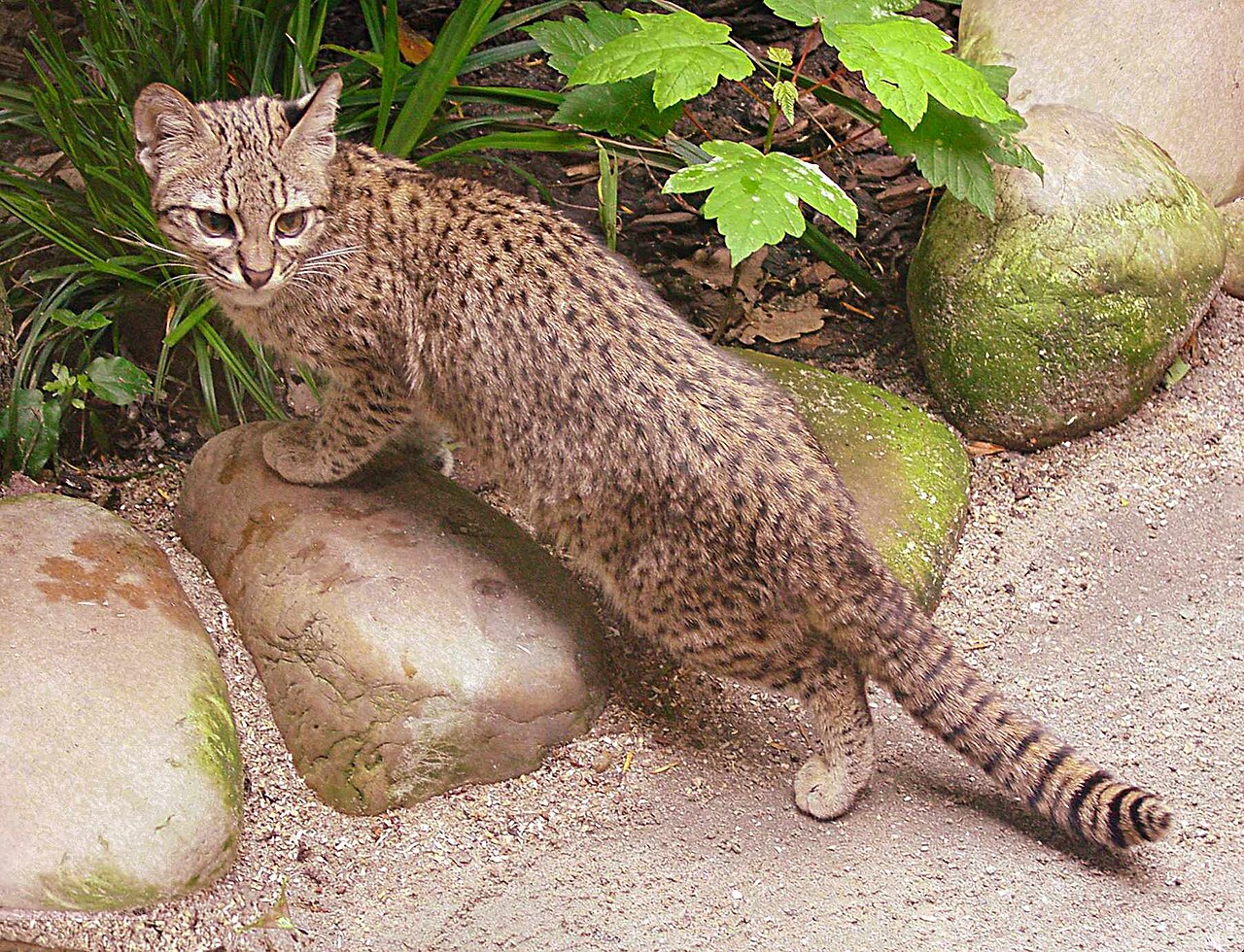

- Origin
- South America
- Type
- Wild cat
- Weight
- 2–5 kg (4.4–11 lb)
- Colors
- Brownish yellow to gray with many small black spots; black individuals are common
- Status
- Least Concern (IUCN)
Geoffroy’s cat (Leopardus geoffroyi) is a small wild cat of southern and central South America, about the size of a domestic cat. It was named in 1844 in honor of the French zoologist Étienne Geoffroy Saint-Hilaire, from specimens collected on the banks of the Rio Negro in Patagonia. It is widespread and common across its range and is listed as Least Concern on the IUCN Red List.
Range and habitat
The species lives in Argentina, Bolivia, Brazil, Chile, Paraguay and Uruguay, from the Gran Chaco of southern Bolivia down to the Straits of Magellan. It is found from sea level up to 3,800 m (12,500 ft) in the Andes. It prefers open woodland and scrub with plenty of cover, and also uses grassland and marshy ground. It is thought to be rare in Chile.
Appearance
The coat is covered in small black spots, with dark bands on the cheeks, head, neck, tail and legs. The background color changes with latitude, from brownish yellow in the north to grayer in the south, and the belly is cream or white. The backs of the ears are black with a white spot. All-black individuals are common.
Head and body measure about 60 cm (24 in), with a fairly short tail of around 31 cm (12 in). Most animals weigh between 2 and 5 kg, though some as heavy as 7.8 kg (17 lb) have been reported. Males are usually larger than females, and southern cats larger than northern ones.
Behavior
Geoffroy’s cat hunts alone at night and meets others of its kind only in the mating season. It has an unusual habit for a cat: it stands upright on its hind legs to look over the landscape, propped on its tail. It can climb but seldom does, except to leave droppings in trees as scent marks.
It eats mainly rodents, hares and other small mammals, as well as birds, snakes, lizards, insects and now and then frogs and fish. Females keep home ranges of about 2 to 6 square km; males range over as much as 12.
The breeding season runs from October to March. Gestation lasts 72 to 78 days, and litters of one to three kittens, usually one or two, are born mostly between December and May. Kittens weigh 65 to 95 g at birth and develop slowly compared with domestic kittens. Their eyes open after 8 to 19 days, they take solid food at six or seven weeks and are independent at about eight months. Females mature at around 18 months and males at 24.
Threats and conservation
From the 1960s to the 1980s Geoffroy’s cats were hunted in large numbers for the international fur trade. Trade fell away after 1988, and the species was moved to CITES Appendix I in 1992, which bans commercial international trade. Hunting and the sale of pelts were made illegal in all six range countries in the late 1980s.
Facts on this page were checked against Wikipedia and may have changed since.