Canada Lynx

- Origin
- North America
- Type
- Wild cat
- Height
- 48–56 cm (19–22 in)
- Weight
- 5–17 kg (11–37 lb)
- Coat
- Long, dense fur, longer in winter
- Colors
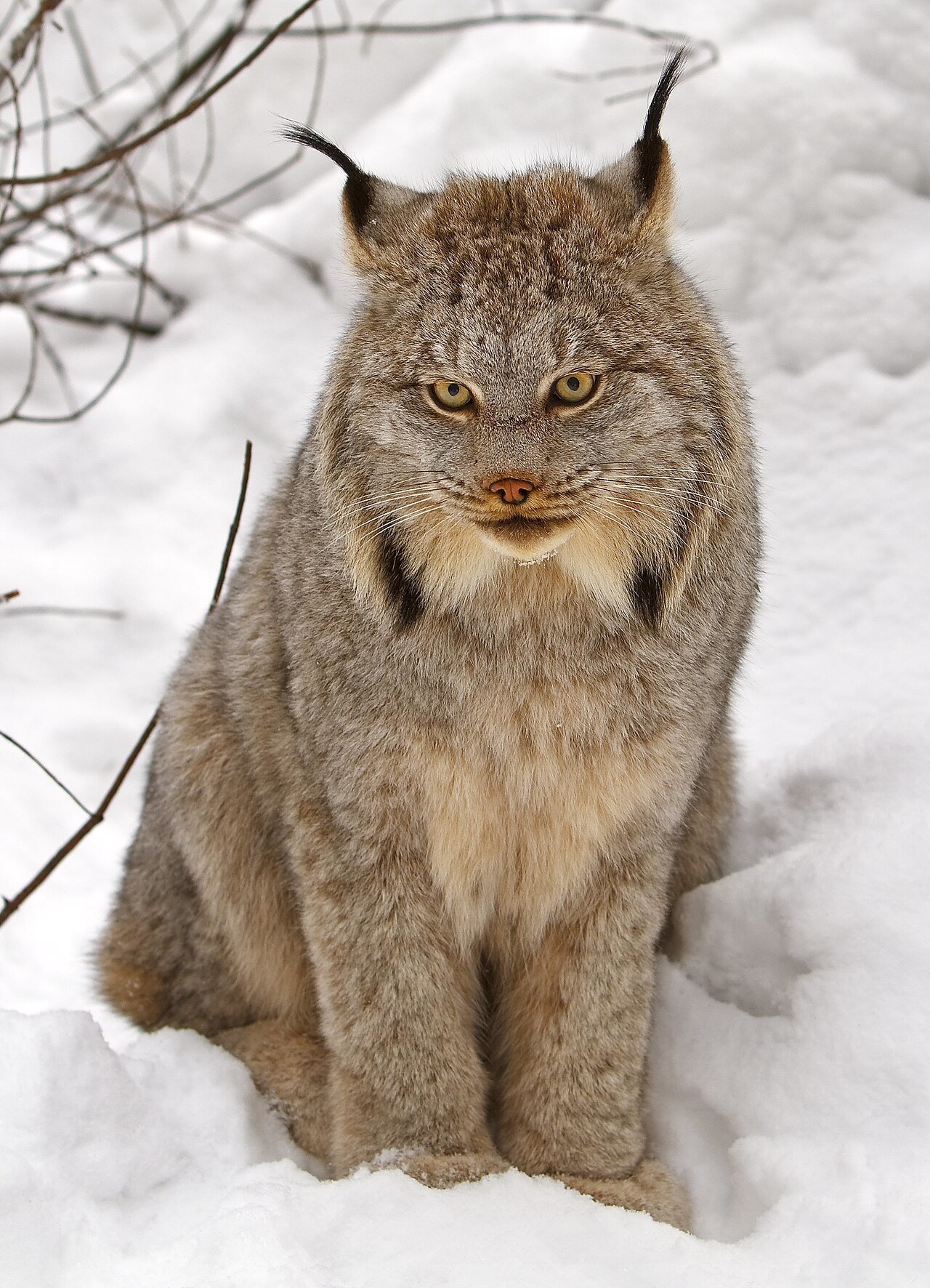
- Yellowish brown with white underparts; black ear tufts and tail tip
- Life span
- Up to 16 years in the wild, 27 in captivity
- Status
- Least Concern (IUCN)
The Canada lynx (Lynx canadensis) is a medium-sized wild cat and one of the four living species of lynx. It lives in the cold forests of northern North America and is built for snow, with thick fur, long legs and very broad paws. It was first described by Robert Kerr in 1792. Three subspecies have been proposed, but most authorities now treat it as a single undivided species.
Range and habitat
The Canada lynx is found across most of Alaska and Canada, mainly in dense boreal forest, and its range closely follows that of the snowshoe hare. In the contiguous United States it lives in the Blue Mountains and Cascade Range of the Pacific Northwest, the Rocky Mountains, the northern Great Lakes region and northern New England. It was reintroduced to Colorado from 1999, after disappearing from the state in the 1970s. It generally avoids open country and does poorly on farmland and in heavily logged areas, though it does well where cleared forest has had at least fifteen years to grow back.
Appearance
This is a lean cat whose hind legs are longer than its front legs, so the back slopes down toward the shoulders. It stands 48–56 cm (19–22 in) at the shoulder and measures 73–107 cm (29–42 in) in length. Females weigh 5–12 kg (11–26 lb) and males 6–17 kg (13–37 lb). The triangular ears end in black tufts about 4 cm long, and the stubby tail has a completely black tip.
The fur is long, thick and usually yellowish brown with few markings; the underparts are white. It is shorter in summer, and in winter the hair on the cheeks lengthens into a ruff. The large, furry paws can spread to 10 cm (3.9 in) across and carry almost twice the weight a bobcat’s can before sinking into snow. Longer ear tufts, wider paws, longer legs, a grayer coat and the all-black tail tip tell it apart from the bobcat.
Behavior
The Canada lynx is mostly solitary and active mainly at twilight and at night, when hares are about. Snowshoe hares make up 35–97% of its diet, and lynx numbers rise and fall with the hare’s population cycle. When hares are scarce it also takes grouse, ducks, squirrels, voles and young hoofed animals, moves to areas with more hares and raises fewer young. It waits beside hare trails or roams along them, then pounces and kills with a bite to the head, throat or nape. It swims well and climbs readily, but hunts only on the ground.
Mating takes place from March to early April. After two to three months a litter of one to eight kittens is born in a den in thick brush. They are weaned at twelve weeks and leave their mother at about ten months.
Conservation
The species is abundant across its wide range and is listed as Least Concern. It is trapped for fur in most of Alaska and Canada but protected in the southern part of its range, where numbers are lower and habitat loss is the main threat. In eastern Canada it faces competition from the eastern coyote.
Facts on this page were checked against Wikipedia and may have changed since.