Iriomote Cat
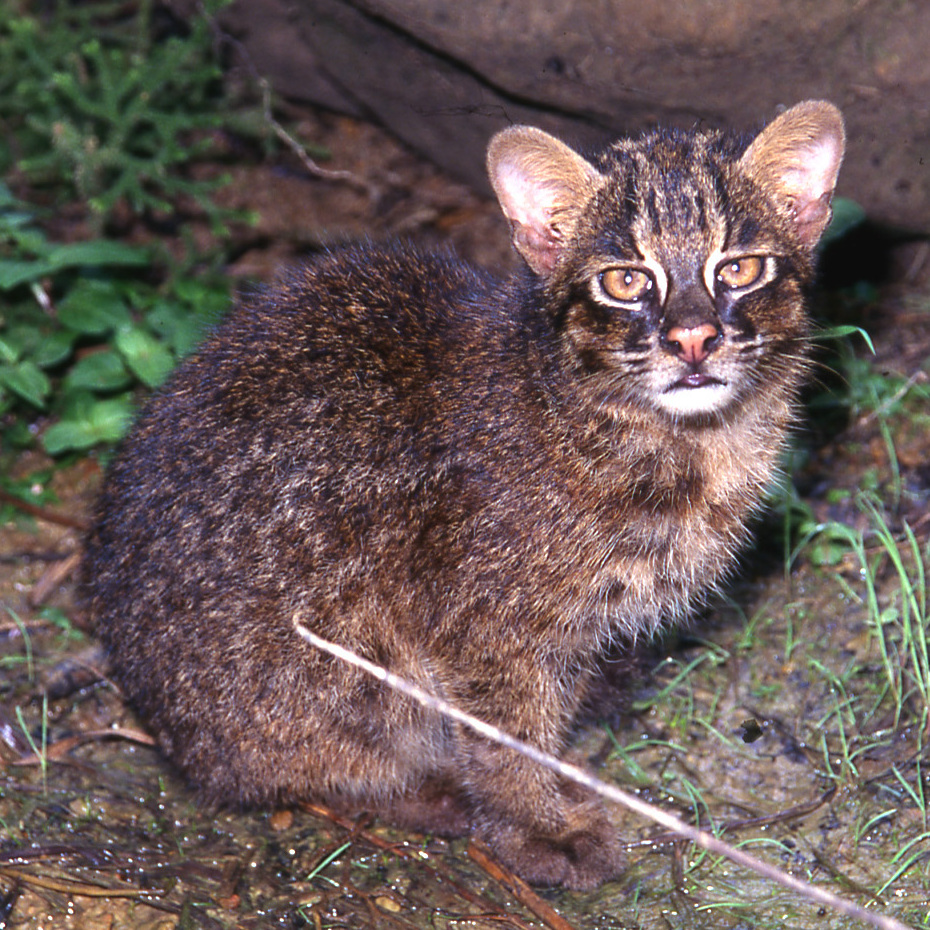

- Origin
- Japan
- Type
- Wild cat
- Weight
- 3–5 kg (6.6–11 lb)
- Coat
- Dark gray and light brown with dark tabby spots and stripes
- Life span
- 7–8 years in the wild
- Status
- Critically Endangered (IUCN)
The Iriomote cat (Prionailurus bengalensis iriomotensis) is a wild cat that lives only on Iriomote, a small island in the far south of Japan. It is a subspecies of the leopard cat. Islanders had long known it under names such as yamamayaa, “the cat in the mountain”, but science learned of it only in 1965, when the writer Yukio Togawa gathered the first skins and a skull. Yoshinori Imaizumi of the National Museum of Nature and Science in Tokyo described it in 1967.
Range and habitat
Iriomote covers about 290 km² (110 sq mi), the smallest range of any wild cat. The island is mostly low mountains under subtropical evergreen forest, with belts of mangrove along its waterways. The cats live chiefly in the forest below 200 m (660 ft), favoring areas near rivers and forest edges.
The Iriomote cat has been listed as Critically Endangered on the IUCN Red List since 2008. The single population numbers fewer than 250 adults and is thought to be falling; Japan’s Ministry of the Environment estimated 100 to 109 animals in 2007. Road accidents and traps shorten many lives, and contact with house cats brings risks of disease, competition for food and interbreeding.
Appearance
The fur is mostly dark gray and light brown, paler on the belly and the insides of the legs, with dark brown to black tabby spots along the flanks. Five to seven stripes run from the forehead to the back of the head and stop short of the shoulders. The ears are rounded, without tufts, and adults carry a pale spot on the back of each. The eyes are light amber.
It is a long-bodied cat with short, thick legs, a thick neck and a tail that stays thick to its tip. Males are 55 to 60 cm (22 to 24 in) long and weigh 3.5 to 5 kg (7.7 to 11 lb); females are 50 to 55 cm (20 to 22 in) and 3 to 3.5 kg (6.6 to 7.7 lb). The tail measures 23 to 24 cm (9.1 to 9.4 in).
Behavior
Iriomote cats live mainly on the ground, but they climb, wade and swim. They are active at night, especially around twilight, and sleep by day in tree hollows or caves. They are solitary and territorial, with home ranges of 1 to 7 km² (0.39 to 2.7 sq mi); one or two females usually live within a male’s range.
With no other carnivores on the island to compete with, they eat a very wide range of prey: rats, fruit bats, young wild boar, birds, snakes, skinks, frogs, crickets, crabs, fish and freshwater prawns. Unlike most cats, they swallow even large birds without plucking them.
Mating runs from December to March. Between April and June the female has one to three kittens in a tree hollow or cave, and they stay with her for about eleven months. In the wild the cats live an estimated seven to eight years; the oldest known in captivity reached about fifteen.
Facts on this page were checked against Wikipedia and may have changed since.