Cat breedsBobtail and tailless
Japanese Bobtail
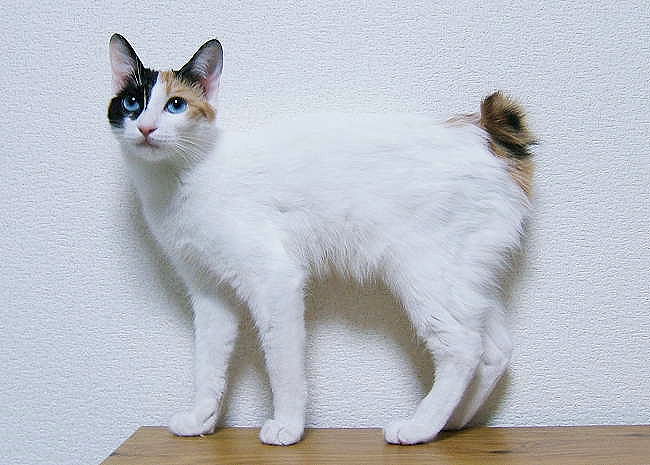

- Origin
- Japan
- Type
- Bobtail and tailless
- Size
- Medium
- Weight
- 2.7–4 kg (6–9 lb)
- Coat
- Soft and silky; medium length, or medium-long to long in the longhair
- Colors
- Almost any; mostly white calico (mi-ke) is the favorite
- Life span
- 9–15 years
- Status
- Recognised by the CFA, TICA and FIFe; not by the GCCF
The Japanese Bobtail is a domestic cat breed with a short, kinked tail that looks more like a rabbit’s than a cat’s. It has been part of Japanese life, art and folklore for centuries, and was registered as a breed in the 1960s.
History
Cats with shortened, kinked tails were common across Southeast Asia and southern China long before modern breeds existed. A 2016 study found that the same mutation, in a gene called HES7, is behind both those cats and the Japanese Bobtail, so the breed’s ancestors probably arrived in Japan with the trait already in place.
Cats are thought to have come to Japan with Buddhist monks in the 6th century, kept to protect scrolls from rats. In 1602 the authorities ordered all cats set free to deal with the rodents threatening the silkworm industry, and bobtailed cats became the street and farm cats of Japan. Around 1701 the German doctor Engelbert Kaempfer described Japan’s cats as patched in yellow, black and white, with short, bent tails.
Elizabeth Freret brought the first Japanese Bobtails to the West in 1968. The CFA gave the shorthair championship status in 1976 and the longhair in 1993. The breed remains rare.
In folklore the bobtail is a lucky cat, the tricolor mi-ke luckiest of all. The maneki-neko, the beckoning cat with a raised paw seen in shops, is modeled on it.
Appearance
This is a medium-sized, long, lean and well-muscled cat, with males larger than females. The legs are long and slender, the hind legs longer than the front, and the paws are oval. The head forms an equilateral triangle with large, upright, wide-set ears and large oval eyes. The coat is soft and silky in both the shorthair and the longhair.
The tail is made of one or more curves or kinks and is different in every cat. The gene reduces the number of tail vertebrae and fuses some of them. Almost any color is accepted. White cats in particular may have odd eyes, one blue and one yellow, more often than in most breeds.
Temperament
Japanese Bobtails are active, intelligent and strongly drawn to people. They learn tricks more readily than most cats and often take to a harness or a game of fetch. They are talkative, with soft voices that cover a wide range of tones.
Care and health
The coat is easy to groom and sheds lightly to moderately. The breed is generally healthy and among the most genetically diverse of pedigree cats, and unlike the Manx gene, its tail gene is not tied to spinal or bone problems. These cats love to climb and can be prone to obesity.
Facts on this page were checked against Wikipedia and may have changed since.