Cat breedsBobtail and tailless
Manx
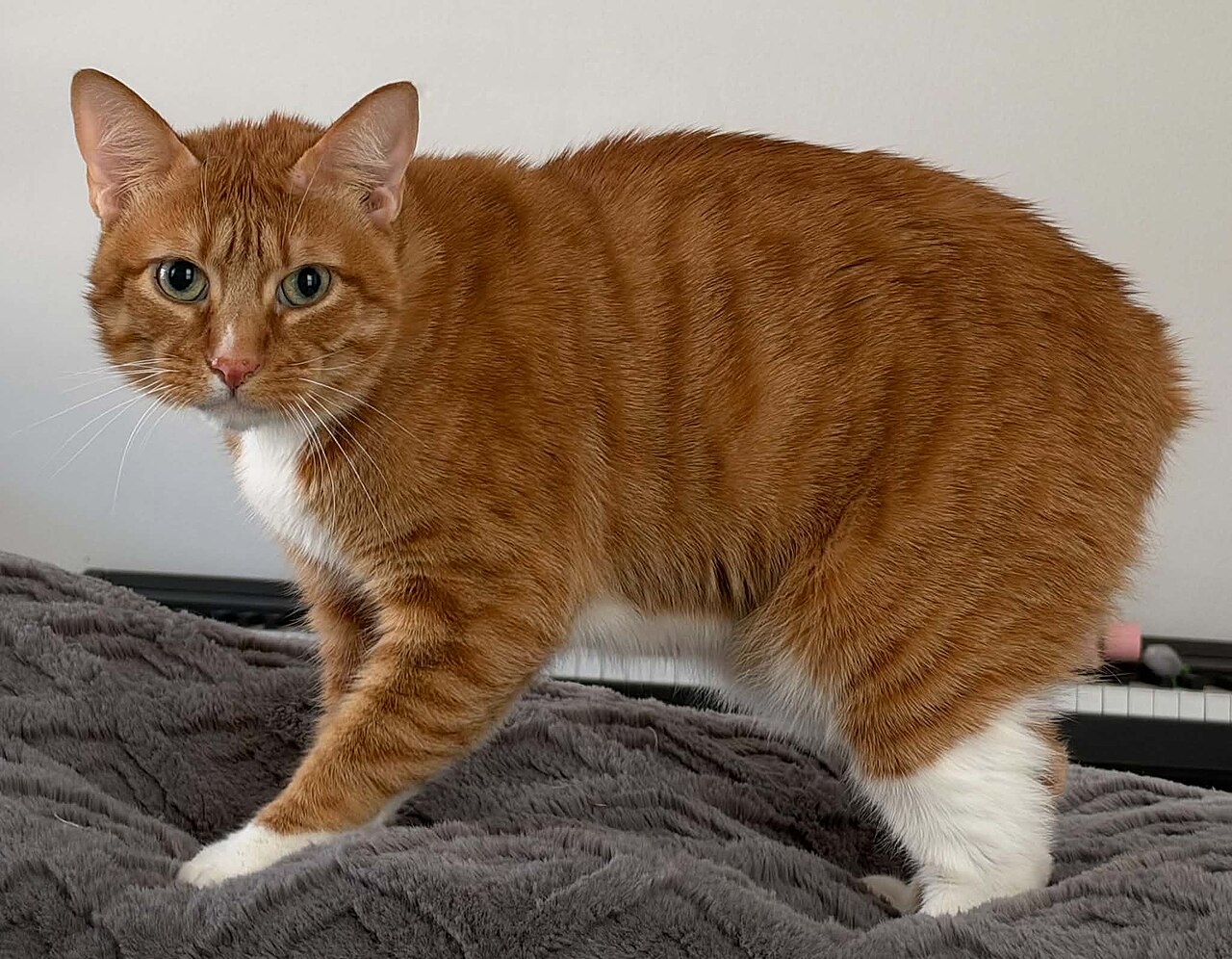

- Origin
- Isle of Man
- Type
- Bobtail and tailless
- Size
- Medium
- Weight
- 3.5–5.5 kg (8–12 lb)
- Coat
- Thick double coat; short, or semi-long in the Cymric
- Colors
- All colors and patterns
- Status
- Recognised by the CFA, TICA, FIFe, GCCF and WCF
The Manx is a domestic cat breed from the Isle of Man, best known for having no tail. A natural mutation shortens the tail, and along with it the breed is marked by long hind legs and a rounded head.
History
Tailless cats were known as the cats of the Isle of Man by the early 19th century. The mutation arose spontaneously and became common because the island’s cat population was small and isolated. On the island a tailless cat is a rumpy and a short-tailed one a stubbin.
Folktales offer other explanations: a cat that swam ashore from a wrecked Spanish Armada ship, Noah shutting the door of the Ark on the cat’s tail, or a cross between a cat and a rabbit. None has any basis.
Manx cats have been shown since the late 1800s. Charles Henry Lane published the first known standard in 1903, and the Manx was among the first breeds recognised by the CFA. Long valued as mousers, they were in demand as farm cats and ship’s cats.
Appearance
The Manx is a medium-sized, broad-chested, firmly muscled cat. Lane gave typical weights of 4.5–5.5 kg (10–12 lb) for males and 3.5–4.5 kg (8–10 lb) for females. Because the hind legs are clearly longer than the front, the rump stands higher than the shoulders and the back forms an arch, a shape often called rabbit-like. The head is round, with largish, round-tipped ears and large, round eyes.
Tail length varies within a litter. A rumpy has no tail, a riser has a small bump of cartilage, a stumpy has a fused stub up to about 3 cm (1 in), and stubby and longy cats have half or full tails. Only the shortest types are usually accepted for showing.
Every Manx has a thick double coat. The original short coat has a dense, soft underlayer and a coarser outer layer. The longhaired variety, with a silky medium-length coat, is the Cymric, which some registries treat as a separate breed. All colors and patterns occur.
Temperament
Fanciers often call the Manx doglike. Lane described the cats more simply as docile, good-tempered and sociable, alert and active.
Care and health
The taillessness gene is dominant, and two copies are usually fatal before birth, so breeders avoid mating two completely tailless cats. When the gene shortens the spine too far, the result is “Manx syndrome”: damage to the spinal cord and nerves, a form of spina bifida, and trouble with the bowels and bladder. One report found it in about 30% of the cats studied, nearly all of them rumpies.
Some partial tails are prone to painful arthritis. The breed is also predisposed to megacolon, skin-fold infection at the rump and corneal dystrophy. The Australian Cat Federation and the GCCF place special restrictions on breeding Manx cats for welfare reasons.
Facts on this page were checked against Wikipedia and may have changed since.