Cat breedsBobtail and tailless
Pixie-bob
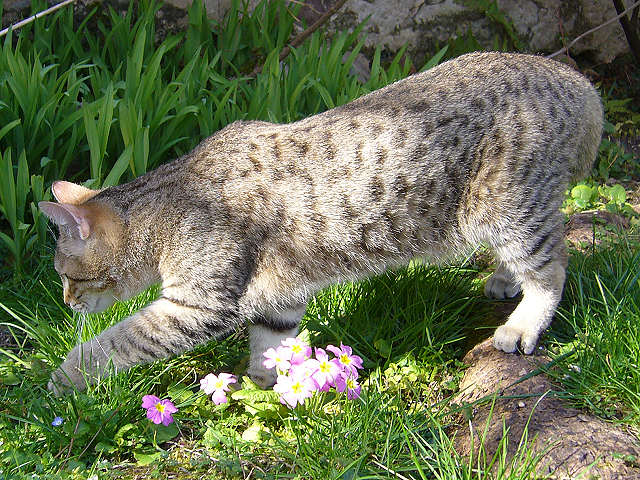

- Origin
- United States
- Type
- Bobtail and tailless
- Size
- Large
- Weight
- Usually up to 5 kg (11 lb)
- Coat
- Mostly short; a longhaired variety exists
- Colors
- Black spotted tabby, often with reddish, apricot or peach tones
- Status
- Recognised by TICA and the ACFA
The Pixie-bob is a pedigreed domestic cat from the United States with a short tail, a spotted tabby coat and, often, extra toes. Its founders believed their cats had bobcat blood, but DNA testing reported in 1996 found no bobcat markers, and the breed is treated as wholly domestic for registration, ownership and import. The data behind that testing has not been published.
History
In spring 1985 Carol Ann Brewer bought a spotted, short-tailed, polydactyl male cat near Mount Baker in Washington. In January 1986 she took in another male, Keba, a very large bobtailed cat said to have been fathered by a bobcat; even underfed he weighed 7.7 kg (17 lb). Keba mated with a neighbor’s spotted tabby, and from the litter born that April Brewer kept a female she named Pixie, who became the foundation of the breed.
Over the following years Brewer added 23 cats from around the Cascade Range that she believed came from natural matings between bobcats and domestic cats. She called them “Legend Cats”. Other breeders working with wild-looking barn cats joined her to widen the foundation.
TICA accepted the Pixie-bob for exhibition in 1993, moved it up in 1996 and gave it championship status in 1998. The ACFA recognises it as well.
Appearance
Pixie-bobs are often bigger than the average cat, though most do not exceed about 5 kg (11 lb); a few lines produce larger, heavy-boned, massive cats. Males are usually bigger than females, and the cats keep growing for up to four years.
The pear-shaped head is considered the breed’s most important feature. It has a heavy brow, triangular eyes that turn from blue to green or gold, a large muzzle with rounded whisker pads, a red nose and tipped ears with heavy ear hair. The coat is a black spotted tabby pattern like a bobcat’s, often warmed with reddish, apricot or peach tones. Most cats are shorthaired. The tail ranges from 5 cm (2 in) to hock length.
Temperament
Pixie-bobs are described as highly intelligent, sociable, active and bold. They are friendly with strangers as well as their own people, like to follow their owners from room to room and enjoy playing with other animals. They rarely meow, preferring chirps, chatters and growls. Many fetch balls, head-butt for attention and walk on a leash.
Care and health
Because the breed is regularly outcrossed, it is genetically diverse and not prone to the problems of inbreeding. A small number of cases of cryptorchidism, difficult births, cystic endometrial hyperplasia and hypertrophic cardiomyopathy have been recorded, and blocked tear ducts also occur.
Facts on this page were checked against Wikipedia and may have changed since.