Bengal
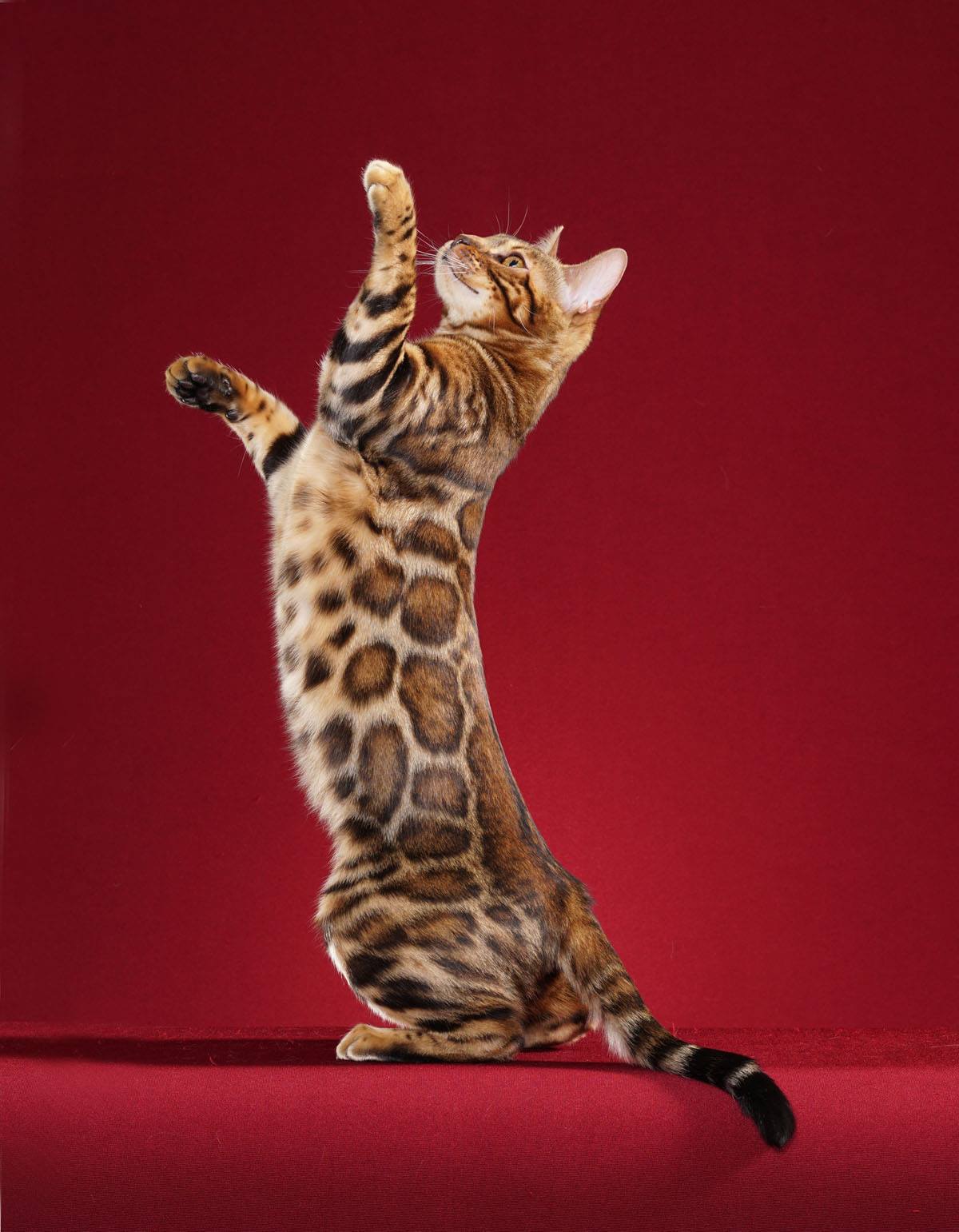

- Origin
- United States
- Type
- Domestic hybrid
- Size
- Medium
- Coat
- Spotted, rosetted or marbled tabby; a longhaired variety (Cashmere Bengal) also exists
- Colors
- Brown (black), blue, silver, charcoal and the three "snow" colorpoint shades
- Life span
- About 8.5 years in one UK study
- Status
- Recognised by TICA, FIFe and the GCCF; CFA Miscellaneous class
The Bengal is a hybrid breed, made by crossing the Asian leopard cat (Prionailurus bengalensis), a small wild species, with domestic cats, especially the spotted Egyptian Mau. Its name comes from the leopard cat’s scientific name, not from the Bengal tiger. It is a medium to large cat registered by most of the major cat registries, and because of its recent wild ancestry, keeping and breeding it is regulated in several countries.
History
Crosses between leopard cats and house cats were mentioned as early as 1889 by Harrison Weir. The modern breed is credited to Jean Mill of California, who made the first known deliberate cross in 1963, between a leopard cat and a black domestic tom. Serious breeding began much later. TICA accepted the Bengal as a new breed in 1986 and gave it championship status in 1991. The GCCF followed in 1997, FIFe and the Australian Cat Federation in 1999, and the CFA admitted it to its Miscellaneous class in 2016, on condition that cats are at least six generations away from the leopard cat.
By the 2000s the Bengal had become very popular. In 2024 it was TICA’s most popular breed and ranked seventh in FIFe.
Appearance
Bengals vary, but the coat is always a tabby pattern: spots, rosettes, arrowhead marks or marbling. The Bengal is the only domestic breed with rosettes, a marking inherited from the leopard cat. Colors include brown (also called black, seal or sable) and blue, with or without silver or charcoal, and three colorpoint shades known in the breed as “snow”. Longhaired kittens have appeared since the breed’s early days from a recessive gene carried by the domestic foundation cats. Some breeders now develop them as the Cashmere Bengal, which TICA has accepted for competition since 2017.
A 2024 study of 947 Bengals found an average of about 3.5 percent leopard cat DNA. Cats of the first three generations are called foundation or early-generation Bengals. Males of those generations are often infertile, so the females are bred to later-generation males.
Care and health
Hypertrophic cardiomyopathy, a thickening of the heart muscle, is a major concern in the breed; one 2013 study put its prevalence at 16.7 percent. Other inherited conditions are Bengal progressive retinal atrophy, which starts at about seven weeks and leaves cats with very poor sight by two years of age, and pyruvate kinase deficiency. A form of ulcerative dermatitis of the nose, first reported in 2004, appears between four and twelve months of age. A UK study of veterinary records found a life expectancy of 8.51 years, against 11.74 years for cats overall.
Bengals are often described as hypoallergenic, but this has not been shown scientifically.
Legal restrictions
Rules differ widely. Australia banned imports in March 2025. In the United States, Hawaii, Connecticut and New York City prohibit the breed, and several other states and cities regulate early generations or require permits; cats five or more generations from the leopard cat are generally treated as domestic. The Netherlands and parts of Belgium ban the first four generations.
Facts on this page were checked against Wikipedia and may have changed since.