Kanaani

- Origin
- Israel
- Type
- Domestic hybrid
- Size
- Large
- Coat
- Short, close-lying and rather coarse, with little undercoat
- Colors
- Black, chocolate or cinnamon spotted or blotched tabby on a beige to cinnamon ground
- Status
- Experimental; recognised by the WCF
The Kanaani is an experimental short-haired breed from Israel that began as a hybrid between the African wildcat (Felis lybica) and domestic cats. It was bred to look like the wild steppe cat native to the region, and its development is still going on. The name comes from Canaan, the ancient name for the land that includes present-day Israel.
History
Doris Pollatschek, a German-Israeli artist, is regarded as the founder of the breed. In the 1990s she bred its foundation stock from a rescued African wildcat and a local stray, working first in Israel; the work later continued in Germany.
The World Cat Federation recognised the Kanaani in 2008, making it the first national cat breed of Israel. From 2010 the federation accepted only kittens born after 1 January 2008 to Kanaani parents. The International Cat Association registers the Kanaani as an experimental cat for record-keeping only and does not recognise it as a breed.
The breed came close to dying out. In the 2020s Rabbi Michail Salita, a breeder in Brooklyn, started a program to revive it with cats bred in Jerusalem by Lyudmila Vlasova. The program rests on two foundation cats, Haifa and Arbuz, and their daughter Laila. These three were registered first with a Ukrainian rare-breeds association, then with an independent British registry, and finally through a Ukrainian club affiliated with the World Cat Federation, which brought the breed back onto that federation’s books.
Appearance
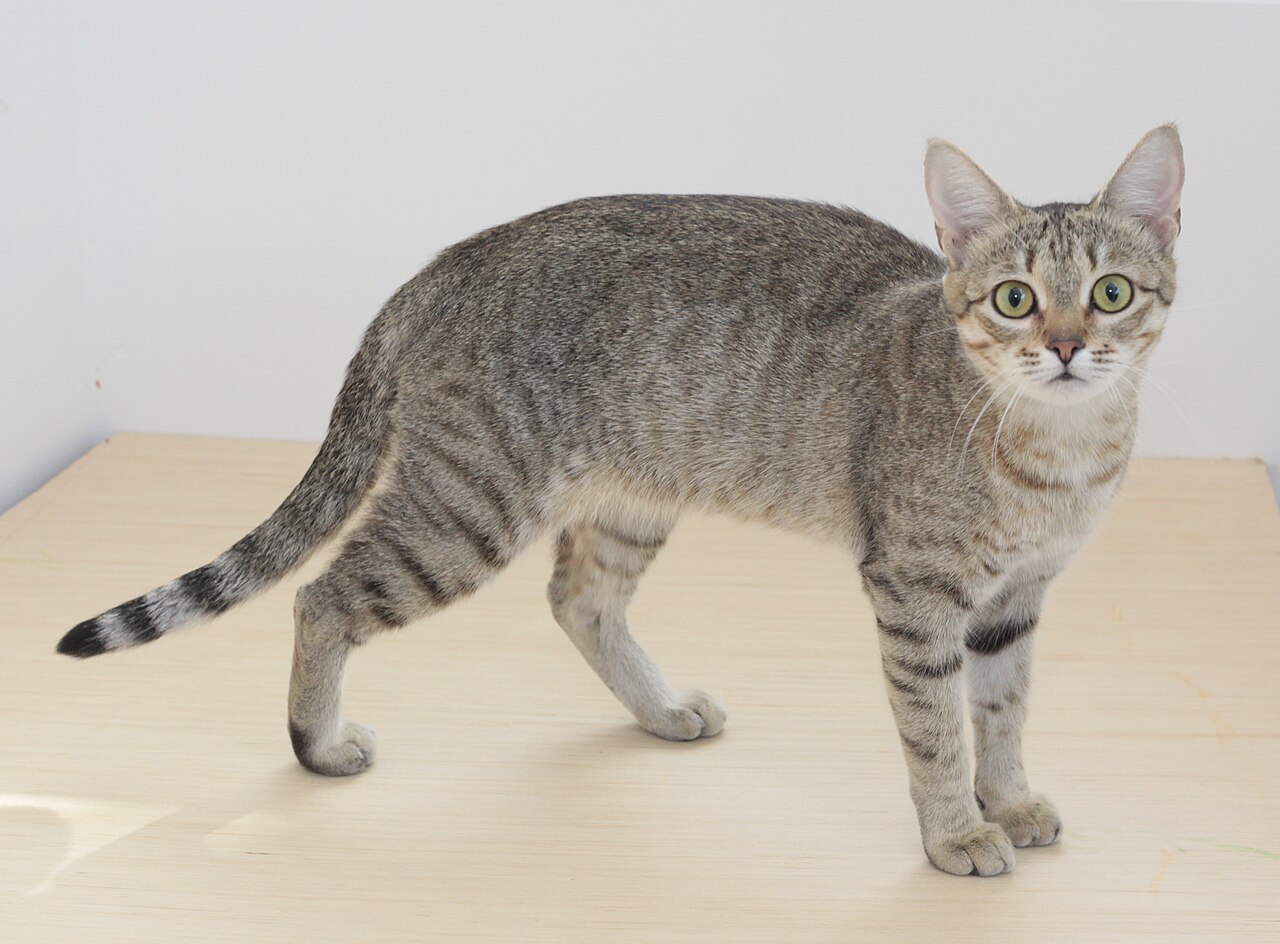
The Kanaani is a medium to large cat, slender, muscular and athletic, with a long body, long slim legs and oval paws. The tail is long, thick at the base and tapering. An oriental body type counts as a fault.
The head is a broad triangle on a long neck, with a flat skull, prominent cheekbones and a straight nose. The ears are large, upright and set wide apart; tufts at the tips are wanted, and a thumbprint mark on the back of each ear is typical. The eyes are large, almond-shaped and slightly slanted, green in adults, though shades toward yellow are allowed.
The coat is short, close and rather coarse, with very little undercoat. There are three base colors, black, chocolate and cinnamon, each in a spotted or blotched tabby pattern on a ground that runs from beige to cinnamon. The hairs are ticked, which softens the markings without hiding them. Silver cats are not accepted.
Temperament
The Kanaani is described as active, energetic, playful and affectionate, and also markedly independent. It keeps some of the behavior of its wildcat ancestors and is considered an excellent hunter.
Because of that ancestry, the breed is restricted in some places. In the Netherlands and in the Flanders and Brussels regions of Belgium, it is illegal to own or breed African wildcats or their hybrid offspring of the first four generations.
Facts on this page were checked against Wikipedia and may have changed since.