Savannah
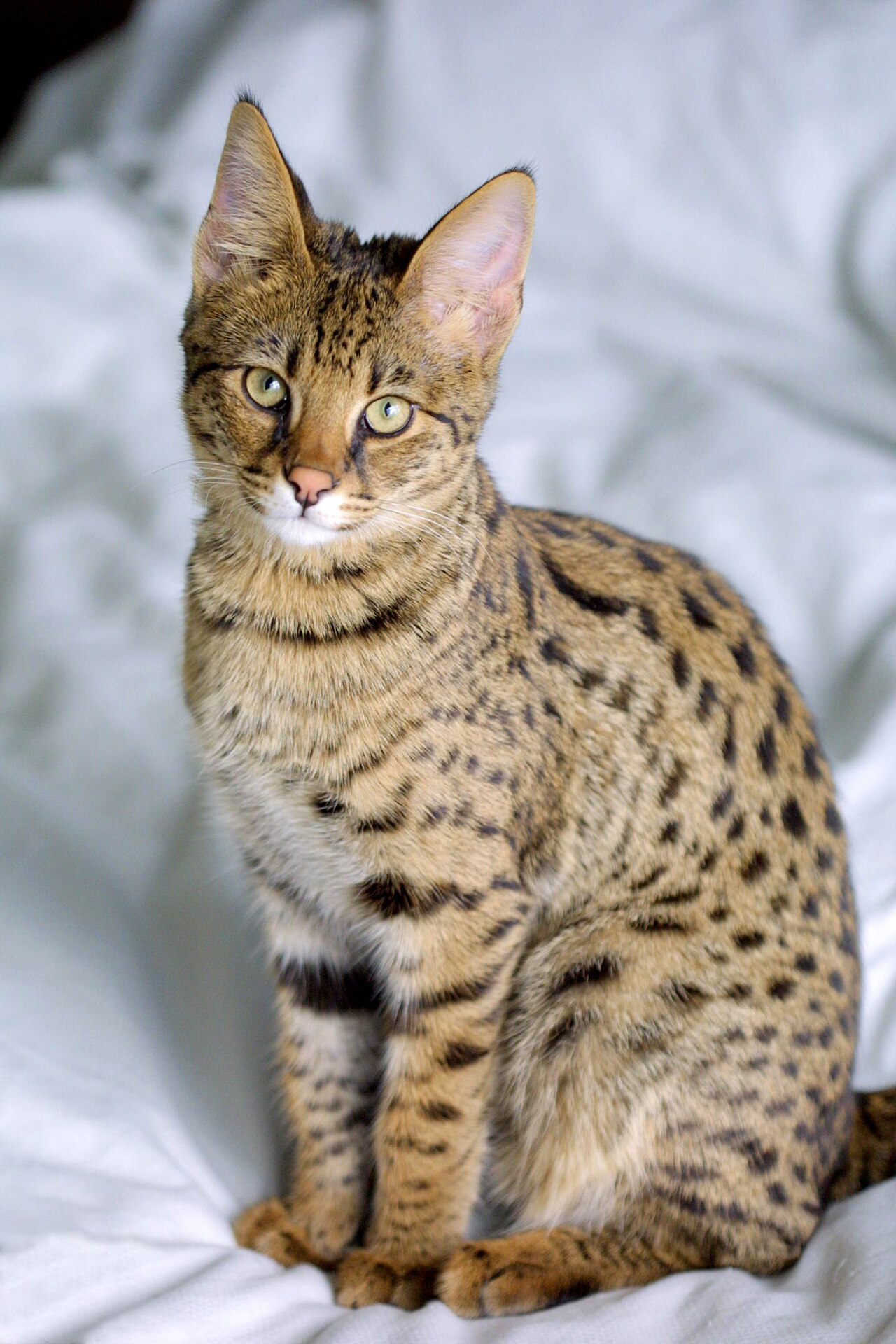

- Origin
- United States
- Type
- Domestic hybrid
- Size
- Large
- Weight
- 3.5–11 kg (7.7–24.3 lb)
- Coat
- Short and spotted
- Colors
- Black spotted tabby, black silver spotted tabby, black and black smoke
- Status
- Recognised by TICA
The Savannah is a hybrid breed, developed in the late twentieth century by crossing the serval, a wild African cat, with domestic cats. The result is a tall, lean cat with the serval’s big ears and boldly spotted coat.
History
The first Savannah was born on April 7, 1986, when Judee Frank bred a male serval to a Siamese. The kitten, a female, was named Savannah. Bred to a Turkish Angora male, she had kittens of her own in 1989. Patrick Kelley and Joyce Sroufe wrote the first breed standard in 1996 and put it to TICA, which accepted the Savannah for registration in 2001 and gave it championship status in May 2012.
Generations
Each Savannah carries a generation label. An F1 has a serval parent, an F2 a serval grandparent, and so on. F1 kittens are hard to produce, because servals and domestic cats differ in the length of pregnancy and many pregnancies fail. Males are usually sterile until about the fifth generation, while females are fertile from the first. The F4 is the first generation that can count as purebred and the first eligible for shows. Domestic outcrosses have not been allowed since 2012.
Appearance
The tall, slim build makes a Savannah look bigger than its weight suggests. Size depends heavily on generation and sex. F1 and F2 cats are the largest, usually 4.5 to 11 kg (9.9 to 24.3 lb), and some F1s reach 18 kg (40 lb) or more. An F2 male set a world record for the tallest cat in 2016, at 48.4 cm (19.1 in). Later generations weigh 3.5 to 8.2 kg (7.7 to 18.1 lb), about the same as other large breeds such as the Maine Coon.
The serval shows in the long legs and body, the long, slender neck, the small head that is taller than wide, the wide nose and the large, upright ears. When the cat stands, its rump is often higher than its shoulders. The tail is short, ringed in black and tipped with solid black. The eyes are hooded and may be green, brown or gold, often with dark “tear” lines running from the inner corners down beside the nose.
The TICA standard accepts only a spotted coat, in black spotted tabby, black silver spotted tabby, black and black smoke.
Temperament
Many Savannahs have no fear of water and will play in it. Early generations in particular can show wild or territorial behavior, and males may be aggressive and mark their territory. Trouble with litter box training is a common reason for owners giving these cats up.
Care and health
Savannahs are more likely than other domestic breeds to develop hypertrophic cardiomyopathy. The Savannah Cat Association recommends screening for it, and for progressive retinal atrophy and pyruvate kinase deficiency.
Ownership is restricted in some places. Rules vary between US states and cities, some Canadian provinces limit F1 and F2 cats, Australia and New Zealand ban imports, and the Netherlands and parts of Belgium ban F1 to F4 cats.
Facts on this page were checked against Wikipedia and may have changed since.