Cat breedsBobtail and tailless
Cymric
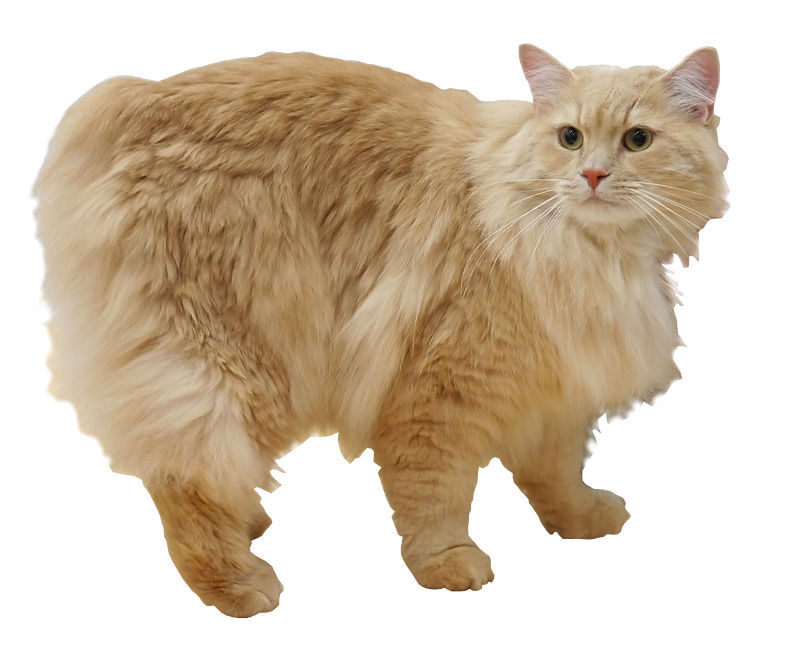

- Origin
- Canada
- Type
- Bobtail and tailless
- Size
- Medium
- Weight
- 4–5 kg (8–12 lb)
- Coat
- Semi-long, dense double coat with a ruff and breeches
- Colors
- Many colors and patterns
- Status
- A separate breed for FIFe and the WCF; a longhaired Manx for the CFA, TICA and GCCF
The Cymric is the semi-longhaired counterpart of the Manx, the tailless cat of the Isle of Man. Apart from the length of the fur the two are the same, and both kinds of kitten can turn up in one litter. Some registries list the Cymric as a breed, while others treat it as a longhaired Manx.
History
Taillessness arose as a mutation among the cats of the Isle of Man, and on a small island with a closed population the dominant gene spread easily, along with a gene for long hair. Longhaired kittens were born to Manx cats there from time to time, but breeders discarded them. In the 1960s similar kittens appeared in Canada and were bred on purpose, which is why the Cymric is counted as a Canadian breed. It was first shown in the 1960s and became popular in the mid-1970s, decades after the Manx had been recognised.
FIFe (since 2006), the World Cat Federation, the Canadian Cat Association, the American Cat Fanciers Association and the registries of Australia, New Zealand and southern Africa accept the Cymric as a separate breed. TICA regards it as a variety of Manx. The Cat Fanciers’ Association calls it the Manx Longhair, and Britain’s GCCF the Semi-longhair Manx Variant.
Appearance
The Cymric is a compact, muscular cat of medium to large size with heavy bone and a rounded outline, though the missing tail can make it look smaller than it is. It weighs about 4 to 5 kg (8 to 12 lb). The front legs are shorter than the hind legs. The ears are tall, tilted slightly outward and lightly tufted.
The double coat is semi-long, dense and springy over a soft undercoat. It is fullest around the neck, where it forms a ruff and shirtfront, and on the upper hind legs, where it forms breeches. Show judges weigh the quality of the coat above its color, and many colors and patterns occur.
Kittens are sorted by tail length. A rumpy has no tail at all; a rumpy riser has up to three vertebrae that lift when the cat is stroked; a stumpy has a short stump of up to five vertebrae; and a longy has a tail that is longer but still short of full length. Rumpies are the most prized in shows.
Care and health
The gene behind the short tail also causes health problems. It can produce spina bifida and other spinal defects, a group of problems known as Manx syndrome, which may affect movement or the control of bladder and bowel; some cats move with a rabbit-like hop. These problems usually show before six months of age. Kittens that inherit two copies of the gene die before birth, so litters are usually small, and mating two tailless cats leads to birth defects. For welfare reasons, the Australian Cat Federation and the GCCF place special restrictions on breeding Manx and Cymric cats.
Facts on this page were checked against Wikipedia and may have changed since.