Sphynx
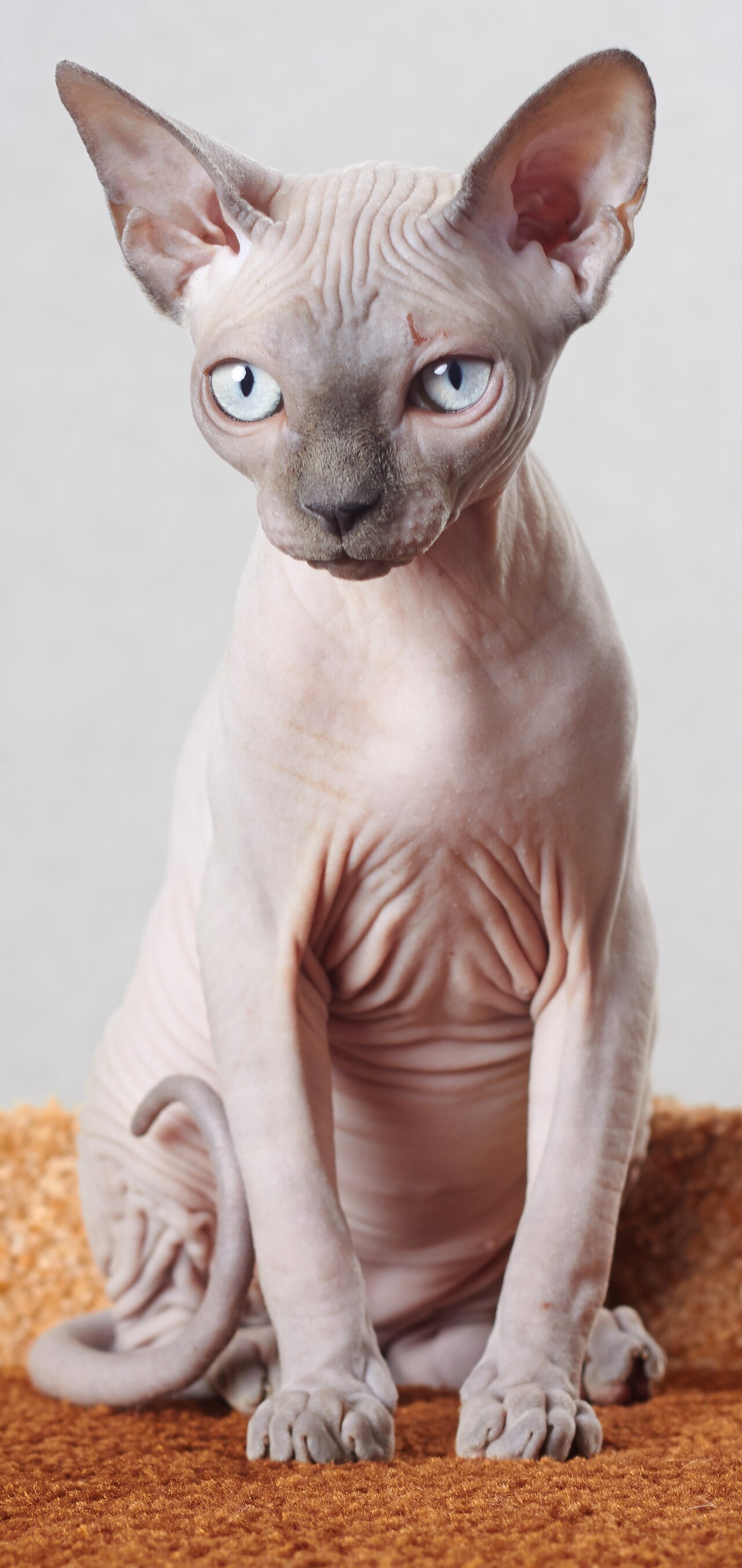

- Origin
- Canada
- Type
- Hairless
- Coat
- Hairless or covered in fine down; skin like chamois leather
- Colors
- All colors and patterns, shown on the skin
- Status
- Recognised by the CFA, TICA and FIFe
The Sphynx, also called the Canadian Sphynx, is a breed known for its lack of fur. Hairlessness turns up in cats now and then as a natural mutation, and the Sphynx was developed by selectively breeding such cats from the 1960s onward. It is a separate breed from the Russian hairless cats, the Donskoy and the Peterbald, whose hairlessness comes from different genes.
History
The breed began in Toronto in 1966, when a hairless male kitten named Prune was born to a black-and-white shorthaired house cat. A University of Toronto science graduate and his mother, a longtime Siamese breeder, worked with Keese and Rita Tenhove to build a breed from these cats, first called Moonstones or Canadian Hairless and later renamed Sphynx. They established that the hairless gene is recessive.
Today’s Sphynx descends from two later finds. In the mid-1970s hairless kittens appeared among barn cats on the Pearson farm in Wadena, Minnesota; two females, Epidermis and Dermis, went to Oregon breeder Kim Mueske. In 1978 Shirley Smith found three hairless kittens on the streets of Toronto, and in 1983 sent two of them, Punkie and Paloma, to the Netherlands, where they were bred to a white Devon Rex.
DNA analysis in 2010 confirmed that Sphynx hairlessness is caused by a variant of KRT71, the same gene that gives the Devon Rex its curly coat. The hair grows without a firm root, so it is fragile and falls out easily.
Appearance
The skin feels like chamois leather and may be bare or carry fine hairs, with a little short hair sometimes left on the nose, tail and toes. Whiskers may be whole, broken or absent. The skin is the color the fur would have been, and shows all the usual patterns: solid, pointed, van, tabby, tortoiseshell and others.
TICA’s standard asks for a wedge-shaped head with prominent cheekbones, large lemon-shaped eyes and very large ears. The neck is muscular, the body medium in length with a barrel chest and a full, rounded belly, and the tail tapers like a whip. The paw pads are thicker than in other cats.
Temperament
Sphynx are extroverted, energetic, curious and affectionate. They are often described as dog-like, greeting their owners at the door and welcoming strangers. They attach strongly to their people, ask for a lot of attention, and like to cuddle for warmth.
Care and health
Without fur the Sphynx loses heat quickly, feels warm to the touch and seeks out warm spots. It can sunburn, and long exposure to the sun may lead to skin cancer, so it should not be left outdoors unattended; in cold weather some owners dress their cats. The skin produces a greasy secretion that builds up and needs regular cleaning, as do the waxy ears, the nails and the skin folds. The breed is not necessarily hypoallergenic, because cat allergy is triggered by a protein in saliva and skin glands, not by hair.
Heart disease is common. In a 2012 study of 114 Sphynx, 34% had an abnormal heart, either hypertrophic cardiomyopathy or mitral valve dysplasia. An inherited muscle weakness, congenital myasthenic syndrome, also occurs in the Sphynx and Devon Rex.
Facts on this page were checked against Wikipedia and may have changed since.