Donskoy

- Origin
- Russia
- Type
- Hairless
- Size
- Medium
- Coat
- Hairless, with wrinkled skin; some keep a little fuzz or a wiry partial coat
- Status
- Recognised by the WCF, TICA and FIFe
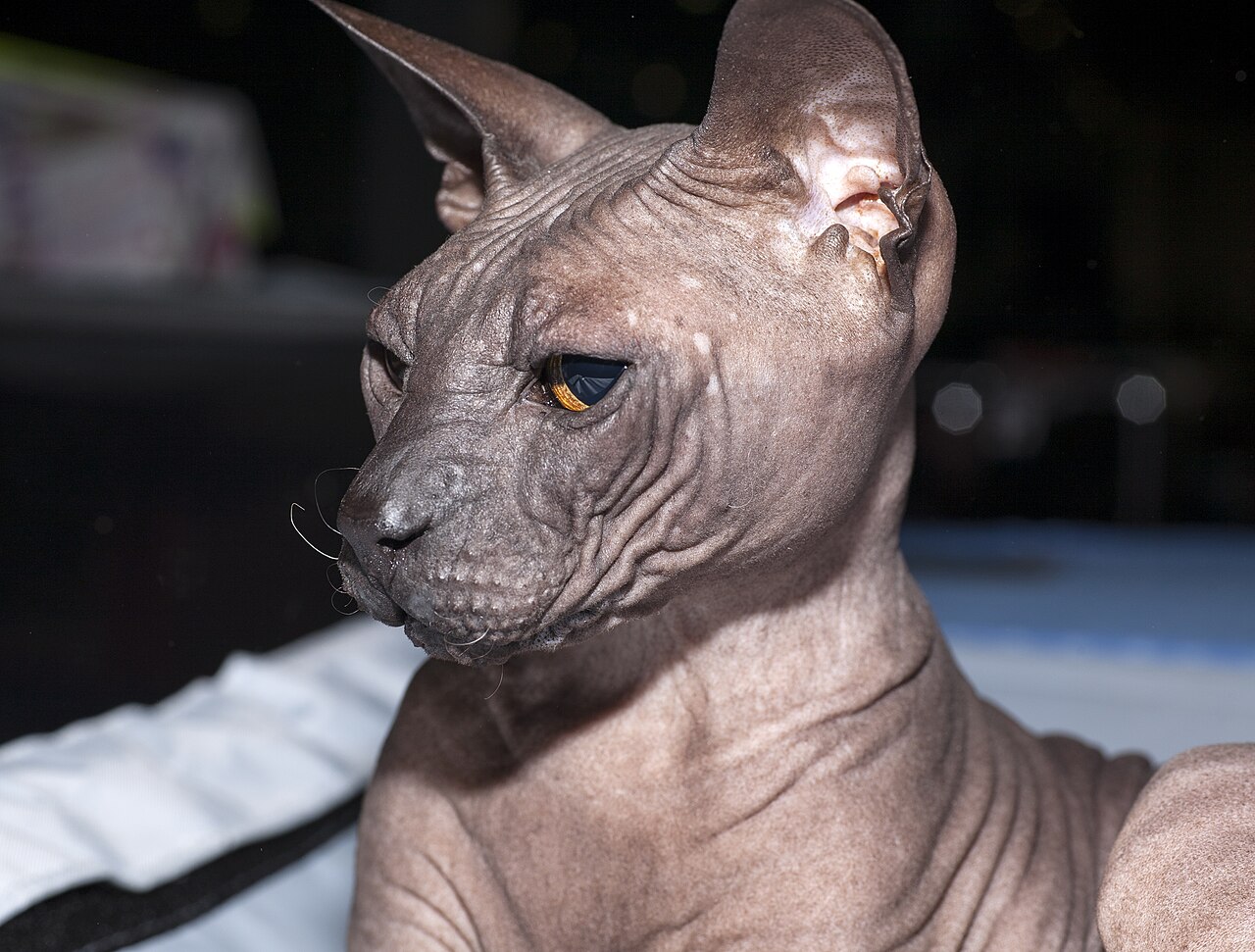
The Donskoy is a hairless cat from Russia. It looks something like the Sphynx but is not related to it: the Sphynx owes its bare skin to a recessive gene, while the Donskoy’s hairlessness comes from a dominant one, so every cat that carries it is either born bald or loses its coat as it grows.
History
The whole breed goes back to one kitten. In 1987 Elena Kovaleva, a cat breeder in the city of Rostov-on-Don, rescued a blue tortoiseshell kitten and named her Varvara. At about four months old the kitten started to lose her fur. Varvara later had a litter by a local tomcat; some kittens were born hairless and others lost their hair as she had. These kittens founded the breed and were later outcrossed to European Shorthairs.
The World Cat Federation recognises the Donskoy, and The International Cat Association accepted it in 2005. The Peterbald was created by crossing Donskoys with Oriental Shorthairs. Matings between Donskoy and Peterbald have not been allowed since 2000, and the only outcross now permitted is the domestic shorthair.
In the Netherlands it has been illegal since 2014 to breed from cats with mutations that harm the welfare of their offspring, and the lack of a protective coat in hairless cats falls under that rule.
Appearance
The Donskoy is a medium-sized, muscular cat with a triangular head, large ears and almond-shaped eyes that give it an elfin look, and long, webbed toes. The skin is heavily wrinkled, most of all on the face, neck, chest and at the base of the tail. Eyes may be blue, green, amber, orange, yellow or brown. Some cats grow a faint coat in winter and shed it again when the weather warms.
Four coat types are described. Rubber bald cats are born hairless and stay that way. Flock cats are born with a peach-fuzz down that usually disappears. Velour cats are born with a short wavy coat and a bald spot on the head, and lose most or all of the hair in their first year. Brush cats have a bristly, wiry coat with bald patches on the head, neck and back and keep it for life; they are the only type that cannot be shown.
Temperament
Donskoys are very social, curious, gentle cats. They are active, spend more time on the move than most cats and need plenty to do. They do not cope well with long stretches alone. They are friendly and intelligent, take well to training, and are generally good with children, with other playful cats and, after a proper introduction, with dogs.
Care and health
Despite having no coat, the Donskoy needs regular grooming, though bathing too often can make the skin very oily.
Not every registry accepts the breed, and there are concerns about its genetic health. The dominant hairless mutation of the Donskoy and Peterbald may cause feline ectodermal dysplasia when a cat inherits two copies, with problems such as poor teeth and a reduced ability to sweat or to produce milk.
Facts on this page were checked against Wikipedia and may have changed since.