Russian Blue
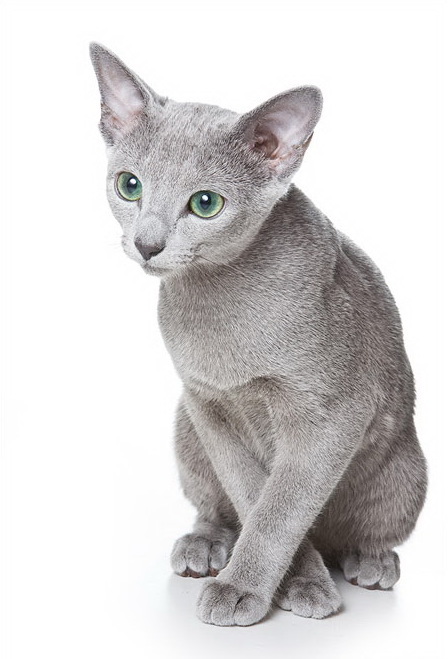

- Origin
- Russia
- Type
- Shorthair
- Size
- Medium
- Weight
- 3.6–6.8 kg (8–15 lb)
- Coat
- Short, dense, plush double coat
- Colors
- Solid blue-gray with a silver sheen
- Status
- Recognised by the CFA, TICA, FIFe and GCCF
The Russian Blue is a pedigreed shorthaired cat known for its solid blue coat, which has defined the breed for more than a century. The fur is a dense, plush double coat of pale blue-gray with a silver sheen, set off by bright green eyes. All the major international registries accept the breed for championship competition.
History
The breed was developed from a natural landrace that may have come from the port of Arkhangelsk in northern Russia, which is why the cats are sometimes called Archangel Blues. Sailors are believed to have carried them to Great Britain and northern Europe in the 1860s. An Archangel Cat is first mentioned in British print in 1862, and one was first shown in 1872 at the Crystal Palace in England. Writing in 1895, Harrison Weir reported that the early show cats called Russian Blues were in fact British-bred gray tabbies, and that separate gray cats matching the modern breed had come from Archangel during the 1800s.
Russian Blues were judged in a class with all other blue cats until 1912, when they were given their own. Until after World War II the breed was developed mainly in Britain and Scandinavia. Numbers were so low just after the war that breeders crossed in Siamese; those traits have now largely been bred out. American breeders created the modern Russian Blue of the United States in the postwar years by combining British and Scandinavian lines.
Appearance
The Russian Blue is a small to moderate-sized cat with a lean build, weighing 3.6 to 6.8 kg (8 to 15 lb) on average; males are usually larger. The eyes are vivid emerald green and the paw pads pinkish lavender to mauve.
In the double coat the soft, downy undercoat is as long as the guard hairs. The guard hairs are an even blue with silver tips, which produce the shimmer. The fur is very thick and soft. The tail may show faint tabby rings. White patches, or yellow eyes in an adult, are show faults.
Russian Whites and Blacks were bred in Britain in the 1960s and Australia in the 1970s from crosses with white cats. The ACF and GCCF accept them as Russian cats, but the CFA, FIFe, TICA and WCF recognise only blue. Because of the postwar Siamese crosses, some lines carry the colorpoint gene, and two carriers can produce blue-pointed kittens; most registries will not register or show these.
Temperament
Russian Blues are generally quiet and tend to be reserved with strangers unless they grow up in a busy household. They are affectionate and easygoing with their own people, but dislike change and prefer a predictable routine. They are highly intelligent, with a good memory for where toys are kept and for favorite visitors, and many have been taught tricks.
They are athletic cats, strong leapers and climbers, and can be keen hunters. Kittens are energetic and can get into mischief when bored. The breed is slow to mature, keeping adolescent habits until three or four years old, and older cats remain easy to tempt into play.
Facts on this page were checked against Wikipedia and may have changed since.