Korat

- Origin
- Thailand
- Type
- Shorthair
- Size
- Small
- Coat
- Short single coat
- Colors
- Silver-tipped blue only
- Status
- Recognised by the CFA, TICA and FIFe
The Korat is a shorthaired, silver-tipped blue-gray cat from Thailand. It is a natural breed and one of the oldest stable ones, said to have kept the same look for centuries. It comes from Phimai and is named after its home province, Nakhon Ratchasima, which Thais usually call Korat. In Thailand the cat is known as Si sawat, meaning “color of the sawat seed”.
Korats are thought of as good luck cats. By tradition they are given in pairs to newlyweds or to people held in high regard, and until recently they were never sold, only given.
History
The earliest likely mention of the breed is in the Tamra Maew, the Thai Cat-Book Poems written some time between 1350 and 1767, though its illustration is not detailed enough to be certain.
Korats first reached Britain in 1889 and 1896 under the name “Blue Siamese”. Judges did not accept solid blue cats as Siamese, and they had vanished from shows by 1901. One of them, a male called Nam Noi, was disqualified as a Siamese but took first place in the class for Russian or other blue cats.
The breed arrived in the United States in the 1950s. In 1959 Cedar Glen cattery imported the first breeding pair, a male named Nara and a female named Darra, and in 1966 the Korat was accepted for championship competition.
Appearance
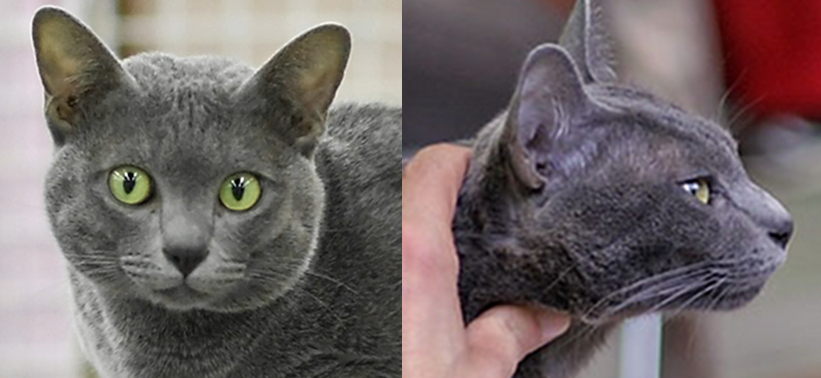
The Korat is small to medium in build, with a semi-cobby body that carries little fat and feels surprisingly heavy for its size. The head is heart-shaped, the eyes are large, and the front legs are shorter than the back legs.
The coat is short and single. Each hair is light silver-blue at the root, deepens to blue along the shaft and ends in a silver tip, most noticeably on the muzzle and toes, which gives the coat a shimmer. Thais call the color “rain-cloud gray” and the sheen “sea foam”. No other color is accepted. Adults have peridot green eyes; kittens start with muddy, amber or golden-green eyes that change over two to four years. Now and then a Korat has white spots or faint gray stripes, which count as show faults.
Britain’s GCCF keeps an experimental register for Korat-type cats of other colors: the solid lilac Thai Lilac, and the Thai Blue Point and Thai Lilac Point, which have Siamese-style points. They appeared after breeding stock imported from Thailand brought in the recessive genes. The first recorded Thai Lilac was born in the UK in 1989.
Temperament
Korats are intelligent, playful and active. They bond closely with their people and are very vocal, with a voice unlike that of other breeds.
Care and health
The Korat is one of the breeds more often affected by gangliosidosis 1 and 2, inherited recessive diseases. The GCCF requires genetic testing for gangliosidosis before full registration. Atherosclerosis resembling the human form, which is almost never seen in cats, has also been found in Korats, and a genetic predisposition is suspected.
Facts on this page were checked against Wikipedia and may have changed since.