Egyptian Mau
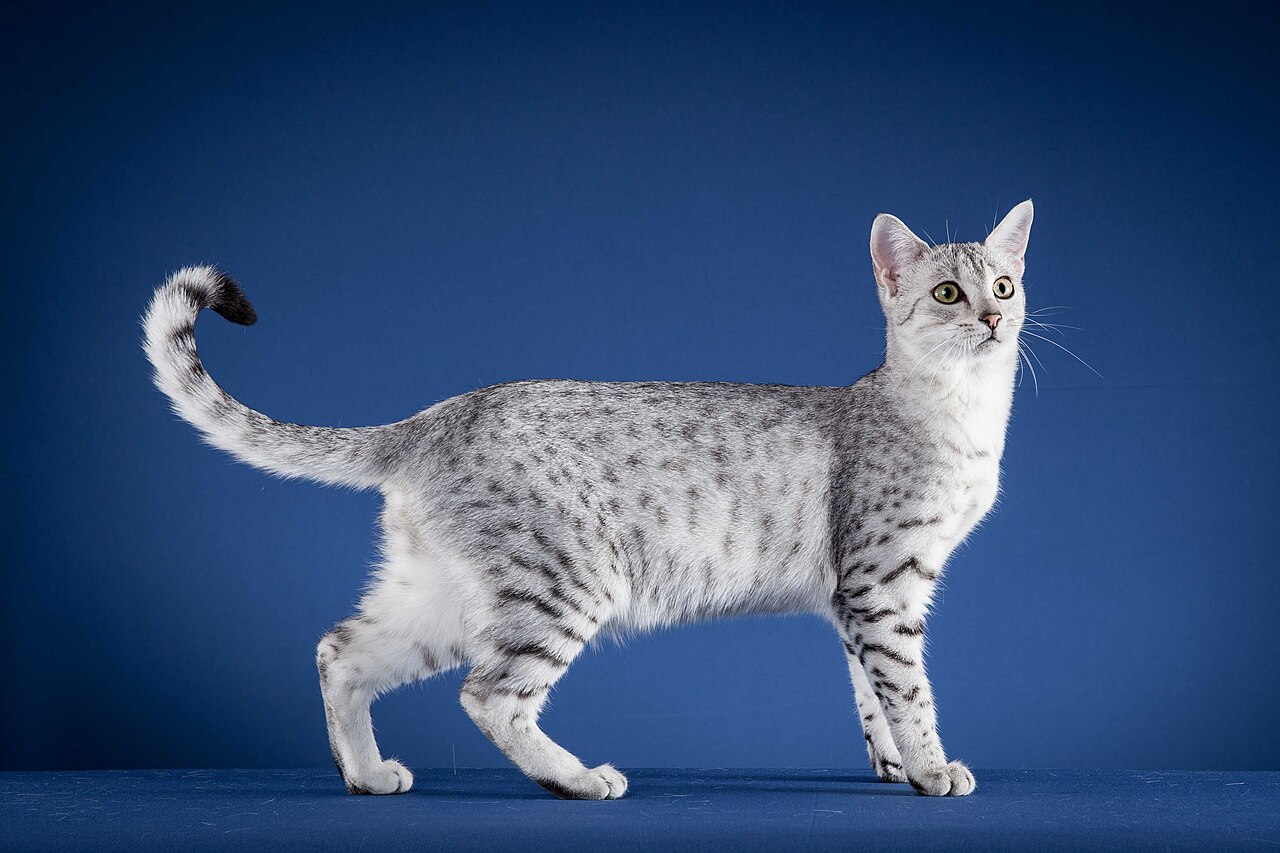

- Origin
- Egypt
- Type
- Shorthair
- Size
- Medium
- Coat
- Short to medium, spotted, with banded hairs
- Colors
- Silver, bronze and smoke
- Status
- Recognised by the CFA, TICA, FIFe and GCCF
The Egyptian Mau is a small to medium-sized, rare breed and one of the few domestic cats whose spots arose naturally. The spots sit only on the tips of the hairs. The breed as known today grew from cats brought out of Cairo in the 1950s.
History
In 1953, in Italy, Princess Natalie Trubetskoy saw a cat that belonged to the Egyptian ambassador and asked him to help her get one from Cairo. She received a female named Baba, who was mated to the ambassador’s cat. A bronze male from that litter was bred back to his mother and produced a female named Lisa. These cats were first shown at the Rome Cat Show in 1955. The princess took her three Maus to the United States in 1956, and Baba became a champion the next year. American Maus are said to descend from Baba, though other accounts trace them to a pair named Gepa and Ludol brought over in 1953.
The Cat Fanciers Federation gave the breed championship status in 1968, followed by the CFA in 1977 and TICA in 1979. The first Maus reached Britain in 1998. The breed is still uncommon: in 2022 only 39 kittens were registered with the GCCF.
Genetic studies place the Mau among Western-derived breeds and show it to be closely related to the Maine Coon, the Korat and Western Turkish Angoras.
Appearance
The Mau is muscular, with a medium-length body often described as a balance between the compact Burmese and the slim Siamese. The hind legs are longer than the front, so the cat seems to stand on tiptoe. A loose flap of skin runs from the flank to the knee of the hind leg and lets the leg stretch further back in a stride. Maus have been timed at more than 48 km/h (30 mph), which makes them the fastest domestic cats.
The head is gently rounded, with medium to fairly large ears and big round eyes. Adult eyes are light green; kittens may have amber eyes. The forehead carries a tabby mark said to resemble a scarab. The coat has two or more bands of ticking on each hair and dark markings of varying size and shape over the body and legs, sometimes with a stripe along the lower spine and tail. The tail is medium long and thick at the base.
Accepted colors are silver, bronze and black smoke. Solid black and blue (pewter) cats occur but are not recognised colors.
Care and health
Egyptian Maus have a much higher rate of urate bladder stones than mixed-breed cats. In a Canadian study, 14 of 17 Maus examined had them. Pregnancy also lasts longer than in most cats, about 73 days against the usual 64 to 67.
Facts on this page were checked against Wikipedia and may have changed since.