British Shorthair

- Origin
- United Kingdom
- Type
- Shorthair
- Size
- Large
- Weight
- 3–8 kg (7–17 lb)
- Coat
- Short, very dense and plush, with a crisp feel
- Colors
- Blue is the classic; many other colors and patterns
- Life span
- About 9.5 to over 12.5 years, depending on the study
- Status
- Recognised by the CFA, TICA, FIFe, GCCF and WCF
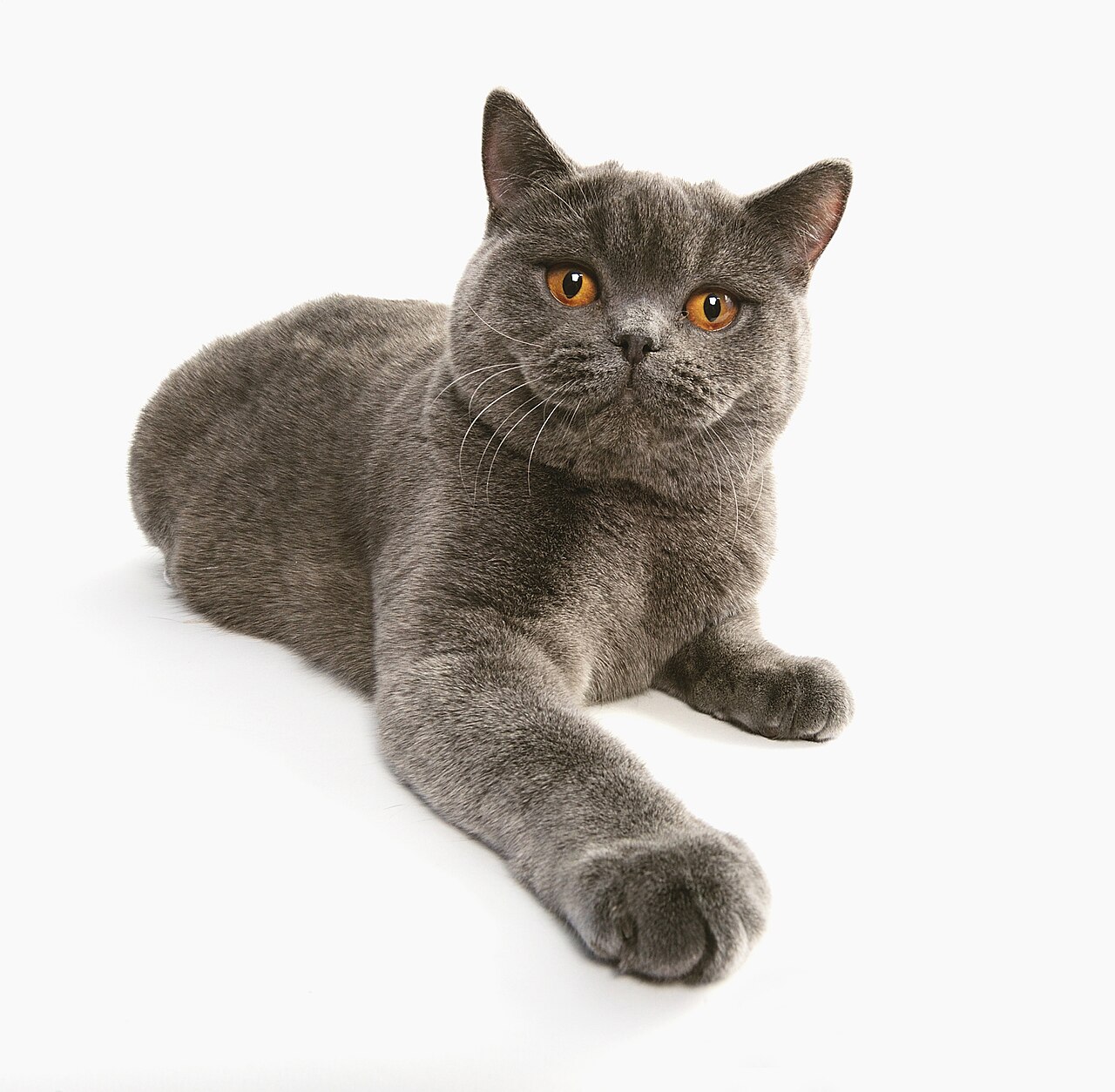
The British Shorthair is the pedigree form of Britain’s traditional domestic cat: stocky, broad-faced and thickly coated. Its best-known variety is the British Blue, a solid blue-gray cat with copper eyes. It was among the first cats to be bred to a standard, and it is the most popular pedigree breed in the United Kingdom.
History
Nobody knows exactly how cats first reached the British Isles. Over many centuries the island population grew into large, sturdy cats with short, very thick coats suited to the climate.
Selective breeding began in the nineteenth century, with most attention on the blue-gray cats. The artist and cat fancier Harrison Weir is often credited with the idea of standardising the breed. British Shorthairs were shown at the first organised cat show, which Weir staged at the Crystal Palace in London in 1871, and they led the show benches until 1895.
Persians and other longhairs then took over in popularity, and by World War I breeding stock was very scarce. Breeders brought in Persian, Russian Blue, Burmese and Chartreux blood to keep the breed going, and did so again after World War II. The type was gradually restored, and by the late 1970s the breed was fully recognised by all the major registries.
Appearance
This is a large, powerful cat with a broad chest, thick-set legs of short to medium length and round paws. The tail is thick at the base, rounded at the tip and about two-thirds the length of the body. The head is big and round, with full cheeks, especially in mature males, a short muzzle and so little visible neck that head and body seem to run together. The ears are set wide apart and the eyes are large and round.
Males are noticeably bigger than females: around 4 to 8 kg (9 to 17 lb) against 3 to 5 kg (7 to 12 lb).
The coat is dense, straight and even in length. It feels plush and firm, not woolly. Besides blue, the breed comes in white, black, red, cream, cinnamon and fawn, and in most registries chocolate and lilac. There are also tabby, tortoiseshell, bicolor, colorpoint, smoke, shaded and tipped versions.
A longhaired variant, the British Longhair, is the same cat with a longer, denser coat. TICA treats it as a separate breed, while the GCCF counts it as a variety of the British.
Temperament
The breed is known for a fairly calm nature. It is said to have been the model for John Tenniel’s Cheshire Cat in Alice in Wonderland.
Care and health
Lifespan figures differ. A British study of veterinary records found a life expectancy of 9.58 years, below the 11.74 years for cats overall, while Swedish insurance data put the median above 12.5 years.
Hypertrophic cardiomyopathy can be a problem. In a Danish study it was found in about a fifth of males and 2 percent of females. The breed is also thought to be at high risk of polycystic kidney disease.
Facts on this page were checked against Wikipedia and may have changed since.