Abyssinian

- Origin
- United Kingdom
- Type
- Shorthair
- Size
- Medium
- Weight
- 3.6–5.4 kg (8–12 lb)
- Coat
- Short, fine, dense and close-lying, with ticked hairs
- Colors
- Ruddy (usual), cinnamon (sorrel), blue and fawn; chocolate, lilac, silver and tortoiseshell in some registries
- Status
- Recognised by the CFA, TICA, FIFe and GCCF
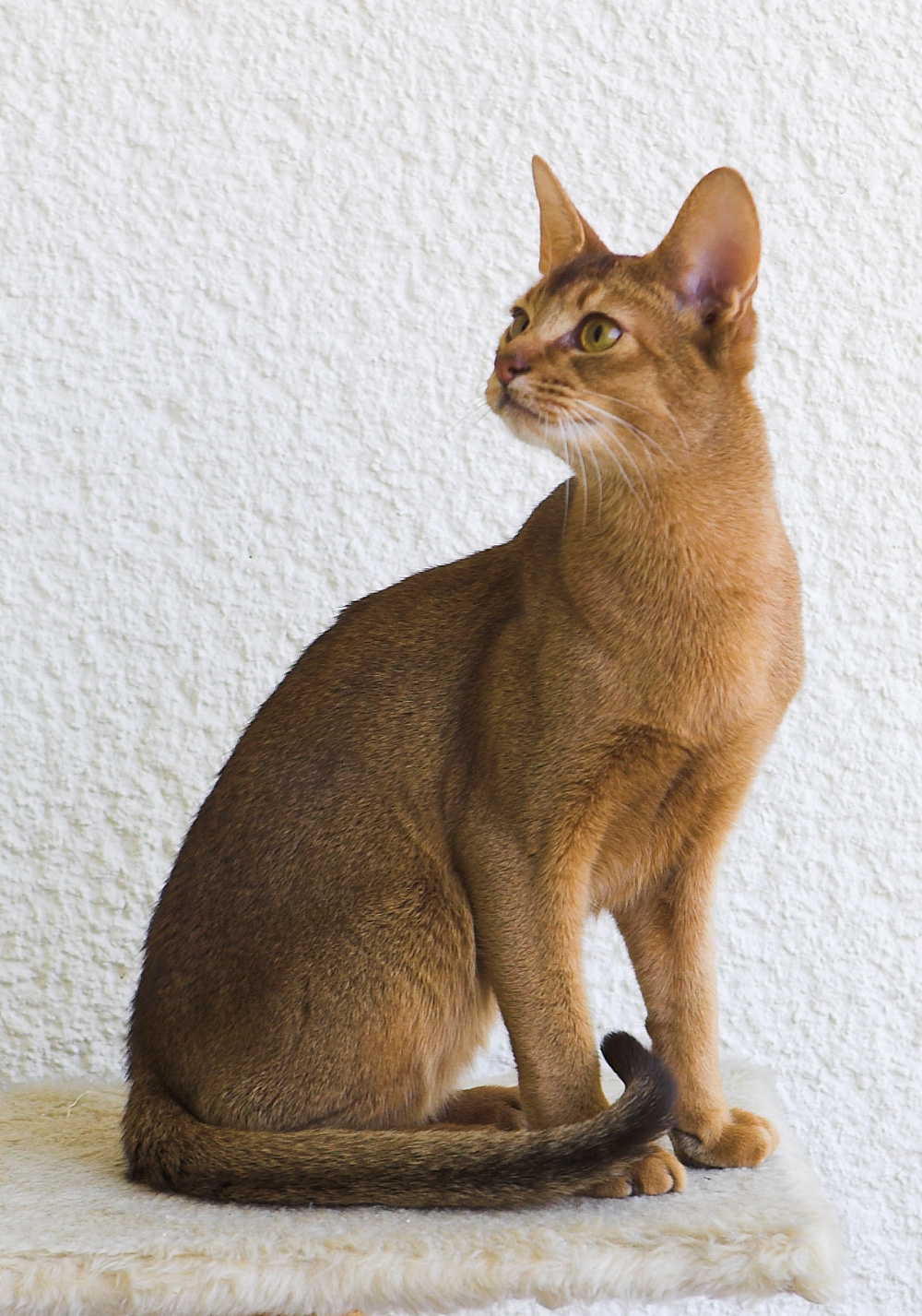
The Abyssinian, often shortened to Aby, is a shorthaired breed with a ticked tabby coat: each hair is banded with several colors, which gives the cat an even, wild-looking finish without stripes on the body. The name comes from Abyssinia, now Ethiopia, because the first cats shown in England were said to have been brought from there. Genetic studies point instead to a mix of Southeast Asian and European cats, and the breed itself was developed in the United Kingdom.
History
A stuffed cat in the Zoological Museum in Leiden, bought in the mid-1830s, is thought to be the earliest known specimen of the type. The best-known early story is that of Zula, a cat brought to England in 1868 by Lt. General Sir Robert Napier after the Abyssinian War, who took a first prize at the Crystal Palace show in December 1871. Many breeders today doubt that Zula was an Abyssinian at all, since pictures show small ears and a rather long, wavy coat.
References to the breed in Britain go back to at least the 1890s, and the GCCF recognised it in 1929, which makes it one of the oldest established breeds. It came close to disappearing in Britain after the Second World War and an outbreak of feline leukemia virus, and was rebuilt with cats imported from the Netherlands, North America, Scandinavia, Australia and New Zealand. TICA gave it championship status in 1979. In 2007 an Abyssinian named Cinnamon became the first cat to have its whole genome published.
Appearance
This is a lithe, fine-boned but muscular cat of medium to large size, averaging about 4.5 kg (10 lb). The head is a moderate wedge with large, alert, pointed ears and almond-shaped eyes in gold, green, hazel or copper. The legs are long and slim with small oval paws, and the tail is long and tapering.
Kittens are born dark and lighten over several months. On an adult, each hair has a light base and three or four darker bands toward the tip. The spine, tail, backs of the hind legs and paw pads are darker than the rest, and a tabby M often shows on the forehead. The original color is a warm reddish brown ticked with black, called usual, tawny or ruddy depending on the country. Cinnamon (also called sorrel or red), blue and fawn are widely accepted; chocolate, lilac, silver and tortoiseshell versions are accepted by some registries.
Temperament
Abyssinians are very social and can demand a good deal of attention. They are not lap cats: they spend most of their time exploring or playing, and their curiosity has earned them the nickname “clowns of the cat kingdom”. They tend to attach closely to their people and do well in homes with several cats. The voice is a soft chirrup instead of a typical meow.
Care and health
Conditions recorded in the breed include renal amyloidosis, progressive retinal atrophy (the Abyssinian is the breed most often affected), pyruvate kinase deficiency and patellar luxation. Studies have also found Abyssinians over-represented in cases of feline infectious peritonitis, atopic dermatitis, psychogenic alopecia, aortic thromboembolism and acquired myasthenia gravis.
Facts on this page were checked against Wikipedia and may have changed since.